# Alloy
## Microsim
### Live player
<div class="microsim-player">
<iframe src="https://editor.p5js.org/sciencenibber/full/XyffhwPcd" width="100%" height="620" frameborder="0" sandbox="allow-scripts allow-same-origin"></iframe>
</div>
<div class="microsim-fallback">
<img src="Microsims/thumbs/Alloy.png" alt="Alloy microsim poster" style="width:100%;border:1px solid #4445;border-radius:6px;">
<p><em>Live microsim (desktop) · <a href="https://editor.p5js.org/sciencenibber/sketches/XyffhwPcd">open sketch in the p5.js editor</a></em></p>
</div>
**Editor URL:** https://editor.p5js.org/sciencenibber/sketches/XyffhwPcd
**Description (100 words):**
A binary isomorphous phase diagram (complete solid solubility) for a generic A-B alloy, with the lever rule read off live. Drag **composition** (at% B) and **temperature** to move the white state point across the map; the glowing liquidus and solidus bound a two-phase lens where a dashed tie-line marks the coexisting liquid (xL) and solid (xS) compositions. The **segregation** slider widens or narrows the lens -- the freezing range. A "crucible" inset fills with solid grains under liquid in exactly the proportions the lever rule predicts (fS = (x0 - xL)/(xS - xL)), so you watch an alloy freeze, not all at once, but across a range.
<!-- REAL-GENERATIVE-MEDIA:START -->
## Links (Wikipedia order)
<!-- injected from _registry/childlinks/Alloy.json (2026-07-30T02:09:12Z) -->
`Acid_dissociation_constant` · `Adolf_Martens` · [[Age_of_Enlightenment]] · `Aircraft` · `Airframe` · `Alfred_Wilm` · `Allotropes_of_iron` · `Allotropy` · `Alloy_(disambiguation)` · `Alloy_broadening` · `Alloy_steel` · `Alloy_wheel` · [[Aluminium]] · `Aluminium_alloy` · `Amalgam_(chemistry)` · `Amphiphile` · `Anatolia` · [[Antimony]] · `Apparent_molar_property` · `Aqueous_solution` · `Archimedes` · `Archimedes'_principle` · `Atom` · `Atomic_ratio` · `Austenite` · `Bauxite` · `Benjamin_Huntsman` · `Beryllium_copper` · `Bessemer_process` · [[Bismuth]] · `Blast_furnace` · `Bloomery` · `Brass` · `Bronze` · `Bronze_Age` · `Buffer_solution` · `CALPHAD` · [[Calcium]] · `Carbide` · [[Carbon]] · `Carbon_steel` · `Carbonitriding` · `Cast_iron` · `Cementation_process` · `Cementite` · [[Chemical_element]] · `Chemical_polarity` · [[Chromium]] · `Cinnabar` · [[Cobalt]] · `Cold_working` · `Colloid` · `Colored_gold` · `Concentration` · [[Copper]] · `Copper(II)_sulfate` · [[Corrosion]] · `Covalent_bond` · `Crucible` · `Crucible_steel` · [[Cubic_crystal_system]] · [[Density]] · [[Diffusion]] · `Diffusionless_transformation` · `Dilution_(equation)` · `Duralumin` · `Edgar_Bain` · `Egypt` · `Electric_arc` · `Electrum` · `Enthalpy_change_of_solution` · `Equivalent_concentration` · `Eutectic_system` · `Extractive_metallurgy` · `Ferrite_(magnet)` · `Flory–Huggins_solution_theory` · `Flux_(metallurgy)` · `Gilding` · [[Gold]] · `Greenland` · `Hardness` · `Henry's_law` · `Henry_Bessemer` · `Henry_Ford` · `High-speed_steel` · `History_of_China` · `Humphry_Davy` · `Hydrophile` · `Hydrophobe` · `Ideal_solution` · `Incoloy` · `Inconel` · `Industrial_espionage` · `Inorganic_nonaqueous_solvent` · `Intermediate_good` · `Intermetallic` · `Interstitial_site` · `Inuit` · [[Iridium]] · [[Iron]] · `Iron_meteorite` · [[Iron_ore]] · `Iron_sulfide` · `Japanese_swordsmithing` · `Lattice_energy` · [[Lead]] · `Lipophilicity` · `Liquid` · `List_of_boiling_and_freezing_information_of_solvents` · [[Lithium]] · [[Magnesium]] · `Magnesium_alloy` · `Mangalloy` · [[Manganese]] · `Martensite` · `Mass_concentration_(chemistry)` · `Mass_fraction_(chemistry)` · `Melting_point` · [[Mercury_(element)]] · `Metal` · `Metallic_bonding` · `Meteoric_iron` · `Meteorite` · `Microstructure` · `Mirror` · `Miscibility` · `Miscibility_gap` · `Mixing_ratio` · `Mixture` · `Molality` · `Molar_concentration` · `Mole_fraction` · [[Molybdenum]] · `Mycenae` · `Natural_abundance` · [[Nickel]] · `Nitriding` · `Number_density` · `Ore` · [[Oxygen]] · `Partition_coefficient` · `Pattern_welding` · `Pearlite` · `Pewter` · `Phase_(matter)` · `Phase_diagram` · `Phase_separation` · [[Phosphorus]] · `Pig_iron` · [[Platinum]] · `Polar_aprotic_solvent` · `Pot_metal` · `Precipitation_hardening` · `Procurement` · `Protic_solvent` · `Puddling_(metallurgy)` · `Qin_dynasty` · `Raoult's_law` · `Reactivity_(chemistry)` · `Recrystallization_(metallurgy)` · `Robert_Forester_Mushet` · `Robert_Hadfield` · `SAE_304_stainless_steel` · `Serial_dilution` · `Shear_strength` · `Sheffield` · `Shinto` · [[Silicon]] · [[Silver]] · `Slag` · `Smelting` · [[Sodium]] · `Solder` · `Solid` · `Solid_solution` · `Solubility` · `Solubility_chart` · `Solubility_equilibrium` · `Solubility_table` · `Solution_(chemistry)` · `Solvation` · `Solvation_shell` · `Solvent` · `Spiegeleisen` · `Spring_steel` · `Stainless_steel` · [[Steel]] · `Sterling_silver` · [[Strength_of_materials]] · [[Sulfur]] · `Superalloy` · `Supersaturation` · `Suspension_(chemistry)` · `Syracuse,_Sicily` · `Temperature` · `Ternary_plot` · [[Tin]] · [[Titanium]] · `Tool_steel` · `Total_dissolved_solids` · `Toughness` · [[Tungsten]] · `Tungsten_carbide` · [[Vanadium]] · `Volume_fraction` · `White_gold` · `Widmanstätten_pattern` · `William_Chandler_Roberts-Austen` · `Work_hardening` · `Wright_brothers` · `Wrought_iron` · `Young's_modulus` · `Zeppelin` · [[Zinc]]
## From the Real GENERATIVE library
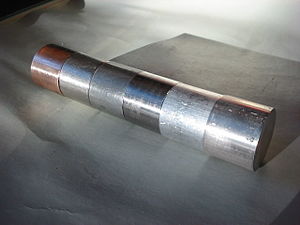
*Alloy — placed from the Real G.E.N.E.R.A.T.I.V.E. course library (Engineering room). Source: Wikimedia Commons (via Wikipedia article media). [Details & license](https://commons.wikimedia.org/wiki/File:Alloy_and_metal_samples_-_Beryllium-Copper%2C_Inconel%2C_Steel%2C_Titanium%2C_Aluminum%2C_Magnesium.jpg).*
> An alloy is a mixture of chemical elements of which in most cases at least one is a metallic element, although it is also sometimes used for mixtures of elements; herein only metallic alloys are described. Most alloys are metallic and show good electrical conductivity, ductility, opacity, and luster, and may have properties that differ from those of the pure ([Wikipedia](https://en.wikipedia.org/wiki/Alloy))
<!-- REAL-GENERATIVE-MEDIA:END -->
<!-- LOCAL-MEDIA-PASS:START -->
## From the vault media library
!Alloy thumb.png
*Alloy — from the vault's own media holdings, placed 2026-07-09. MTN / Wikitube.io original · CC BY-SA 4.0.*
<!-- LOCAL-MEDIA-PASS:END -->
> **Room:** [[Helium]] · **Status:** ✅ shipped
## Overview
An **alloy** is a metallic material made by combining a base metal with one or more other elements, producing a *solid solution* (or a mixture of solid phases) whose properties differ from those of the pure components. Most structural metals are alloys precisely because alloying is the cheapest, most controllable lever on strength, ductility, [[Corrosion|corrosion]] resistance, and workability: solute atoms distort the host lattice and impede the **dislocation** glide that carries plastic flow (solid-solution and precipitation hardening), while finer **grain** [[Structure|structure]] adds boundary obstacles (the Hall-Petch effect, see Grain boundary). The behaviour of a binary alloy is read off its **phase diagram** -- a map of temperature against composition that says which phases are stable and, in the two-phase regions, in what proportions. In the simplest and most fundamental case, **complete solid solubility** (an *isomorphous* [[System|system]], the lens-shaped Cu-Ni archetype), an alloy does not freeze at a single temperature the way a pure metal does: cooling a melt of composition x0 crosses the **liquidus** (where the first solid appears) and only finishes at the **solidus** (where the last liquid disappears). Between those two curves liquid and solid of *different* compositions coexist, their relative amounts fixed by the **lever rule** fS = (x0 - xL)/(xS - xL). This *freezing range* is not an academic detail: it governs casting soundness, weld solidification cracking, and microsegregation -- and within the Helium room's advanced-[[Manufacturing|manufacturing]] thread it is exactly the property that determines how the structural alloys (steels, [[Titanium|titanium]], [[Copper|copper]], aluminium) used for cryostats, superconducting-magnet formers, and helium pressure vessels solidify, weld, and survive thermal cycling to 4.2 K. Helium [[Leak|leak]]-testing, in turn, is the standard that qualifies the welds joining those alloy components.
<!-- CRAFT-LINK:START g12 -->
*Built to the [[WT!P5_js_Microsim_Master_Class|p5.js Master Class]].*
<!-- CRAFT-LINK:END -->
<!-- MATTERSIM:BEGIN g33 — Matter & Energy Cluster microsim (framework build, specs/sims/Alloy.json); do not hand-edit inside -->
**Microsim — three.js (Wikitube framework):** *Alloy*
<div class="wt-sim" data-src="https://wikitube-3d-microsims.netlify.app/matter/Alloy.html" data-title="Alloy"></div>
*Built from `MICROSIM_GUIDE/specs/sims/Alloy.json`; part of the [[PORTAL_Matter|Matter portal]] spine (section sims and See-also variants).*
<!-- MATTERSIM:END -->
## Wikipedia : Wikitube
**Strict pair:** [Wikipedia](https://en.wikipedia.org/wiki/Alloy) : [Wikitube](https://en.wikitube.io/wiki/Alloy)
## Previous hub tags
Tree parent: [[Emergence]].
Legacy hubs: none.
---
*Sources: 1 legacy note. Minted wave 1, 2026-07-30 (v1.6 order).*