# Angular frequency
## Microsim
### Live player
<div class="microsim-player">
<iframe src="https://editor.p5js.org/sciencenibber/full/NjMZXTu5Z" width="100%" height="620" frameborder="0" sandbox="allow-scripts allow-same-origin"></iframe>
</div>
<div class="microsim-fallback">
<img src="Microsims/thumbs/Angular_frequency.png" alt="Angular_frequency microsim poster" style="width:100%;border:1px solid #4445;border-radius:6px;">
<p><em>Live microsim (desktop) · <a href="https://editor.p5js.org/sciencenibber/sketches/NjMZXTu5Z">open sketch in the p5.js editor</a></em></p>
</div>
**Editor URL:** https://editor.p5js.org/sciencenibber/sketches/NjMZXTu5Z
**Description (100 words):**
This microsim makes angular frequency tangible by linking circular motion to [[Oscillation|oscillation]]. An orange phasor of fixed length rotates around a unit circle at angular rate omega = 2*pi*f, sweeping phase at constant speed. Its vertical height is projected rightward to trace the sinusoid y = A*sin(omega*t + phi), and a red tie line locks the phasor tip to the [[Wave|wave]]'s leading edge. Drag f to spin the phasor faster and watch the period T = 1/f shrink as cycles bunch up; drag A to scale the wave and phi to slide it. Live readouts show f, omega, and T.
```js
// =====================================================================
// Article : Angular frequency
// Slug : Angular_frequency
// Wikitube : en.wikitube.io/wiki/Angular_frequency
// Room : Energy
//
// Idea : Angular frequency ω is the rate at which a rotating phasor
// sweeps phase. This microsim shows the defining identity
// ω = 2πf = 2π/T directly: a unit vector spins on a circle at
// angular rate ω, and its vertical projection traces the
// sinusoid y = A·sin(ωt + φ) to the right. Drag f and the
// phasor spins faster while the wave bunches up (T shrinks);
// drag A and φ to scale and shift the wave. A horizontal tie
// line keeps the phasor tip and the leading edge of the wave
// locked together so the "rotation → oscillation" link is
// visible at a glance.
//
// Equation : ω = 2πf = 2π/T (rad/s); y(t) = A·sin(ωt + φ)
// =====================================================================
// Rule §3 — single source of truth for title/URL/save-name.
const ARTICLE = "Angular_frequency";
// Rule §4 — disable the Friendly Error System for ship.
p5.disableFriendlyErrors = true;
// ---------- controls ----------
let fSlider; // f — ordinary frequency (Hz, cycles per second)
let aSlider; // A — amplitude (dimensionless display units)
let phiSlider; // phi — phase offset (radians)
// ---------- layout constants (computed in setup) ----------
let cx, cy, R; // phasor circle: centre and radius
let waveX0, waveW; // time-domain plot: left edge and width
let baseY; // shared vertical centre for circle and wave
// pixels-per-radian along the time axis: sets how wide one cycle reads.
const PPR = 42;
function setup() {
// Rule §5 — canvas inside setup, standard size, retina density.
createCanvas(720, 520);
pixelDensity(2);
// Geometry derived from canvas size so a resize stays coherent.
baseY = height * 0.40;
cx = 150;
cy = baseY;
R = 110;
waveX0 = 320;
waveW = width - waveX0 - 20;
// Rule §6 — controls in setup, explicit positions, meaningful ranges.
// f from a slow 0.1 Hz crawl to 2 Hz; default 0.5 Hz so one cycle is
// easy to follow by eye.
fSlider = createSlider(0.1, 2.0, 0.5, 0.1);
fSlider.position(120, height - 96);
fSlider.style("width", "180px");
// A in display units; default 1.0 fills most of the plot height.
aSlider = createSlider(0.2, 1.0, 1.0, 0.05);
aSlider.position(120, height - 64);
aSlider.style("width", "180px");
// phi over a full turn so the reader can see the wave slide.
phiSlider = createSlider(0, TWO_PI, 0, 0.01);
phiSlider.position(120, height - 32);
phiSlider.style("width", "180px");
}
function draw() {
background(248);
// ---------- read controls ----------
const f = fSlider.value(); // Hz
const A = aSlider.value(); // display units
const phi = phiSlider.value(); // rad
// ---------- math (the whole point) ----------
const omega = TWO_PI * f; // ω = 2πf (rad/s)
const T = 1 / f; // T = 1/f (s)
const t = millis() / 1000; // wall-clock seconds
const theta = omega * t + phi; // current phase of the phasor
// amplitude in pixels for the wave; matches the circle radius at A=1.
const Apx = A * R;
// tip of the rotating phasor (screen y grows downward, so negate sin).
const tipX = cx + R * cos(theta);
const tipY = cy - R * sin(theta);
// ---------- layer 1: reference geometry (neutral grey) ----------
noFill();
stroke(180);
strokeWeight(1);
circle(cx, cy, 2 * R); // the unit circle
line(cx - R - 8, cy, cx + R + 8, cy); // circle horizontal axis
line(cx, cy - R - 8, cx, cy + R + 8); // circle vertical axis
line(waveX0, baseY, waveX0 + waveW, baseY); // time axis (y = 0)
// ---------- layer 2: active geometry (<=3 accent colours) ----------
// The sinusoid. Leftmost sample (s = 0) equals the phasor's current
// phase, so as theta advances the curve scrolls left in lockstep.
stroke(40, 90, 200); // blue: the waveform
strokeWeight(2);
noFill();
beginShape();
for (let s = 0; s <= waveW; s++) {
const ph = theta - s / PPR; // phase recedes into the past
const y = baseY - Apx * sin(ph);
vertex(waveX0 + s, y);
}
endShape();
// The rotating phasor itself.
stroke(220, 130, 40); // orange: the phasor
strokeWeight(3);
line(cx, cy, tipX, tipY);
noStroke();
fill(220, 130, 40);
circle(tipX, tipY, 10);
// Horizontal tie line: phasor tip height -> leading edge of the wave.
stroke(220, 60, 60, 140); // red, semi-transparent
strokeWeight(1.5);
line(tipX, tipY, waveX0, tipY);
noStroke();
fill(220, 60, 60);
circle(waveX0, tipY, 8); // sample point on the wave
// ---------- HUD watermark (rule §2) ----------
noStroke();
textFont("system-ui");
// §2a — top-left title block.
fill(20);
textSize(20);
textAlign(LEFT, TOP);
text("Angular frequency", 16, 14);
textSize(12);
fill(110);
text("Wikitube microsim - en.wikitube.io/wiki/" + ARTICLE, 16, 40);
// §2b — top-right control hints.
textAlign(RIGHT, TOP);
textSize(11);
fill(110);
text("sliders: f (frequency), A (amplitude), phi (phase)", width - 16, 14);
text("phasor spins at omega = 2*pi*f; projection traces the wave", width - 16, 30);
// §2c — bottom-left live readouts (canonical symbols).
textAlign(LEFT, BOTTOM);
textSize(13);
fill(40, 90, 200);
text("f = " + f.toFixed(2) + " Hz", 16, height - 118);
fill(20);
text("omega = " + omega.toFixed(2) + " rad/s", 120, height - 118);
text("T = " + T.toFixed(2) + " s", 270, height - 118);
// §2c (cont.) — slider labels, right-aligned to the LEFT of each slider.
textAlign(RIGHT, CENTER);
textSize(12);
fill(60);
text("f (Hz)", 112, height - 96 + 8);
text("A (amp)", 112, height - 64 + 8);
text("phi (rad)", 112, height - 32 + 8);
// §2d — bottom-right equation footer (ASCII only — see pitfalls.md).
textAlign(RIGHT, BOTTOM);
textSize(11);
fill(80);
text("omega = 2*pi*f = 2*pi/T | y(t) = A*sin(omega*t + phi)",
width - 16, height - 8);
}
```
## Links (Wikipedia order)
<!-- injected from _registry/childlinks/Angular_frequency.json (2026-07-30T02:09:12Z) -->
`Acceleration` · `Alexis_Clairaut` · `Analytical_mechanics` · `Angle` · `Angular_acceleration` · `Angular_displacement` · `Angular_momentum` · `Angular_velocity` · `Appell's_equation_of_motion` · `Applied_mechanics` · `Augustin-Louis_Cauchy` · `Bernard_Koopman` · `Capacitance` · `Carl_Gustav_Jacob_Jacobi` · `Celestial_mechanics` · `Centrifugal_force` · `Centripetal_force` · [[Christiaan_Huygens]] · `Circular_motion` · `Classical_field_theory` · `Classical_mechanics` · `Continuum_mechanics` · `Coriolis_force` · `Couple_(mechanics)` · `Cycle_per_second` · `D'Alembert's_principle` · [[Damping]] · `Daniel_Bernoulli` · `Degree_(angle)` · [[Digital_signal_processing]] · `Dimensional_analysis` · `Displacement_(geometry)` · [[Dynamics_(mechanics)]] · `Edmond_Halley` · `Edward_Routh` · [[Energy]] · `Equations_of_motion` · `Euler's_equations_(rigid_body_dynamics)` · `Euler's_laws_of_motion` · `Farad` · `Fictitious_force` · [[Force]] · `Frame_of_reference` · `Frequency` · `Friction` · `Galileo_Galilei` · `Hamiltonian_mechanics` · `Hamilton–Jacobi_equation` · `Harmonic_oscillator` · `Henry_(unit)` · `Hertz` · `History_of_classical_mechanics` · `Impulse_(physics)` · `Inductance` · `Inertia` · `Inertial_frame_of_reference` · `International_Organization_for_Standardization` · `Inverse_second` · [[Isaac_Newton]] · `Jeremiah_Horrocks` · `Johann_Bernoulli` · [[Johannes_Kepler]] · [[John_von_Neumann]] · `Joseph-Louis_Lagrange` · `Joseph_Liouville` · [[Josiah_Willard_Gibbs]] · `Kinematics` · `Kinetic_energy` · `Kinetics_(physics)` · `Koopman–von_Neumann_classical_mechanics` · `LC_circuit` · `Lagrangian_mechanics` · `Leonhard_Euler` · `Linear_motion` · `List_of_textbooks_on_classical_mechanics_and_quantum_mechanics` · `Mass` · `Mean_motion` · `Moment_(physics)` · `Moment_of_inertia` · `Momentum` · `Motion` · `Multiplicative_inverse` · `Newton's_law_of_universal_gravitation` · [[Newton's_laws_of_motion]] · `Non-inertial_reference_frame` · `Nu_(Greek)` · `Omega` · [[Oscillation]] · `Paul_Émile_Appell` · `Pendulum_(mechanics)` · `Phase_(waves)` · [[Physics]] · `Pi` · `Pierre-Simon_Laplace` · `Pierre_Louis_Maupertuis` · `Potential_energy` · `Pseudovector` · `Radian` · `Radian_per_second` · `Rate_(mathematics)` · `Reactive_centrifugal_force` · `Relative_velocity` · `Rigid_body` · `Rigid_body_dynamics` · `Rotating_reference_frame` · `Rotation_around_a_fixed_axis` · `Rotational_frequency` · `Routhian_mechanics` · `SI_base_unit` · `Scalar_(physics)` · `Second` · [[Simple_harmonic_motion]] · `Siméon_Denis_Poisson` · `Space` · `Speed` · `Statics` · `Statistical_mechanics` · `Tangential_speed` · `Time` · `Timeline_of_classical_mechanics` · `Torque` · [[Velocity]] · `Vibration` · `Virtual_work` · `William_Rowan_Hamilton` · `Work_(physics)`
## From the Real GENERATIVE library

*Angular frequency — placed from the Real G.E.N.E.R.A.T.I.V.E. course library (Energy room). Source: Wikimedia Commons (via Wikipedia article media). [Details & license](https://commons.wikimedia.org/wiki/File:Stylised_atom_with_three_Bohr_model_orbits_and_stylised_nucleus.svg).*
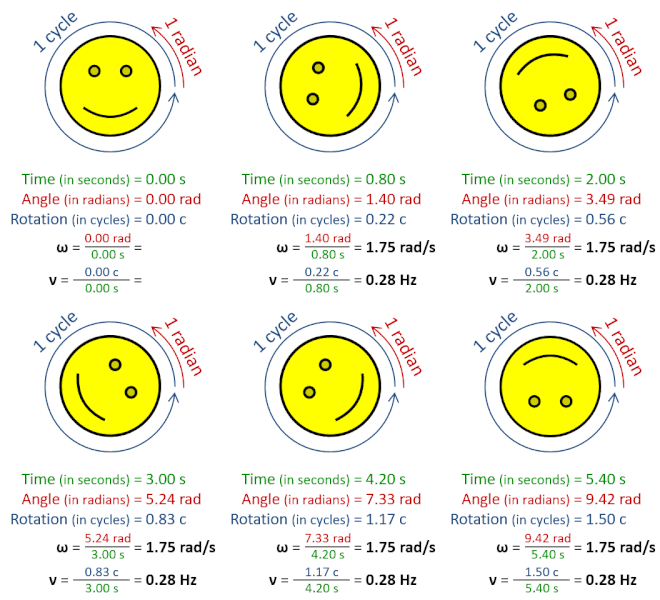
*Animated: Angular frequency — placed from the Real G.E.N.E.R.A.T.I.V.E. course library (Energy room). Source: Wikimedia Commons (via Wikipedia article media). [Details & license](https://commons.wikimedia.org/wiki/File:AngularFrequency.gif).*
> In physics, angular frequency (symbol ω), also called angular speed and angular rate, is a scalar measure of the angle rate (the angle per unit time) or the temporal rate of change of the phase argument of a sinusoidal waveform or sine function (for example, in oscillations and waves). Angular frequency (or angular speed) is the magnitude of the pseudovector ([Wikipedia](https://en.wikipedia.org/wiki/Angular_frequency))
<!-- REAL-GENERATIVE-MEDIA:END -->
<!-- LOCAL-MEDIA-PASS:START -->
## From the vault media library
!Angular frequency thumb.png
*Angular Frequency — from the vault's own media holdings, placed 2026-07-09. MTN / Wikitube.io original · CC BY-SA 4.0.*
<!-- LOCAL-MEDIA-PASS:END -->
## Media (PD/CC)
<!-- MEDIA-DEPLOY:Angular_frequency/AngularFrequency.gif -->
!Gif Library/Rotational frequency/AngularFrequency.gif
*AngularFrequency.gif · Public domain*
<!-- /MEDIA-DEPLOY -->
<!-- SIGN-SYSTEMS:START -->
**Semiotic universals** (the notations and alphabet letters this article speaks — each opens its canonical card): kanji radicals · frequency · wave · rotation · energy. Index: the glyph gallery · SEMIOTICS PORTAL.
<!-- SIGN-SYSTEMS:END -->
> **Room:** [[Energy]] · **Status:** ✅ shipped
## Overview
In [[Physics|physics]], angular frequency (symbol ω), also called angular speed and angular rate, is a scalar measure of the angle rate (the angle per unit time) or the temporal rate of change of the phase argument of a sinusoidal waveform or sine function (for example, in oscillations and waves). Angular frequency (or angular speed) is the magnitude of the pseudovector quantity angular velocity.1
_(Overview is shorter than 200 words; the pipeline should expand it from textbook context before publishing.)_
## See also
- Room hub: [[Energy]]
- p5.js Editor conventions: P5 JS EDITOR
- Wiki root: MAIN
---
*Scaffolded by `generative-microsim` from row 9 of the Energy sheet on 2026-06-03T06:48:33Z.*
Letters: frequency · wave · rotation · energy · cycle · oscillation · amplitude · mined_geometry
<!-- REAL-GENERATIVE-MEDIA:START -->
<!-- CRAFT-LINK:START g12 -->
*Built to the [[WT!P5_js_Microsim_Master_Class|p5.js Master Class]].*
<!-- CRAFT-LINK:END -->
## Wikipedia : Wikitube
**Strict pair:** [Wikipedia](https://en.wikipedia.org/wiki/Angular_frequency) : [Wikitube](https://en.wikitube.io/wiki/Angular_frequency)
## Previous hub tags
Tree parent: [[Feedback]].
Legacy hubs: `GENERATIVE`.
---
*Sources: 1 legacy note. Minted wave 1, 2026-07-30 (v1.6 order).*