# Diffusion of innovations
## Microsim
### Live player
<div class="microsim-player">
<iframe src="https://editor.p5js.org/sciencenibber/full/Y7el79u3v" width="100%" height="620" frameborder="0" sandbox="allow-scripts allow-same-origin"></iframe>
</div>
<div class="microsim-fallback">
<img src="Microsims/thumbs/Diffusion_of_innovations.png" alt="Diffusion_of_innovations microsim poster" style="width:100%;border:1px solid #4445;border-radius:6px;">
<p><em>Live microsim (desktop) · <a href="https://editor.p5js.org/sciencenibber/sketches/Y7el79u3v">open sketch in the p5.js editor</a></em></p>
</div>
**Editor URL:** https://editor.p5js.org/sciencenibber/sketches/Y7el79u3v
**Description (100 words):**
This microsim drives the Bass diffusion model with two sliders: p, the coefficient of innovation (external influence like advertising), and q, the coefficient of imitation (word-of-mouth proportional to those already adopted). The shaded bell curve shows the adoption *rate* over time, split into Everett Rogers' five adopter categories — innovators (2.5%), early adopters (13.5%), early majority (34%), late majority (34%), and laggards (16%) — placed at the cumulative-adoption cut points so the segments stay faithful as you move the sliders. The bold dark line traces the cumulative S-curve toward 100%. Readouts report the peak-adoption time and the early-adopter-to-majority "chasm."
```js
// =====================================================================
// Article : Diffusion of innovations
// Slug : Diffusion_of_innovations
// Wikitube : en.wikitube.io/wiki/Diffusion_of_innovations
// Room : Electronics
//
// Idea : Everett Rogers' theory says a new technology is adopted by
// a population over time, not all at once. The rate of new
// adoption traces a bell curve whose area splits into five
// classic adopter categories (innovators 2.5%, early
// adopters 13.5%, early majority 34%, late majority 34%,
// laggards 16%), while the cumulative adoption traces the
// famous S-curve. This sketch drives both with the Bass
// diffusion model: a slider for p (coefficient of
// innovation / external influence) and q (coefficient of
// imitation / word-of-mouth). The five Rogers segments are
// placed at the cumulative-adoption cut points (2.5%, 16%,
// 50%, 84%) so the bell shading and the S-curve stay
// consistent as you move the sliders.
//
// Equation : Bass model rate of adoption
// dN/dt = (p + (q/M)*N) * (M - N)
// Closed form for the cumulative fraction F(t):
// F(t) = (1 - e^-(p+q)t) / (1 + (q/p) e^-(p+q)t)
// Peak adoption rate at t* = ln(q/p) / (p+q) (when q > p)
// =====================================================================
// Rule sec.3 - single source of truth for the title/URL/save name.
const ARTICLE = "Diffusion_of_innovations";
// Rule sec.4 - disable the Friendly Error System for ship.
p5.disableFriendlyErrors = true;
// ---------- controls ----------
let pSlider; // coefficient of innovation (external influence)
let qSlider; // coefficient of imitation (word-of-mouth)
// ---------- layout constants (computed in setup) ----------
let PLOT_L, PLOT_R, PLOT_T, PLOT_B;
// Rogers' five adopter categories: cumulative-adoption upper cut points
// and the share of the population each band contains.
const CUTS = [0.025, 0.16, 0.50, 0.84, 1.0];
const NAMES = ["Innovators", "Early adopters", "Early majority",
"Late majority", "Laggards"];
const PCTS = ["2.5%", "13.5%", "34%", "34%", "16%"];
// Three accent colors expanded into a five-step ramp (rule sec.8).
const CATCOL = [
[40, 90, 200], // innovators - blue
[60, 150, 210], // early adopt - light blue
[90, 180, 120], // early maj - green
[220, 150, 60], // late maj - orange
[200, 70, 60], // laggards - red
];
function setup() {
// Rule sec.5 - canvas inside setup, standard size, 2x density.
createCanvas(720, 520);
pixelDensity(2);
// Plot rectangle. Computed from width/height so layout is resilient.
PLOT_L = 64;
PLOT_R = width - 40;
PLOT_T = 92;
PLOT_B = height - 92;
// Rule sec.6 - controls in setup, positioned explicitly, labelled in draw.
// p: coefficient of innovation. Empirical Bass values cluster near 0.03.
pSlider = createSlider(0.002, 0.10, 0.03, 0.002);
pSlider.position(170, height - 52);
pSlider.style("width", "200px");
// q: coefficient of imitation. Empirical Bass values cluster near 0.38.
qSlider = createSlider(0.05, 0.90, 0.38, 0.01);
qSlider.position(170, height - 28);
qSlider.style("width", "200px");
}
function draw() {
background(248);
// ---------- read controls ----------
const p = pSlider.value();
const q = qSlider.value();
// ---------- math ----------
// Time horizon: run out to ~99.9% adoption so the curve always fills
// the plot regardless of p, q.
const Tmax = Math.min(tForCut(0.999, p, q), 120);
// Peak adoption rate (mode of the bell). Only a real interior peak
// exists when imitation dominates innovation (q > p).
const tStar = q > p ? Math.log(q / p) / (p + q) : 0;
const fMax = fBass(Math.max(tStar, 0), p, q);
// Cumulative-adoption cut points -> the time boundaries between the
// five Rogers categories (closed-form inverse of F).
const cutT = CUTS.map((c) => Math.min(tForCut(c, p, q), Tmax));
// ---------- reference geometry (rule sec.8 layer 1) ----------
drawAxes(Tmax);
// ---------- active geometry (rule sec.8 layer 2) ----------
// Bell of adoption RATE f(t), shaded by adopter category.
drawRateBands(p, q, Tmax, fMax, cutT);
// Cumulative S-curve F(t) overlaid (right axis = 0..100%).
drawScurve(p, q, Tmax);
// Vertical guide at the peak adoption time.
if (tStar > 0 && tStar < Tmax) {
const xp = xOf(tStar, Tmax);
stroke(120);
strokeWeight(1);
drawingContext.setLineDash([4, 4]);
line(xp, PLOT_T, xp, PLOT_B);
drawingContext.setLineDash([]);
}
// ---------- HUD watermark (rule sec.2) ----------
noStroke();
textFont("system-ui");
// sec.2a - top-left title block.
fill(20);
textSize(20);
textAlign(LEFT, TOP);
text("Diffusion of innovations", 16, 12);
textSize(12);
fill(110);
text("Wikitube microsim - en.wikitube.io/wiki/" + ARTICLE, 16, 38);
// sec.2b - top-right control hints.
textAlign(RIGHT, TOP);
textSize(11);
fill(110);
text("sliders: p (innovation), q (imitation)", width - 16, 12);
text("bands = Rogers adopter categories; line = cumulative %", width - 16, 28);
// Category legend across the top of the plot.
drawLegend();
// sec.2c - bottom-left live readouts (inside plot, top-left corner).
textAlign(LEFT, TOP);
textSize(12);
fill(20);
text("p = " + p.toFixed(3) + " q = " + q.toFixed(2), PLOT_L + 8, PLOT_T + 6);
fill(60);
text("peak adoption at t* = " + (tStar > 0 ? tStar.toFixed(1) : "n/a"),
PLOT_L + 8, PLOT_T + 24);
text("chasm (early adopters -> early majority) at t = " + cutT[1].toFixed(1),
PLOT_L + 8, PLOT_T + 42);
// Slider labels (rule sec.7) - to the LEFT of each slider, right-aligned.
textAlign(RIGHT, CENTER);
textSize(12);
fill(60);
text("p (innovation)", 160, height - 52 + 8);
text("q (imitation)", 160, height - 28 + 8);
// sec.2d - bottom-right equation footer (ASCII only - see pitfalls.md).
textAlign(RIGHT, BOTTOM);
textSize(11);
fill(80);
text("dN/dt = (p + (q/M)*N)(M - N) -> S-curve F(t)", width - 16, height - 8);
}
// ---------- drawing helpers ----------
// Axes, the time axis label, and the right-hand cumulative-% axis.
function drawAxes(Tmax) {
stroke(180);
strokeWeight(1);
line(PLOT_L, PLOT_B, PLOT_R, PLOT_B); // x axis (time)
line(PLOT_L, PLOT_T, PLOT_L, PLOT_B); // left y axis (adoption rate)
noStroke();
fill(120);
textSize(11);
// x axis label
textAlign(CENTER, TOP);
text("time ->", (PLOT_L + PLOT_R) / 2, PLOT_B + 8);
// right axis: cumulative percentage gridlines at 0/50/100
textAlign(LEFT, CENTER);
for (let i = 0; i <= 2; i++) {
const frac = i / 2; // 0, 0.5, 1
const y = PLOT_B - frac * (PLOT_B - PLOT_T);
stroke(225);
line(PLOT_L, y, PLOT_R, y);
noStroke();
fill(150);
text(Math.round(frac * 100) + "%", PLOT_R + 4, y);
}
}
// Shade the area under the adoption-RATE curve f(t), one fill per
// Rogers category, split at the cumulative-adoption cut times.
function drawRateBands(p, q, Tmax, fMax, cutT) {
const STEP = 1; // pixels along x
let prevCut = 0;
for (let c = 0; c < CUTS.length; c++) {
const t0 = prevCut;
const t1 = cutT[c];
prevCut = t1;
if (t1 <= t0) continue;
const col = CATCOL[c];
noStroke();
fill(col[0], col[1], col[2], 150);
beginShape();
vertex(xOf(t0, Tmax), PLOT_B);
for (let x = xOf(t0, Tmax); x <= xOf(t1, Tmax); x += STEP) {
const t = tOf(x, Tmax);
vertex(x, yRate(fBass(t, p, q), fMax));
}
vertex(xOf(t1, Tmax), yRate(fBass(t1, p, q), fMax));
vertex(xOf(t1, Tmax), PLOT_B);
endShape(CLOSE);
}
// Outline the rate curve on top for crispness.
noFill();
stroke(70);
strokeWeight(1.5);
beginShape();
for (let x = PLOT_L; x <= PLOT_R; x += STEP) {
const t = tOf(x, Tmax);
vertex(x, yRate(fBass(t, p, q), fMax));
}
endShape();
}
// The cumulative adoption fraction F(t) as a bold dark S-curve.
function drawScurve(p, q, Tmax) {
noFill();
stroke(20);
strokeWeight(2.5);
beginShape();
for (let x = PLOT_L; x <= PLOT_R; x += 1) {
const t = tOf(x, Tmax);
const F = FBass(t, p, q);
vertex(x, PLOT_B - F * (PLOT_B - PLOT_T));
}
endShape();
}
// Horizontal legend of the five categories under the title.
function drawLegend() {
let x = 16;
const y = 62;
textAlign(LEFT, CENTER);
textSize(11);
for (let c = 0; c < NAMES.length; c++) {
const col = CATCOL[c];
noStroke();
fill(col[0], col[1], col[2], 200);
rect(x, y - 6, 12, 12, 2);
fill(70);
const label = NAMES[c] + " (" + PCTS[c] + ")";
text(label, x + 16, y);
x += 18 + textWidth(label) + 16;
}
}
// ---------- coordinate maps ----------
function xOf(t, Tmax) { return PLOT_L + (t / Tmax) * (PLOT_R - PLOT_L); }
function tOf(x, Tmax) { return ((x - PLOT_L) / (PLOT_R - PLOT_L)) * Tmax; }
// Map a rate value to a y pixel, scaled so the peak uses ~88% of height.
function yRate(f, fMax) {
const h = (PLOT_B - PLOT_T) * 0.88;
return PLOT_B - (fMax > 0 ? (f / fMax) * h : 0);
}
// ---------- Bass diffusion model (rule sec.10 - named helpers) ----------
// Cumulative fraction adopted by time t.
function FBass(t, p, q) {
const e = Math.exp(-(p + q) * t);
return (1 - e) / (1 + (q / p) * e);
}
// Instantaneous adoption rate dF/dt at time t.
function fBass(t, p, q) {
const e = Math.exp(-(p + q) * t);
const denom = 1 + (q / p) * e;
return (((p + q) * (p + q)) / p) * e / (denom * denom);
}
// Closed-form inverse: the time at which cumulative adoption equals c.
function tForCut(c, p, q) {
if (c >= 1) return Infinity;
const e = (1 - c) / (1 + c * (q / p));
return -Math.log(e) / (p + q);
}
```
## Links (Wikipedia order)
<!-- injected from _registry/childlinks/Diffusion_of_innovations.json (2026-07-30T02:09:12Z) -->
`Academic_bias` · `Academic_freedom` · `Actor–network_theory` · `Adult_mortality` · [[Air_pollution]] · `Analysis_of_variance` · `Annual_Review_of_Sociology` · `Anthropocene` · `Anthropology` · `Antipositivism` · `Antiscience` · `Asymptomatic_carrier` · `Auxology` · `BRICS` · `Bachelor_of_Science_in_Public_Health` · `Bass_diffusion_model` · `Behavior_change_(public_health)` · `Behavioural_change_theories` · `Best_practice` · `Bibliometrics` · `Biological_hazard` · `Biostatistics` · `Boundary-work` · `Caribbean_Public_Health_Agency` · `Carl_Rogers_Darnall` · `Case–control_study` · `Centers_for_Disease_Control_and_Prevention` · `Chief_medical_officer` · `Child_mortality` · `Chinese_Center_for_Disease_Control_and_Prevention` · `Christianization_of_the_Roman_Empire_as_diffusion_of_innovation` · `Citizen_science` · `Clustering_coefficient` · `Cognitive_dissonance` · `Collaborative_innovation_network` · `Commercial_determinants_of_health` · `Communication` · [[Communication_channel]] · `Community_health` · `Competition_(economics)` · `Complex_network` · `Conservation_biology` · `Consilience` · `Council_on_Education_for_Public_Health` · `Critical_mass_(sociodynamics)` · `Criticism_of_science` · `Criticism_of_technology` · `Cultural_diffusion` · `Cyborg_anthropology` · `Demarcation_problem` · `Dematerialization_(products)` · `Democratization_of_technology` · `Design_studies` · `Development_studies` · `Deviance_(sociology)` · `Diane_Stone` · [[Diffusion]] · `Diffusion_of_Innovations` · `Digital_anthropology` · `Digital_divide` · `Digital_media_use_and_mental_health` · `Disease_surveillance` · `Disruptive_innovation` · `Doctor_of_Public_Health` · `Donald_Berwick` · `Dorit_S._Hochbaum` · `Double_hermeneutic` · `Drug_checking` · `Drug_policy` · `Early_adopter` · `Economics` · `Economics_of_science` · `Education` · `Effects_of_climate_change_on_human_health` · `El_Salvador` · `Emergency_sanitation` · `Empiricism` · `Engineering_studies` · `Environmental_health` · `Epidemic` · `Epidemiology` · `Eugenics` · `European_Centre_for_Disease_Prevention_and_Control` · `Euthenics` · `Everett_Rogers` · `Evidence-based_policy` · `Factor_10` · `Family_planning` · `Fecal–oral_route` · `Feminist_technoscience` · `Financial_technology` · `Food_additive` · `Food_chemistry` · [[Food_engineering]] · `Food_microbiology` · `Food_processing` · `Food_safety` · `Four_Asian_Tigers` · `Friedrich_Ratzel` · `Frugal_innovation` · `Funding_of_science` · `Fuzzy_logic` · `Gabriel_Tarde` · `Germ_theory_of_disease` · `Global_health` · `Globalization_and_disease` · `Good_agricultural_practice` · `Good_manufacturing_practice` · `Google_Trends` · `Governance_(journal)` · `Graph_(discrete_mathematics)` · `Hand_washing` · `Harm_reduction` · `Health_Canada` · `Health_belief_model` · `Health_care_reform` · `Health_communication` · `Health_departments_in_the_United_States` · `Health_economics` · `Health_education` · `Health_equity` · `Health_impact_assessment` · `Health_literacy` · `Health_policy` · `Health_politics` · `Health_promotion` · `Health_psychology` · `Health_system` · `Healthy_diet` · `Heterophily` · `Hierarchical_organization` · `History` · `History_and_philosophy_of_science` · `History_of_eugenics` · `History_of_public_health_in_Australia` · `History_of_public_health_in_the_United_Kingdom` · `History_of_public_health_in_the_United_States` · `History_of_science` · `History_of_science_and_technology` · `History_of_science_policy` · `History_of_technology` · `Homophily` · `Horizon_scanning` · `Housing_First` · `Human_nutrition` · `Human_right_to_water_and_sanitation` · `Hygiene` · `ISO_22000` · `Idea` · `Industrial_sociology` · `Infant_mortality` · `Infrastructure` · `Injury_prevention` · `Innovation` · `Intellectual_inbreeding` · `Interpersonal_ties` · `Joseph_Lister` · `Journal_of_European_Public_Policy` · `Knowledge_management` · `Labor_rights` · `Languages_of_science` · `Lateral_communication` · `Lazy_user_model` · `Leapfrogging` · `Leo_Frobenius` · `Light_pollution` · `Linear_model_of_innovation` · `List_of_epidemics_and_pandemics` · `List_of_national_public_health_agencies` · `List_of_notifiable_diseases` · `List_of_open-source_health_software` · `Logistic_function` · `Management_of_depression` · `Mapping_controversies` · `Marcia_Friesen` · `Margaret_Sanger` · `Market_share` · `Marketing` · `Mary_Mallon` · `Mass_media` · `Maternal_health` · `Media_studies` · `Medical_anthropology` · `Medical_sociology` · `Memetics` · `Mental_health` · `Metascience` · `Minister_of_Mental_Health` · `Ministry_of_Health_and_Family_Welfare` · `Multimorbidity` · `Needle_and_syringe_programmes` · `Neo-Luddism` · `Neo-colonial_science` · `New_eugenics` · `Normal_science` · `Normalization_process_theory` · `Notifiable_disease` · `OECD` · `Occupational_health_nursing` · `Occupational_hygiene` · `Occupational_medicine` · `Occupational_safety_and_health` · `Ohio_State_University` · `Open_defecation` · `Opinion_leadership` · `Oral_hygiene` · `Organizational_behavior` · `Organizational_culture` · `PRECEDE–PROCEED_model` · `Pace_of_innovation` · `Paradigm_shift` · `Patient_safety` · `Patient_safety_organization` · `Pharmaceutical_policy` · `Pharmacovigilance` · `Philosophy` · [[Philosophy_of_science]] · `Philosophy_of_social_science` · `Philosophy_of_technology` · `Policy` · `Political_Economy_of_Research_and_Innovation` · `Politicization_of_science` · `Pollution` · `Population_health` · `Positive_deviance` · `Positivism` · `Post-normal_science` · `Postpositivism` · `Preventive_healthcare` · `Preventive_nutrition` · `Prisoners'_rights` · `Pro-innovation_bias` · `Professional_degrees_of_public_health` · `Pseudoscience` · `Psychology_of_science` · `Public_Health_Agency_of_Canada` · `Public_health` · `Public_health_genomics` · `Public_health_informatics` · `Public_health_intervention` · `Public_health_laboratory` · `Public_health_law` · `Public_health_surveillance` · `Quarantine` · `Race_and_health` · `Radioactive_contamination` · `Radium_Girls` · `Randomized_controlled_trial` · `Reagent_testing` · `Regis_McKenna` · `Regression_analysis` · `Regulation_of_science` · `Regulatory_agency` · `Relative_risk` · `Replication_crisis` · `Research_ethics` · `Reverse_salient` · `Rhetoric_of_science` · `Right_to_a_healthy_environment` · `Right_to_food` · `Right_to_health` · `Right_to_housing` · `Right_to_rest_and_leisure` · `Right_to_science_and_culture` · `Right_to_sit` · `Rospotrebnadzor` · `Rural_sociology` · `Safe_sex` · `Samuel_Jay_Crumbine` · `Sanitary_sewer` · `Sanitation` · `Sanitation_worker` · `Sara_Josephine_Baker` · `School_hygiene` · `Science_and_technology_studies` · `Science_communication` · `Science_education` · `Science_of_science_policy` · `Science_of_team_science` · `Science_policy` · `Science_studies` · `Science_wars` · `Scientific_community` · `Scientific_consensus` · `Scientific_controversy` · `Scientific_dissent` · `Scientific_enterprise` · `Scientific_integrity` · `Scientific_literacy` · `Scientific_method` · `Scientific_misconduct` · `Scientific_priority` · `Scientific_skepticism` · `Scientism` · `Scientocracy` · `Scientometrics` · `Security_of_person` · `Sexual_and_reproductive_health` · `Sexually_transmitted_infection` · `Sigmoid_function` · `Six_Sigma` · `Skunkworks_project` · `Smoking_cessation` · `Social_Science_&_Medicine` · `Social_capital` · `Social_cognitive_theory` · `Social_construction_of_technology` · `Social_constructivism` · `Social_determinants_of_health` · `Social_distancing` · `Social_epistemology` · `Social_hygiene_movement` · `Social_medicine` · `Social_network` · [[Social_network_analysis]] · `Social_norms_approach` · `Social_psychology` · `Social_shaping_of_technology` · `Social_system` · `Sociology` · `Sociology_of_health_and_illness` · `Sociology_of_knowledge` · `Sociology_of_scientific_ignorance` · `Sociology_of_scientific_knowledge` · [[Sociotechnical_system]] · `Sociotechnology` · `Strong_programme` · `Student's_t-test` · `Supervised_injection_site` · `Tacit_knowledge` · `Technical_change` · `Technocracy` · `Technological_change` · `Technological_convergence` · `Technological_determinism` · `Technological_innovation_system` · `Technological_revolution` · `Technological_transitions` · `Technology` · `Technology_acceptance_model` · `Technology_and_society` · `Technology_assessment` · `Technology_dynamics` · `Technology_policy` · `Technology_transfer` · `Technoscience` · `The_Wisdom_of_Crowds` · `Theories_of_technology` · `Theory` · `Theory_of_planned_behavior` · `Traditional_ecological_knowledge` · `Traditional_knowledge` · `Transhumanism` · `Transition_management_(governance)` · `Transtheoretical_model` · `Trisha_Greenhalgh` · `Tropical_disease` · `Unified_theory_of_acceptance_and_use_of_technology` · `Unisex_changing_rooms` · `United_States_Public_Health_Service` · `Unity_of_science` · `User_innovation` · `Vaccination` · `Vaccine_trial` · `Vector_control` · `WASH` · `Water_pollution` · [[Wayback_Machine]] · `Women_in_engineering` · `Women_in_science` · `Workers'_right_to_access_the_toilet` · `World_Health_Organization` · `World_Toilet_Organization` · `Z-test`
## From the Real GENERATIVE library
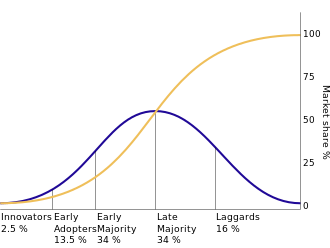
*Diffusion of innovations — placed from the Real G.E.N.E.R.A.T.I.V.E. course library (STEM and Music room). Source: Wikimedia Commons (via Wikipedia article media). [Details & license](https://commons.wikimedia.org/wiki/File:Diffusion_of_ideas.svg).*
> Diffusion of innovations is a theory that seeks to explain how, why, and at what rate new ideas and technology spread. The theory was popularized by Everett Rogers in his book Diffusion of Innovations, first published in 1962.[1] Rogers argues that diffusion is the process by which an innovation is communicated through certain channels over time among the pa ([Wikipedia](https://en.wikipedia.org/wiki/Diffusion_of_innovations))
<!-- REAL-GENERATIVE-MEDIA:END -->
<!-- LOCAL-MEDIA-PASS:START -->
## From the vault media library
!Diffusion of innovations thumb.png
*Diffusion Of Innovations — from the vault's own media holdings, placed 2026-07-09. MTN / Wikitube.io original · CC BY-SA 4.0.*
<!-- LOCAL-MEDIA-PASS:END -->
> **Room:** [[Electronics]] · **Status:** ✅ shipped
## Overview
Diffusion of innovations is a theory that explains how, why, and at what rate new ideas and technologies spread through a social [[System|system]]. Popularized by Everett Rogers in his 1962 book of the same name, the theory holds that adoption is not instantaneous but unfolds over time as [[Information|information]] and social influence accumulate. Rogers partitioned adopters into five categories along a bell curve of adoption timing: innovators (2.5%), early adopters (13.5%), early majority (34%), late majority (34%), and laggards (16%). Cumulative adoption traces the characteristic S-shaped curve — slow at first, accelerating once early adopters and opinion leaders legitimize the innovation, then saturating as the remaining holdouts convert.
The same dynamics are captured quantitatively by the Bass [[Diffusion|diffusion]] model, which expresses the rate of new adoption as the product of a coefficient of innovation (external influence, such as advertising) and a coefficient of imitation (internal word-of-mouth pressure proportional to the share already adopted). In electronics and technology markets, diffusion theory underpins product launch forecasting, the timing of standards adoption, and the famous "crossing the chasm" gap between early adopters and the pragmatic early majority that determines whether a new device reaches mass market.
## See also
- Room hub: [[Electronics]]
- p5.js Editor conventions: P5 JS EDITOR
- Wiki root: MAIN
---
*Scaffolded by `generative-microsim` from row 1 of the Electronics sheet on 2026-06-02T16:18:40Z.*
Letters: diffusion · mined_electronics · mined_system · distribution · mined_geometry · mined_information · kanji_radicals · mined_density
<!-- REAL-GENERATIVE-MEDIA:START -->
<!-- CRAFT-LINK:START g12 -->
*Built to the [[WT!P5_js_Microsim_Master_Class|p5.js Master Class]].*
<!-- CRAFT-LINK:END -->
## Wikipedia : Wikitube
**Strict pair:** [Wikipedia](https://en.wikipedia.org/wiki/Diffusion_of_innovations) : [Wikitube](https://en.wikitube.io/wiki/Diffusion_of_innovations)
## Previous hub tags
Tree parent: [[Network_theory]].
Legacy hubs: `GENERATIVE`.
---
*Sources: 1 legacy note. Minted wave 1, 2026-07-30 (v1.6 order).*