# Earth
<!-- SOLSIM:BEGIN g31 — Solar System explorer state (hand-built on wt-core, specs/solar/); do not hand-edit inside -->
**Microsim — three.js (Wikitube framework):** *Earth in the Solar System explorer*
<div class="wt-sim" data-src="https://wikitube-3d-microsims.netlify.app/solar/Solar_System.html?obj=Earth&embed=1" data-title="Earth in the Solar System explorer"></div>
*The Solar System explorer locked on this article's state (`?obj=Earth`); every object and population of the [[PORTAL_Solar_System|Solar System portal]] has its own state in the same scene.*
<!-- SOLSIM:END -->
<!-- SOLART:BEGIN g31 — Solar System portal child article, wave 1 (SOL-011, pinned oldid 1375342933); do not hand-edit inside -->
*Try: set the speed to 1 day/s and switch the scale to true to open Earth's local frame, where the Moon takes about 27 seconds to go once around at 384,399 km; switch back to log scale and raise the speed to 1 year/s to watch Earth complete one lap of the Sun each second; press l to hide the labels and compare Earth's path with the orbits of Venus and Mars on either side.*
**Earth** is the third planet from the [[Sun]] and the only world known to support life. It is the largest of the four [[Terrestrial_planet|terrestrial planets]], with a mean radius of 6,371 km and a mass of 5.97 × 10²⁴ kg, and at 5,513 kg/m³ it is the densest planet in the Solar System.[^nasa-fs][^R10] Liquid [[Water|water]] covers 70.8% of its surface, a thin nitrogen–oxygen atmosphere keeps the mean surface temperature near 15 °C, and a magnetic field generated in the liquid outer core deflects most of the [[Solar_wind|solar wind]].[^R147][^nasa-fs][^R242]
Earth formed about 4.54 billion years ago, acquired oceans and life within its first billion years, and has since been reshaped by plate tectonics and by life itself, which filled the air with free oxygen.[^R61][^R7] It orbits the Sun at a mean distance of 149.6 million km, the length that defines the [[Astronomical_unit|astronomical unit]], once every 365.256 days, and rotates in about 23 hours 56 minutes with its axis tilted 23.44°, which produces the seasons.[^nasa-fs] One large natural satellite, the [[Moon]], raises tides, slows Earth's spin and steadies its tilt.[^R103][^R58] About eight billion humans live on the planet and now measurably alter its climate and biosphere.[^R296][^R43]
The explorer at the top of this page is locked on Earth. Its dot marks the Earth–Moon barycentre, the point the two bodies circle together, placed from JPL orbital elements; in true scale it opens a local frame in which the Moon orbits 384,399 km out every 27.32 days, with its starting phase ILLUSTRATIVE rather than ephemeris-exact.[^jpl-t1][^nasa-fs-moon]
## Etymology
The English word descends through Middle English from an Old English noun, and cognates appear across the Germanic languages. In early use it stood for the ground and soil, dry land, the human world and the whole globe, in the same range of senses as Latin *terra* and Greek *gē*.[^R3] Norse myth personified the Earth as Jörð, a giantess and the mother of Thor.[^R196] Writers long used a lowercase "the earth"; the capitalised form spread as the planet came to be named alongside the others, and both remain in use.[^R3] Scientific and fictional writing sometimes uses the Latin name Terra, and the adjectives terrestrial and tellurian come from Latin *terra* and *tellus*.[^R3]
## Natural history
### Formation
The oldest solids in the Solar System, calcium–aluminium-rich inclusions in meteorites, are dated to 4.5682 billion years ago, and Earth had largely assembled by about 4.54 billion years ago.[^R78][^R61] Planetesimals grew by accretion in the [[Protoplanetary_disk|disc]] around the young Sun, a process estimated to have taken 70–100 million years for Earth.[^R206] The leading explanation for the Moon is a glancing collision with a Mars-sized body, called Theia, whose debris re-accreted in orbit.[^R85] Between about 4.0 and 3.8 billion years ago the [[Late_Heavy_Bombardment|Late Heavy Bombardment]] battered the Moon and, by inference, Earth.[^R209]
### After formation
Volcanic outgassing built the early atmosphere and oceans, with water also delivered by asteroids and comets.[^R210][^R184] Greenhouse gases kept the oceans liquid although the young Sun gave only about 70% of today's light.[^R71] Zircon crystals from Western Australia show that continental crust and liquid water existed about 4.4 billion years ago, within roughly 150 million years of formation.[^R165] Continents have since gathered into supercontinents and split apart several times: Rodinia broke up about 750 million years ago, and Pangaea began to rift about 180 million years ago.[^R79] The most recent glacial period ended about 11,700 years ago.[^R214]
### Origin of life and evolution
Self-replicating molecules are thought to have appeared about four billion years ago.[^R157] Among the oldest widely accepted traces of life are microbial mat structures in 3.48-billion-year-old sandstone in Western Australia and fossil microorganisms in 3.45-billion-year-old rocks from the same region.[^R215][^R219] [[Photosynthesis]] released oxygen, which accumulated in the atmosphere and formed the [[Ozone_layer|ozone layer]], allowing life to colonise land.[^R7] Since the Cambrian explosion there have been at least five mass extinctions; the most recent, 66 million years ago, ended the non-avian dinosaurs.[^R171][^R109]
### Future
The Sun brightens slowly, by about 10% over the next 1.1 billion years and 40% over 3.5 billion years; the warming will speed up the removal of carbon dioxide by weathering and eventually starve plants of it.[^R173][^R80] Estimates place the loss of the oceans to a runaway greenhouse 1.6–3 billion years ahead.[^R8] In about five billion years the Sun will become a red giant; whether Earth is engulfed depends on how far its orbit widens as the Sun loses mass against how strongly tides drag it inward.[^R173][^R174]
## Composition and structure
Earth is the most massive rocky body in the Solar System, 81 times the mass of the Moon.[^R10] Its equatorial diameter is 12,756 km.[^nasa-fs]
### Chemical composition
By mass the planet is about 32% [[Iron|iron]], 30% [[Oxygen|oxygen]], 15% [[Silicon|silicon]] and 14% [[Magnesium|magnesium]], with smaller amounts of sulfur, nickel, calcium and aluminium.[^R150] Gravity separated the dense metals into the core, which is about 89% iron with nickel and sulfur.[^R150] The crust is made almost entirely of oxides, chiefly silicate minerals.[^R150]
### Internal structure
The interior is layered: a solid silicate [[Crust_(geology)|crust]], about 6 km thick under the oceans and 30–50 km under continents, rests on a viscous mantle, which surrounds a liquid outer core and a solid inner core.[^R227][^R175] Mineral phase changes at depths of about 410 and 660 km mark the mantle transition zone.[^R175] The rigid crust and uppermost mantle form the lithosphere, which rides on a weaker layer, the asthenosphere.[^R227]
### Internal heat
The interior is heated by warmth left over from formation and by the [[Radioactive_decay|radioactive decay]] of potassium-40, uranium-238 and thorium-232.[^R14][^R160] The temperature at the centre may reach about 6,000 °C and the pressure about 360 GPa.[^R228][^R154] Heat escapes through the surface at an average 87 mW/m², a global total of 4.42 × 10¹³ W, roughly the output of 44,000 large power stations of 1 GW each (derived).[^R121] Most of it is lost through the creation and cooling of oceanic lithosphere.[^R112]
### Tectonic plates
The lithosphere is broken into plates that meet at convergent, divergent and transform boundaries, where most earthquakes, volcanoes and mountain belts occur.[^R125] Oceanic crust forms at mid-ocean ridges and returns to the mantle at subduction zones, so most of the sea floor is younger than 100 million years and the oldest, in the western Pacific, about 200 million years.[^R142] Plate speeds range from about 75 mm per year for the Cocos Plate to about 10.6 mm per year for the South American Plate.[^R151][^R15]
### Crust
Oceanic crust is mostly basalt; continental crust is lighter, rich in granite and metamorphic rock, with a veneer of sediment.[^R128] The ocean floor lies on average about 3.7–3.8 km below sea level.[^R230][^R143]
### Surface
The surface covers about 510 million km², 70.8% of it ocean and 29.2% land.[^R147] About a tenth of the land is under ice sheets and roughly a third is desert.[^R27][^R29]
### Surface topography
Land elevations range from −418 m at the Dead Sea to 8,848 m at Mount Everest, and the mean height of land is about 797 m.[^R235]
### Shape
Rotation flattens Earth into an oblate ellipsoid whose equatorial diameter exceeds the polar one by about 43 km (derived from the fact-sheet radii).[^nasa-fs] Because of this bulge, the summit of Chimborazo in Ecuador, 6,384.4 km from the centre, is the point on the surface farthest from Earth's centre.[^R152] Geodesists measure heights against the geoid, the shape the ocean would take under gravity and rotation alone.[^R241]
## Gravity and magnetic field
### Magnetic field
The main field is produced by a dynamo in the liquid outer core, where [[Convection|convection]] of molten iron converts kinetic energy into magnetic energy. At the surface it is close to a dipole aligned roughly with the rotation axis, with a dipole moment of 7.79 × 10²² A·m² in 2000, declining by nearly 6% per century.[^R31] The core flow is chaotic, so the poles drift and the field reverses at irregular intervals; the last reversal took place roughly three-quarters of a million years ago.[^R84] In space the field forms the magnetosphere, compressed to about ten Earth radii on the day side by the solar wind and drawn into a long tail on the night side; charged particles funnelled into the upper atmosphere produce aurorae.[^R242][^R172]
### Gravitational field
Surface [[Gravity|gravity]] averages 9.82 m/s², and uneven mass distribution produces measurable gravity anomalies.[^nasa-fs][^R246] Earth's [[Hill_sphere|Hill sphere]], the region in which its gravity dominates the Sun's, extends about 1.5 million km.[^R181]
## Moon and orbital space
### Moon
The Moon is about a quarter of Earth's diameter, the largest moon relative to its planet in the Solar System apart from [[Charon_(moon)|Charon]] relative to [[Pluto]].[^R247] The pair orbit their common barycentre every 27.32 days relative to the stars, and new moons recur every 29.53 days.[^nasa-fs-moon] The Sun is about 400 times wider than the Moon and about 400 times farther away, so both appear nearly the same size, which allows total solar eclipses.[^R67] The Moon's orbit is tilted about 5.1° to the [[Ecliptic|ecliptic]], so eclipses happen only when a new or full moon falls near a crossing of that plane.[^nasa-fs-moon]
[[Tide|Tides]] raised by the Moon have locked its rotation, so it always shows Earth the same face, and they carry angular momentum outward: the Moon recedes by about 38 mm per year while the day lengthens by about 23 microseconds per year.[^R103] About 620 million years ago the year had about 400 days of 21.9 hours each.[^R254] The Moon is also thought to stabilise Earth's axial tilt, although that has been questioned.[^R58][^R255]
### Asteroids and artificial satellites
Earth has small co-orbital companions, including quasi-satellites such as 469219 Kamoʻoalewa (2016 HO3), bodies on horseshoe orbits, and the trojan 2010 TK7 at the leading Lagrange point L4.[^R257][^R88][^R87] Several thousand operational satellites orbit Earth, among them the International Space Station.[^R178]
## Orbit and rotation
### Rotation
Relative to the Sun, the mean solar day is 86,400 seconds; relative to the stars, Earth turns once in 86,164.0989 seconds, or 23 h 56 min 4.1 s.[^R62][^R117] The difference arises because Earth moves about 1° along its orbit each day, so it must turn a little more than once to bring the Sun back to the meridian: 360.986° in 24 hours (derived). Tidal braking makes the solar day slowly longer, by up to about 2 ms compared with the 19th-century standard day.[^R62]
### Orbit and location
Earth orbits at a mean 149.6 million km, sunlight taking about 8.3 minutes to arrive (derived), at an average 29.78 km/s.[^nasa-fs] The orbit's eccentricity is 0.0167, carrying Earth between 147.1 million km at perihelion in early January and 152.1 million km at aphelion in early July; sunlight at perihelion is about 6.8% stronger than at aphelion.[^nasa-fs][^R267] In [[Kepler's_laws_of_planetary_motion|Kepler's]] terms that difference also makes the northern winter half of the year a few days shorter than the summer half.[^R81] The Solar System lies about 28,000 light-years from the centre of the [[Milky_Way|Milky Way]] in the [[Orion_Arm|Orion Arm]].[^R138]
### Axial tilt and seasons
The axis is tilted 23.44° to the perpendicular of the orbital plane.[^R117] As Earth moves around the Sun, each hemisphere in turn leans towards it, receiving sunlight more steeply and for longer days; that, not the change in distance, drives the seasons.[^R81] Beyond the polar circles the Sun can stay up or down for a full day or more. The axis precesses in a cycle of about 25,800 years, and the tilt and orbit also vary in the Milankovitch cycles that pace the ice ages.[^R104][^R267]
## Atmosphere and climate
Dry air is 78.08% [[Nitrogen|nitrogen]], 20.95% oxygen and 0.93% [[Argon|argon]], with about 420 parts per million of carbon dioxide; water vapour varies but averages about 1%.[^nasa-fs][^R37] Oxygen accumulated only after oxygenic photosynthesis evolved, and the resulting ozone blocks most solar ultraviolet light.[^R7] Water vapour, carbon dioxide, methane and other trace gases absorb infrared radiation from the surface; without this greenhouse effect the average temperature would be about −18 °C instead of about +15 °C.[^R148] The fact-sheet black-body temperature of 254 K (−19 °C) is the same estimate computed from sunlight and albedo alone.[^nasa-fs]
### Exosphere
In the outermost layer molecules are so sparse that the fastest can escape. Light [[Hydrogen|hydrogen]] leaks away most easily, and its loss over time helped the atmosphere change from reducing to oxidising.[^R119][^R161]
### Upper atmosphere
Above the troposphere lie the [[Stratosphere|stratosphere]], which contains the ozone layer, the mesosphere and the thermosphere. The Kármán line at 100 km is a working boundary between the atmosphere and space.[^R91]
### Troposphere
The lowest layer holds about three-quarters of the atmosphere's mass and all ordinary weather, and extends from about 8 km at the poles to 17 km at the equator.[^R270][^R107] Sea-level pressure averages 101.325 kPa, with a scale height of about 8.5 km.[^R37][^nasa-fs]
### Weather and climate
Earth intercepts 1,361 W/m² of sunlight at its mean distance, but the energy reaching a unit of ground falls with latitude, and mean sea-level temperature drops by about 0.4 °C per degree of latitude away from the equator.[^nasa-fs][^R158] The imbalance drives the trade winds and mid-latitude westerlies and, in the oceans, the [[Thermohaline_circulation|thermohaline circulation]] that carries heat towards the poles.[^R75][^R155] Clouds cover about two-thirds of the planet.[^R38]
## Hydrosphere
The oceans hold about 1.35 × 10¹⁸ tonnes of water, roughly 1/4,400 of Earth's mass, with a volume of about 1.33 billion km³ and a mean depth of 3,682 m.[^R143] About 97.5% of all water is saline.[^R281] Of the fresh water, about 69% is locked in ice caps and glaciers and about 30% is [[Groundwater|groundwater]].[^R283][^R39] Seawater averages about 35 g of salt per kilogram.[^R124] Earth is the only body in the Solar System known to have stable liquid water at its surface; several icy moons hide oceans beneath kilometres of ice.[^R42][^R286] Through the [[Water_cycle|water cycle]], ocean water evaporates, falls as precipitation and erodes the land.[^R134]
## Biosphere
Life arose in water within a few hundred million years of Earth's formation and depends on liquid water, complex organic chemistry and a source of energy.[^R59] It has since spread to nearly every environment, and species richness and biomass peak in warm, wet tropical forests and shallow seas.[^R66] Life has also reshaped the planet, most dramatically in the Great Oxidation Event.[^R290]
### Challenges for life on Earth
Tropical cyclones, earthquakes, floods, droughts and other hazards affect much of the planet; tropical cyclones alone killed an average of about 11,800 people per year in 1980–2000.[^R291] Human-caused greenhouse emissions are warming the climate, melting ice and raising sea levels.[^R43][^R44]
## Human geography
Modern humans arose in Africa about 300,000 years ago and have spread to every continent.[^R295] The population reached eight billion in November 2022, and most people now live in cities.[^R296][^R145] About 90% of people live in the Northern Hemisphere, which holds 68% of the land.[^R297][^R298] Beyond the surface, only a few hundred people have spent time in space, and only a handful have reached another world, the Moon.[^R170][^R299]
### Natural resources and land use
Fossil fuels and metal ores formed over geological time and are extracted from the crust.[^R305][^R307] In 2019 forests covered about 39 million km² of land, grazing and animal feed used about 40 million km², and crops about 11 million km².[^R144]
### Environmental impact
Burning fossil fuels has raised greenhouse-gas concentrations and altered Earth's [[Earth's_energy_budget|energy budget]]; global temperature in 2020 was about 1.2 °C above the pre-industrial baseline.[^R43][^R314] Several of the planetary boundaries proposed to describe a safe operating space for humanity are assessed as already crossed.[^R46]
## In culture
Many cultures personify Earth as a mother goddess, and many creation myths describe its making by one or more deities.[^R50] Greek thinkers replaced a flat Earth with a spherical one, and in the 16th century astronomers recognised Earth as a moving planet rather than the centre of the universe.[^R320][^R69] In 1864 Lord Kelvin estimated from cooling that Earth was 20–400 million years old; only radiometric dating in the 20th century showed it to be billions of years old.[^R324][^R325] Photographs from space, notably *Earthrise* taken from Apollo 8 in 1968, changed how people see the planet.[^R326]
## See also
- [[Terrestrial_planet]]
- [[Venus]] · [[Mars]] · [[Moon]]
- [[Atmosphere_of_Earth]]
- [[Earth_system_science]]
- [[Habitable_zone]]
- [[PORTAL_Solar_System|Solar System portal]]
## Notes
Derived numbers use the NASA fact-sheet values: the flattening gives an equatorial radius 6,378.1 km and polar radius 6,356.8 km, a diameter difference of 2 × 21.4 ≈ 43 km; light time over 149.6 million km at 299,792 km/s is about 499 s, or 8.3 minutes; 360°/365.256 ≈ 0.986° of orbital motion per day. The global heat flow of 4.42 × 10¹³ W divided by 5.10 × 10¹⁴ m² gives about 87 mW/m², and 4.42 × 10¹³ W / 10⁹ W ≈ 44,000 one-gigawatt power stations. At 1 day/s in the explorer, the 27.32-day sidereal month takes about 27 seconds.
## References
[^nasa-fs]: Williams, D. R. "Earth Fact Sheet". NASA NSSDCA, last updated 15 November 2024. https://nssdc.gsfc.nasa.gov/planetary/factsheet/earthfact.html (fetched 2026-09-18).
[^nasa-fs-moon]: Williams, D. R. "Moon Fact Sheet". NASA NSSDCA, last updated 11 January 2024. https://nssdc.gsfc.nasa.gov/planetary/factsheet/moonfact.html (fetched 2026-09-18).
[^jpl-t1]: JPL Solar System Dynamics. "Approximate Positions of the Planets", Table 1. https://ssd.jpl.nasa.gov/planets/approx_pos.html
[^R10]: Siegel, Ethan (31 March 2020). "This Is Why Earth, Surprisingly, Is The Densest Object In Our Solar System". *Forbes*. https://www.forbes.com/sites/startswithabang/2020/03/31/this-is-why-earth-surprisingly-is-the-densest-object-in-our-solar-system/
[^R147]: Pidwirny, Michael (2 February 2006). "Fundamentals of Physical Geography, 2nd Edition". *University of British Columbia, Okanagan*. http://www.physicalgeography.net/fundamentals/8o.html
[^R242]: Ganushkina, N. Yu.; Liemohn, M. W.; Dubyagin, S. (June 2018). "Current Systems in the Earth's Magnetosphere". *Reviews of Geophysics* 56, 309–332. https://doi.org/10.1002/2017RG000590
[^R61]: Dalrymple, G. Brent (1991). "The Age of the Earth". *Stanford University Press*. ISBN 978-0-8047-1569-0
[^R7]: Zimmer, Carl (3 October 2013). "Earth's Oxygen: A Mystery Easy to Take for Granted". *The New York Times*. https://www.nytimes.com/2013/10/03/science/earths-oxygen-a-mystery-easy-to-take-for-granted.html
[^R103]: Espenak, Fred; Meeus, Jean (7 February 2007). "Secular acceleration of the Moon". *NASA*. http://sunearth.gsfc.nasa.gov/eclipse/SEcat5/secular.html
[^R58]: Laskar, J.; Robutel, P.; Joutel, F.; Gastineau, M.; Correia, A.C.M.; Levrard, B. (2004). "A long-term numerical solution for the insolation quantities of the Earth". *Astronomy and Astrophysics* 428, 261–285. https://doi.org/10.1051/0004-6361:20041335
[^R296]: (15 November 2025). "Day of 8 Billion". *United Nations*. https://www.un.org/en/dayof8billion
[^R43]: Cook, John; Oreskes, Naomi; Doran, Peter T.; Anderegg, William R. L.; Verheggen, Bart; Maibach, Ed W et al. (2016). "Consensus on consensus: a synthesis of consensus estimates on human-caused global warming". *Environmental Research Letters* 11. https://doi.org/10.1088/1748-9326/11/4/048002
[^R3]: (2010). "Oxford English Dictionary". *Oxford University Press*. https://doi.org/10.1093/acref/9780199571123.001.0001 ISBN 978-0-19-957112-3
[^R196]: Simek, Rudolf (2007). "Dictionary of Northern Mythology". *D. S. Brewer*, 179. ISBN 978-0-85991-513-7
[^R78]: Bouvier, Audrey; Wadhwa, Meenakshi (September 2010). "The age of the Solar System redefined by the oldest Pb–Pb age of a meteoritic inclusion". *Nature Geoscience* 3, 637–641. https://doi.org/10.1038/ngeo941
[^R206]: Righter, K.; Schonbachler, M. (7 May 2018). "Ag Isotopic Evolution of the Mantle During Accretion: New Constraints from Pd and Ag Metal–Silicate Partitioning". *Differentiation: Building the Internal Architecture of Planets* 2084, 4034. https://ntrs.nasa.gov/citations/20180002991
[^R85]: Canup, R.; Asphaug, E. I. (2001). "Origin of the Moon in a giant impact near the end of the Earth's formation". *Nature* 412, 708–712. https://doi.org/10.1038/35089010
[^R209]: Claeys, Philippe; Morbidelli, Alessandro (2011). "Encyclopedia of Astrobiology". *Springer Berlin Heidelberg*, 909–912. https://doi.org/10.1007/978-3-642-11274-4_869 ISBN 978-3-642-11271-3
[^R210]: "Earth's Early Atmosphere and Oceans". *Lunar and Planetary Institute*. https://www.lpi.usra.edu/education/timeline/gallery/slide_17.html
[^R184]: Morbidelli, A.; Chambers, J.; Lunine, J. I.; Petit, J. M.; Robert, F.; Valsecchi, G. B. et al. (2000). "Source regions and time scales for the delivery of water to Earth". *Meteoritics & Planetary Science* 35, 1309–1320. https://doi.org/10.1111/j.1945-5100.2000.tb01518.x
[^R71]: Guinan, E. F.; Ribas, I. (2002). "Our Changing Sun: The Role of Solar Nuclear Evolution and Magnetic Activity on Earth's Atmosphere and Climate". *ASP Conference Proceedings: The Evolving Sun and its Influence on Planetary Environments*. bibcode 2002ASPC..269...85G ISBN 978-1-58381-109-2
[^R165]: Harrison, T. M.; Blichert-Toft, J.; Müller, W.; Albarede, F.; Holden, P.; Mojzsis, S. (December 2005). "Heterogeneous Hadean hafnium: evidence of continental crust at 4.4 to 4.5 ga". *Science* 310, 1947–1950. https://doi.org/10.1126/science.1117926
[^R79]: Bradley, D.C. (2011). "Secular Trends in the Geologic Record and the Supercontinent Cycle". *Earth-Science Reviews* 108, 16–33. https://doi.org/10.1016/j.earscirev.2011.05.003
[^R214]: Turney, Chris S.M.; Fifield, L. Keith; Hogg, Alan G.; Palmer, Jonathan G.; Hughen, Konrad; Baillie, Mike G.L. et al. (December 2010). "The potential of New Zealand kauri (Agathis australis) for testing the synchronicity of abrupt climate change during the Last Glacial Interval (60,000–11,700 years ago)". *Quaternary Science Reviews* 29, 3677–3682. https://doi.org/10.1016/j.quascirev.2010.08.017
[^R157]: Doolittle, W. Ford; Worm, Boris (February 2000). "Uprooting the tree of life". *Scientific American* 282, 90–95. https://doi.org/10.1038/scientificamerican0200-90
[^R215]: Noffke, Nora; Christian, Daniel; Wacey, David; Hazen, Robert M. (8 November 2013). "Microbially Induced Sedimentary Structures Recording an Ancient Ecosystem in the ca. 3.48 Billion-Year-Old Dresser Formation, Pilbara, Western Australia". *Astrobiology* 13, 1103–1124. https://doi.org/10.1089/ast.2013.1030
[^R219]: Tyrell, Kelly April (18 December 2017). "Oldest fossils ever found show life on Earth began before 3.5 billion years ago". *University of Wisconsin–Madison*. https://news.wisc.edu/oldest-fossils-ever-found-show-life-on-earth-began-before-3-5-billion-years-ago/
[^R171]: Stanley, S. M. (2016). "Estimates of the magnitudes of major marine mass extinctions in earth history". *Proceedings of the National Academy of Sciences of the United States of America* 113, E6325–E6334. https://doi.org/10.1073/pnas.1613094113
[^R109]: Gould, Stephen Jay (October 1994). "The Evolution of Life on the Earth". *Scientific American* 271, 84–91. https://doi.org/10.1038/scientificamerican1094-84
[^R173]: Sackmann, I.-J.; Boothroyd, A. I.; Kraemer, K. E. (1993). "Our Sun. III. Present and Future". *Astrophysical Journal* 418, 457–468. https://doi.org/10.1086/173407
[^R80]: Britt, Robert (25 February 2000). "Freeze, Fry or Dry: How Long Has the Earth Got?". *Space.com*. http://www.space.com/scienceastronomy/solarsystem/death_of_earth_000224.html
[^R8]: Mello, Fernando de Sousa; Friaça, Amâncio César Santos (2020). "The end of life on Earth is not the end of the world: converging to an estimate of life span of the biosphere?". *International Journal of Astrobiology* 19, 25–42. https://doi.org/10.1017/S1473550419000120
[^R174]: Schröder, K.-P.; Connon Smith, Robert (2008). "Distant future of the Sun and Earth revisited". *Monthly Notices of the Royal Astronomical Society* 386, 155–163. https://doi.org/10.1111/j.1365-2966.2008.13022.x
[^R150]: Morgan, J. W.; Anders, E. (1980). "Chemical composition of Earth, Venus, and Mercury". *Proceedings of the National Academy of Sciences* 77, 6973–6977. https://doi.org/10.1073/pnas.77.12.6973
[^R227]: Micalizio, Caryl-Sue; Evers, Jeannie (20 May 2015). "Lithosphere". *National Geographic*. https://education.nationalgeographic.org/resource/lithosphere/
[^R175]: Tanimoto, Toshiro (1995). "Global Earth Physics: A Handbook of Physical Constants". *American Geophysical Union* 1. https://doi.org/10.1029/RF001 ISBN 978-0-87590-851-9
[^R14]: Turcotte, Donald L.; Schubert, Gerald (25 March 2002). "Geodynamics". *Cambridge University Press*. https://books.google.com/books?id=-nCHlVuJ4FoC&q=primordial&pg=PA286 ISBN 978-0-521-66624-4
[^R160]: Sanders, Robert (10 December 2003). "Radioactive potassium may be major heat source in Earth's core". *UC Berkeley News*. http://www.berkeley.edu/news/media/releases/2003/12/10_heat.shtml
[^R228]: (25 April 2013). "The Earth's Centre is 1000 Degrees Hotter than Previously Thought". *The European Synchrotron (ESRF)*. http://www.esrf.eu/news/general/Earth-Center-Hotter
[^R154]: Alfè, D.; Gillan, M. J.; Vočadlo, L.; Brodholt, J.; Price, G. D. (2002). "The ab initio simulation of the Earth's core". *Philosophical Transactions of the Royal Society* 360, 1227–1244. https://doi.org/10.1098/rsta.2002.0992
[^R121]: Pollack, Henry N.; Hurter, Suzanne J.; Johnson, Jeffrey R. (August 1993). "Heat flow from the Earth's interior: Analysis of the global data set". *Reviews of Geophysics* 31, 267–280. https://doi.org/10.1029/93RG01249
[^R112]: Sclater, John G; Parsons, Barry; Jaupart, Claude (1981). "Oceans and Continents: Similarities and Differences in the Mechanisms of Heat Loss". *Journal of Geophysical Research* 86. https://doi.org/10.1029/JB086iB12p11535
[^R125]: Kious, W. J.; Tilling, R. I. (5 May 1999). "Understanding plate motions". *USGS*. https://pubs.usgs.gov/gip/dynamic/understanding.html
[^R142]: Mueller, R. D.; Roest, W. R.; Royer, J.-Y.; Gahagan, L. M.; Sclater, J. G. (7 March 2007). "Age of the Ocean Floor Poster". *NOAA*. http://www.ngdc.noaa.gov/mgg/fliers/96mgg04.html
[^R151]: Meschede, Martin; Barckhausen, Udo (20 November 2000). "Plate Tectonic Evolution of the Cocos-Nazca Spreading Center". *Proceedings of the Ocean Drilling Program*. http://www-odp.tamu.edu/publications/170_SR/chap_07/chap_07.htm
[^R15]: Argus, D.F.; Gordon, R.G.; DeMets, C. (2011). "Geologically current motion of 56 plates relative to the no-net-rotation reference frame". *Geochemistry, Geophysics, Geosystems* 12, n/a. https://doi.org/10.1029/2011GC003751
[^R128]: Staff "Layers of the Earth". *Volcano World*. http://volcano.oregonstate.edu/vwdocs/vwlessons/plate_tectonics/part1.html
[^R230]: Weatherall, Pauline (2015). "A new digital bathymetric model of the world's oceans". *Earth and Space Science* 2, 331–345. https://doi.org/10.1002/2015EA000107
[^R143]: Charette, Matthew A.; Smith, Walter H. F. (June 2010). "The Volume of Earth's Ocean". *Oceanography* 23, 112–114. https://doi.org/10.5670/oceanog.2010.51
[^R27]: (6 August 2006). "Ice Sheet". *National Geographic Society*. https://education.nationalgeographic.org/resource/ice-sheet/
[^R29]: Cain, Fraser (1 June 2010). "What Percentage of the Earth's Land Surface is Desert?". *Universe Today*. https://www.universetoday.com/65639/what-percentage-of-the-earths-land-surface-is-desert/
[^R235]: Center, National Geophysical Data (19 August 2020). "Hypsographic Curve of Earth's Surface from ETOPO1". *ngdc.noaa.gov*. https://www.ncei.noaa.gov/products/etopo-global-relief-model
[^R152]: Senne, Joseph H. (2000). "Did Edmund Hillary Climb the Wrong Mountain". *Professional Surveyor* 20, 16–21. http://archives.profsurv.com/magazine/article.aspx?i=589
[^R241]: "What is the geoid?". *oceanservice.noaa.gov*. https://oceanservice.noaa.gov/facts/geoid.html
[^R31]: Olson, Peter; Amit, Hagay (2006). "Changes in earth's dipole". *Naturwissenschaften* 93, 519–542. https://doi.org/10.1007/s00114-006-0138-6
[^R84]: Campbell, Wallace Hall (2003). "Introduction to Geomagnetic Fields". *Cambridge University Press*, 57. ISBN 978-0-521-82206-0
[^R172]: Stern, David P. (8 July 2005). "Exploration of the Earth's Magnetosphere". *NASA*. http://www-spof.gsfc.nasa.gov/Education/wmap.html
[^R246]: Watts, A. B.; Daly, S. F. (May 1981). "Long wavelength gravity and topography anomalies". *Annual Review of Earth and Planetary Sciences* 9, 415–418. https://doi.org/10.1146/annurev.ea.09.050181.002215
[^R181]: Vázquez, M.; Rodríguez, P. Montañés; Palle, E. (2006). "The Earth as an Object of Astrophysical Interest in the Search for Extrasolar Planets". *Lecture Notes and Essays in Astrophysics* 2, 49. http://www.iac.es/folleto/research/preprints/files/PP06024.pdf
[^R247]: Klemetti, Erik (17 June 2019). "What's so special about our Moon, anyway?". *Astronomy*. https://astronomy.com/news/2019/06/whats-so-special-about-our-moon-anyway
[^R67]: Williams, David R. (10 February 2006). "Planetary Fact Sheets". *NASA*. http://nssdc.gsfc.nasa.gov/planetary/planetfact.html
[^R254]: Williams, G.E. (2000). "Geological constraints on the Precambrian history of Earth's rotation and the Moon's orbit". *Reviews of Geophysics* 38, 37–59. https://doi.org/10.1029/1999RG900016
[^R255]: Cooper, Keith (27 January 2015). "Earth's moon may not be critical to life". *Phys.org*. https://phys.org/news/2015-01-earth-moon-critical-life.html#:~:text=Lissauer's%20team%20found%20that%20without,day%20angle%20of%2023.5%20degrees.
[^R257]: de la Fuente Marcos, C.; de la Fuente Marcos, R. (11 November 2016). "Asteroid (469219) 2016 HO 3, the smallest and closest Earth quasi-satellite". *Monthly Notices of the Royal Astronomical Society* 462, 3441–3456. https://doi.org/10.1093/mnras/stw1972
[^R88]: Christou, Apostolos A.; Asher, David J. (31 March 2011). "A long-lived horseshoe companion to the Earth". *Monthly Notices of the Royal Astronomical Society* 414, 2965–2969. https://doi.org/10.1111/j.1365-2966.2011.18595.x
[^R87]: Choi, Charles Q. (27 July 2011). "First Asteroid Companion of Earth Discovered at Last". *Space.com*. http://www.space.com/12443-earth-asteroid-companion-discovered-2010-tk7.html
[^R178]: (1 September 2021). "UCS Satellite Database". *Nuclear Weapons & Global Security*. https://www.ucsusa.org/nuclear-weapons/space-weapons/satellite-database
[^R62]: McCarthy, Dennis D.; Hackman, Christine; Nelson, Robert A. (November 2008). "The Physical Basis of the Leap Second". *The Astronomical Journal* 136, 1906–1908. https://doi.org/10.1088/0004-6256/136/5/1906
[^R117]: Staff (13 March 2021). "Useful Constants". *International Earth Rotation and Reference Systems Service*. http://hpiers.obspm.fr/eop-pc/models/constants.html
[^R267]: Buis, Alan (27 February 2020). "Milankovitch (Orbital) Cycles and Their Role in Earth's Climate". *NASA*. https://climate.nasa.gov/news/2948/milankovitch-orbital-cycles-and-their-role-in-earths-climate/
[^R81]: Bromberg, Irv (1 May 2008). "The Lengths of the Seasons (on Earth)". *Sym545*. http://www.sym454.org/seasons/
[^R138]: Astrophysicist team (1 December 2005). "Earth's location in the Milky Way". *NASA*. http://imagine.gsfc.nasa.gov/docs/ask_astro/answers/030827a.html
[^R104]: Fisher, Rick (5 February 1996). "Earth Rotation and Equatorial Coordinates". *National Radio Astronomy Observatory*. http://www.cv.nrao.edu/~rfisher/Ephemerides/earth_rot.html
[^R37]: Exline, Joseph D.; Levine, Arlene S.; Levine, Joel S. (2006). "Meteorology: An Educator's Resource for Inquiry-Based Learning for Grades 5–9". *NASA/Langley Research Center*, 6. https://www.nasa.gov/pdf/288978main_Meteorology_Guide.pdf
[^R148]: Pidwirny, Michael (2006). "Fundamentals of Physical Geography (2nd Edition)". *University of British Columbia, Okanagan*. http://www.physicalgeography.net/fundamentals/7h.html
[^R119]: Liu, S. C.; Donahue, T. M. (1974). "The Aeronomy of Hydrogen in the Atmosphere of the Earth". *Journal of the Atmospheric Sciences* 31, 1118–1136. https://doi.org/10.1175/1520-0469(1974)031<1118:TAOHIT>2.0.CO;2
[^R161]: Catling, David C.; Zahnle, Kevin J.; McKay, Christopher P. (2001). "Biogenic Methane, Hydrogen Escape, and the Irreversible Oxidation of Early Earth". *Science* 293, 839–843. https://doi.org/10.1126/science.1061976
[^R91]: de Córdoba, S. Sanz Fernández (21 June 2004). "Presentation of the Karman separation line, used as the boundary separating Aeronautics and Astronautics". *Fédération Aéronautique Internationale*. http://www.fai.org/astronautics/100km.asp
[^R270]: Erickson, Kristen; Doyle, Heather (28 June 2019). "Troposphere". *SpacePlace*. https://spaceplace.nasa.gov/troposphere/en/
[^R107]: Geerts, B.; Linacre, E. (November 1997). "The height of the tropopause". *Resources in Atmospheric Sciences*. http://www-das.uwyo.edu/~geerts/cwx/notes/chap01/tropo.html
[^R158]: Sadava, David E.; Heller, H. Craig; Orians, Gordon H. (2006). "Life, the Science of Biology". *MacMillan*, [https://archive.org/details/lifescienceofbio00davi/page/1114 1114]. https://archive.org/details/lifescienceofbio00davi/page/1114 ISBN 978-0-7167-7671-0
[^R75]: Berger, Wolfgang H. (2002). "The Earth's Climate System". *University of California, San Diego*. http://earthguide.ucsd.edu/virtualmuseum/climatechange1/cc1syllabus.shtml
[^R155]: Rahmstorf, Stefan (2003). "The Thermohaline Ocean Circulation". *Potsdam Institute for Climate Impact Research*. http://www.pik-potsdam.de/~stefan/thc_fact_sheet.html
[^R38]: King, Michael D.; Platnick, Steven; Menzel, W. Paul; Ackerman, Steven A.; Hubanks, Paul A. (2013). "Spatial and Temporal Distribution of Clouds Observed by MODIS Onboard the Terra and Aqua Satellites". *IEEE Transactions on Geoscience and Remote Sensing* 51, 3826–3852. https://doi.org/10.1109/tgrs.2012.2227333
[^R281]: European Investment Bank (2019). "On Water". *Publications Office*. https://doi.org/10.2867/509830 ISBN 978-92-861-4319-9
[^R283]: Perlman, Howard (17 March 2014). "The World's Water". *USGS Water-Science School*. https://water.usgs.gov/edu/earthwherewater.html
[^R39]: (28 February 2016). "Where Are Lakes?". *Lake Scientist*. https://www.lakescientist.com/where-are-lakes/
[^R124]: Kennish, Michael J. (2001). "Practical handbook of marine science". *CRC Press*, 35. https://doi.org/10.1201/9781420038484 ISBN 978-0-8493-2391-1
[^R42]: Center, Astrogeology Science (14 October 2021). "Tour of Water in the Solar System – U.S. Geological Survey". *USGS.gov*. https://www.usgs.gov/news/tour-water-solar-system
[^R286]: (1 June 2013). "Are there oceans on other planets?". *NOAA's National Ocean Service*. https://oceanservice.noaa.gov/facts/et-oceans.html
[^R134]: Moran, Joseph M. (2005). "Weather". *World Book Online Reference Center*. http://www.nasa.gov/worldbook/weather_worldbook.html
[^R59]: Staff (September 2003). "Astrobiology Roadmap". *NASA, Lockheed Martin*. http://astrobiology.arc.nasa.gov/roadmap/g1.html
[^R66]: Hillebrand, Helmut (2004). "On the Generality of the Latitudinal Gradient". *American Naturalist* 163, 192–211. https://doi.org/10.1086/381004
[^R290]: "NASA Astrobiology Institute". *astrobiology.nasa.gov*. https://astrobiology.nasa.gov/nai/articles/2019/3/5/clues-of-earths-early-rise-of-oxygen/index.html
[^R291]: Smith, Sharon; Fleming, Lora; Solo-Gabriele, Helena; Gerwick, William H. (2011). "Oceans and Human Health". *Elsevier Science*, 212. ISBN 978-0-08-087782-2
[^R44]: (14 January 2019). "Global Warming Effects". *National Geographic*. https://www.nationalgeographic.com/environment/global-warming/global-warming-effects/
[^R295]: (11 July 2022). "Introduction to Human Evolution | The Smithsonian Institution's Human Origins Program". *humanorigins.si.edu*. http://humanorigins.si.edu/education/introduction-human-evolution
[^R145]: Ritchie, H.; Roser, M. (2019). "What share of people will live in urban areas in the future?". *Our World in Data*. https://ourworldindata.org/urbanization#what-share-of-people-will-live-in-urban-areas-in-the-future
[^R297]: Lutz, Ashley (4 May 2012). "MAP OF THE DAY: Pretty Much Everyone Lives In The Northern Hemisphere". *Business Insider*. https://www.businessinsider.com/90-of-people-live-in-the-northern-hemisphere-2012-5
[^R298]: Méndez, Abel (6 July 2011). "Distribution of landmasses of the Paleo-Earth". *University of Puerto Rico at Arecibo*. http://phl.upr.edu/library/notes/distributionoflandmassesofthepaleo-earth
[^R170]: Shayler, David; Vis, Bert (2005). "Russia's Cosmonauts: Inside the Yuri Gagarin Training Center". *Birkhäuser*. ISBN 978-0-387-21894-6
[^R299]: Holmes, Oliver (19 November 2018). "Space: how far have we gone – and where are we going?". *The Guardian*. https://www.theguardian.com/science/2018/nov/19/space-how-far-have-we-gone-and-where-are-we-going
[^R305]: Huebsch, Russell (29 September 2017). "How Are Fossil Fuels Extracted From the Ground?". *Sciencing*. https://sciencing.com/how-are-fossil-fuels-extracted-from-the-ground-12227026.html
[^R307]: Brimhall, George (May 1991). "The Genesis of Ores". *Scientific American* 264, 84–91. https://doi.org/10.1038/scientificamerican0591-84
[^R144]: Ritchie, H.; Roser, M. (2019). "Land Use". *Our World in Data*. https://ourworldindata.org/land-use
[^R314]: (14 January 2021). "The State of the Global Climate 2020". *World Meteorological Organization*. https://public-old.wmo.int/en/our-mandate/climate/wmo-statement-state-of-global-climate
[^R46]: DiGirolamo, Mike (8 September 2021). "We've crossed four of nine planetary boundaries. What does this mean?". *Mongabay*. https://news.mongabay.com/2021/09/weve-crossed-four-of-nine-planetary-boundaries-what-does-this-mean/
[^R50]: Stookey, Lorena Laura (2004). "Thematic Guide to World Mythology". *Greenwood Press*, [https://archive.org/details/thematicguidetow00lore/page/114 114–115]. https://archive.org/details/thematicguidetow00lore/page/114 ISBN 978-0-313-31505-3
[^R320]: Kahn, Charles H. (2001). "Pythagoras and the Pythagoreans: A Brief History". *Hackett Publishing Company*, 53. https://books.google.com/books?id=GKUtAwAAQBAJ&q=Pythagoreanism&pg=PA72 ISBN 978-0-87220-575-8
[^R69]: Arnett, Bill (16 July 2006). "Earth". *The Nine Planets, A Multimedia Tour of the Solar System: one star, eight planets, and more*. http://nineplanets.org/earth.html
[^R324]: Henshaw, John M. (2014). "An Equation for Every Occasion: Fifty-Two Formulas and Why They Matter". *Johns Hopkins University Press*, 117–118. ISBN 978-1-4214-1491-1
[^R325]: Burchfield, Joe D. (1990). "Lord Kelvin and the Age of the Earth". *University of Chicago Press*, 13–18. ISBN 978-0-226-08043-7
[^R326]: Overbye, Dennis (21 December 2018). "Apollo 8's Earthrise: The Shot Seen Round the World – Half a century ago today, a photograph from the moon helped humans rediscover Earth.". *The New York Times*. https://www.nytimes.com/2018/12/21/science/earthrise-moon-apollo-nasa.html
## External links
- NASA Science: Earth. https://science.nasa.gov/earth/
- NASA NSSDCA Earth Fact Sheet. https://nssdc.gsfc.nasa.gov/planetary/factsheet/earthfact.html
- NASA Earth Observatory. https://earthobservatory.nasa.gov/
- USGS: This Dynamic Earth, the story of plate tectonics. https://pubs.usgs.gov/gip/dynamic/dynamic.html
*Article prose: Solar System portal child articles, wave 1, 2026-09-18 · row SOL-011 · strict pair pinned at revision [1375342933](https://en.wikipedia.org/w/index.php?oldid=1375342933). The sections below this block are the page's earlier material, kept in place.*
<!-- SOLART:END -->
## Microsim To Do
*Claimable rows, house pattern. All real Wikipedia articles.*
- Ore genesis
- Banded iron formation
- Plate tectonics
- Mining
<!-- REAL-GENERATIVE-MEDIA:START -->
## Links (Wikipedia order)
<!-- injected from _registry/childlinks/Earth.json (2026-07-30T02:09:12Z) -->
`10_Hygiea` · `120347_Salacia` · `174567_Varda` · `2006_RH120` · `2013_ND15` · `2019_UO14` · `2060_Chiron` · `208996_Achlys` · `28978_Ixion` · `2_Pallas` · `307261_Máni` · `469219_Kamoʻoalewa` · `4_Vesta` · `532037_Chiminigagua` · `55565_Aya` · `Abel_Méndez` · `Abiogenesis` · `Absolute_magnitude` · `Abundance_of_elements_in_Earth's_crust` · `Abundance_of_the_chemical_elements` · `Abyssal_plain` · `Acceleration` · `Accretion_(astrophysics)` · `Accretion_disk` · `Acid_rain` · `Active_asteroid` · `Africa` · `Afro-Eurasia` · `Afterglow` · `Age_of_Earth` · `Airglow` · `Albedo` · `Alessandro_Morbidelli_(astronomer)` · `Alpine_tundra` · [[Aluminium]] · `American_Geophysical_Union` · `American_Institute_of_Physics` · `American_Museum_of_Natural_History` · `Americas` · `Ancient_Greece` · `Andrew_Goudie_(geographer)` · `Angular_velocity` · `Animal` · `Anny_Cazenave` · `Antarctic_Circle` · `Antarctic_Treaty_System` · `Antarctic_ice_sheet` · `Antarctic_sea_ice` · `Antarctica` · `Ape` · `Apollo_17` · `Apsis` · `Arable_land` · `Archaea` · `Archean` · `Arctic_Circle` · `Arctic_Ocean` · [[Argon]] · `Argument_of_periapsis` · `Ariel_(moon)` · `Arizona_State_University` · `Artemis_II` · `Asia` · `Associated_Press` · `Asteroid` · `Asteroid_belt` · `Asteroid_family` · `Asteroid_mining` · `Asthenosphere` · `Astrobiology` · `Astrobiology_(journal)` · `Astronomical_nutation` · `Astronomical_object` · `Astronomical_unit` · `Astronomy` · `Astronomy_(magazine)` · `Asymptotic_giant_branch` · `Atlantic_Ocean` · `Atmosphere_of_Earth` · `Atmospheric_chemistry` · `Atmospheric_circulation` · `Atmospheric_escape` · `Atmospheric_pressure` · `Atmospheric_science` · `Aurora` · `Australia_(continent)` · `Axial_precession` · `Axial_tilt` · `Axis_mundi` · `BBC` · `BBC_Bitesize` · `Bacteria` · `Bahamut` · `Basalt` · `Behemoth` · `Billiard_ball` · `Biodiversity` · `Biodiversity_loss` · `Biogenic_substance` · `Biogeochemical_cycle` · `Biogeology` · `Biological_organisation` · `Biology` · `Biomass` · `Biomass_(ecology)` · `Biome` · `Biosphere` · `Biotic_material` · `Blizzard` · `Bob_McDonald_(science_journalist)` · `Bond_albedo` · `Border` · `Boris_Worm` · `Bow_shock` · `Brent_Dalrymple` · `Building_material` · `C4_carbon_fixation` · `CRC_Press` · [[Calcium]] · [[Calculus]] · `Caleb_Scharf` · `California_State_Polytechnic_University,_Pomona` · `Callisto_(moon)` · `Cambrian_explosion` · `Capitalization_in_English` · `Capture_of_Triton` · `Carbon_cycle` · `Carbon_dioxide` · `Carbonate–silicate_cycle` · `Carl_Zimmer` · `Carleton_University` · `Cartography` · `Celestial_equator` · `Celestial_pole` · `Celestial_sphere` · `Centaur_(small_Solar_System_body)` · `Center_of_mass` · `Center_of_the_universe` · [[Ceres_(dwarf_planet)]] · `Chandler_wobble` · `Charged_particle` · `Charles_H._Kahn` · `Charon_(moon)` · [[Chemical_element]] · `Chemical_reaction` · `Chimborazo` · `Chiron_(hypothetical_moon)` · `Christopher_Hawkesworth` · `Christopher_McKay` · `Chrysalis_(hypothetical_moon)` · `Circumference` · `Circumplanetary_disk` · `Circumstellar_disc` · `Circumstellar_envelope` · `Clabon_Allen` · `Claimed_moons_of_Earth` · `Classical_Kuiper_belt_object` · `Claude_Jaupart` · `Climate` · `Climate_change` · `Climate_system` · `Climate_variability_and_change` · `Climatology` · `Cloud` · `Cloud_cover` · `Co-orbital_configuration` · `Coatlicue_(star)` · `Colony_(biology)` · `Comet` · `Compositing` · `Computer_cartography` · `Conrad_discontinuity` · `Continent` · `Continental_climate` · `Continental_crust` · `Continental_shelf` · `Convergent_boundary` · `Core–mantle_boundary` · `Cosmic_Eye` · `Cosmic_View` · `Cosmic_Voyage_(1996_film)` · `Cosmic_Zoom` · `Cosmic_dust` · `Cosmic_ocean` · `Cosmochemistry` · `Counter-Earth` · `Creation_myth` · `Cretaceous–Paleogene_extinction_event` · `Crustal_recycling` · `Cryosphere` · `Crystallography` · `Culture` · `Damocloid` · `David_Catling` · `David_J._Asher` · `Dead_Sea` · `Death_Valley_National_Park` · `Debris_disk` · `Deep_space_exploration` · `Deforestation` · `Deimos_(moon)` · `Deity` · `Dennis_McCarthy_(scientist)` · `Dennis_Overbye` · [[Density]] · `Dependent_territory` · `Desert` · `Desertification` · `Detached_object` · `Dione_(moon)` · `Dipole` · `Discovery_and_exploration_of_the_Solar_System` · `Disrupted_planet` · `Divergent_boundary` · `Donal_Bradley` · `Donald_E._Brownlee` · `Donald_L._Turcotte` · `Dose_rate` · `Double_planet` · `Drought` · `Dwarf_planet` · `Dynamo_theory` · `Dysnomia_(moon)` · `Earliest_known_life_forms` · `Early_Earth` · `Early_Modern_English` · [[Earth]] · `Earth's_circumference` · `Earth's_crust` · `Earth's_energy_budget` · `Earth's_inner_core` · `Earth's_internal_heat_budget` · `Earth's_magnetic_field` · `Earth's_mantle` · `Earth's_orbit` · `Earth's_outer_core` · `Earth's_rotation` · `Earth_(disambiguation)` · `Earth_Day` · `Earth_ellipsoid` · `Earth_in_culture` · `Earth_in_science_fiction` · `Earth_mass` · `Earth_observation` · `Earth_phase` · `Earth_radius` · `Earth_science` · `Earth_symbol` · `Earth_trojan` · `Earthquake` · `Earthrise` · `Eastern_Hemisphere` · `Ecliptic` · `Ecological_network` · [[Ecology]] · `Economic_geology` · [[Ecosystem]] · `Ediacaran` · `Edward_L._Widmer` · `Edward_Maibach` · `Effective_temperature` · `Effects_of_Planet_Nine_on_trans-Neptunian_objects` · `Effects_of_climate_change` · `El_Niño–Southern_Oscillation` · `Enceladus` · [[Energy]] · `Engineering_geology` · `Environmental_geology` · `Environmental_science` · `Environmentalism` · `Epoch_(astronomy)` · `Equator` · `Equatorial_bulge` · `Equinox` · `Equivalent_dose` · `Erik_Ian_Asphaug` · `Eris_(dwarf_planet)` · `Erosion` · `Escape_velocity` · `Eukaryote` · `Europa_(moon)` · `Europe` · `European_Environment_Agency` · `European_Union` · `Excite_(web_portal)` · `Exoplanetary_Circumstellar_Environments_and_Disk_Explorer` · `Exosphere` · `Exozodiacal_dust` · `Exploration_of_Jupiter` · `Exploration_of_Mars` · `Exploration_of_Mercury` · `Exploration_of_Neptune` · `Exploration_of_Pluto` · `Exploration_of_Saturn` · `Exploration_of_Uranus` · `Exploration_of_the_Moon` · `Extinction` · `Extinction_event` · `Extraterrestrial_liquid_water` · `Extraterrestrial_materials` · `Extraterrestrial_sample_curation` · `Extreme_weather` · `Extremes_on_Earth` · `Faint_young_Sun_paradox` · `Fauna` · `Felsic` · `Field_(physics)` · `Fifth_Giant` · `Figure_of_the_Earth` · `Fiona_Harvey` · `Five-planet_Nice_model` · `Flag_of_Earth` · `Flag_of_the_United_Nations` · `Flat_Earth` · `Flattening` · `Flood` · `Flood_basalt` · `Flora` · `Ford_Doolittle` · `Forensic_geology` · `Forensic_geophysics` · `Formation_and_evolution_of_the_Solar_System` · `Fossil` · `Fossil_fuel` · `Francis_Albarède` · `Fred_Espenak` · `Frequency` · `Fresh_water` · `Frost_line_(astrophysics)` · `Fungus` · `Future_of_Earth` · `Gaia` · `Gaia_hypothesis` · `Galactic_plane` · `Ganymede_(moon)` · `Gas_giant` · `Geobiology` · `Geocentrism` · `Geochemistry` · `Geochronology` · `Geodesy` · `Geodetic_astronomy` · `Geodynamics` · `Geographical_pole` · `Geoid` · `Geologic_record` · `Geologic_time_scale` · `Geological_history_of_Earth` · `Geologist` · `Geology` · `Geology_of_solar_terrestrial_planets` · `Geomagnetic_reversal` · `Geomagnetic_secular_variation` · `Geomatics` · `Geometric_albedo` · [[Geomorphology]] · `Geophysical_fluid_dynamics` · `Geophysical_imaging` · `Geophysical_survey` · `Geophysics` · `Geopositioning` · `Geosynchronous_orbit` · `Gerald_Schubert` · `Germanic_paganism` · `Giant-impact_hypothesis` · `Giant_planet` · `Glacier` · `Glaciology` · `Global_catastrophic_risk` · `Globe` · `Glossary_of_geology` · `Gonggong_(dwarf_planet)` · `Gordon_Orians` · `Gould_Belt` · `Grand_tack_hypothesis` · `Granite` · `Graphite` · `Gravitational_acceleration` · `Gravitational_collapse` · `Gravity_anomaly` · `Gravity_of_Earth` · `Great_Oxidation_Event` · `Great_Plains` · `Greeks` · `Greenhouse_effect` · `Greenhouse_gas` · `Greenland` · `Groundwater` · `Hadean` · `Hadean_zircon` · [[Hafnium]] · `Hannah_Ritchie` · `Haumea` · `Heliocentrism` · [[Helium]] · `Hello,_World_(photograph)` · `Hemispheres_of_Earth` · `Henry_Pollack_(geophysicist)` · `Highest_temperature_recorded_on_Earth` · `Hill_sphere` · `Hills_cloud` · `Historical_geology` · `Historical_models_of_the_Solar_System` · `History_of_Earth` · `History_of_Solar_System_formation_and_evolution_hypotheses` · `History_of_agriculture` · `History_of_geology` · `History_of_human_migration` · `History_of_life` · `Hiʻiaka_(moon)` · `Holocene_extinction` · `Horseshoe_orbit` · `Hotspot_(geology)` · `Human` · `Human_evolution` · `Human_geography` · `Human_history` · `Human_impact_on_the_environment` · `Human_spaceflight` · `Human_spaceflight_programs` · `Humid_subtropical_climate` · `Humidity` · `Hydra_(moon)` · [[Hydrogen]] · `Hydrogeology` · `Hydrology` · `Hydrosphere` · `Hydrostatic_equilibrium` · `Hyperion_(moon)` · `Hypothetical_moon_of_Mercury` · `Hypsometry` · `I.B._Tauris` · `IPCC_Sixth_Assessment_Report` · `Iapetus_(moon)` · `Iberdrola` · `Ice_age` · `Ice_cap` · `Ice_giant` · `Ice_sheet` · `Ice_shelf` · `Igneous_rock` · `Impact_event` · `Index_of_Earth_science_articles` · `Index_of_geology_articles` · `Indian_Ocean` · `Internal_structure_of_Earth` · `International_Earth_Rotation_and_Reference_Systems_Service` · `International_Space_Station` · `Interplanetary_dust_cloud` · `Interplanetary_medium` · `Interstellar_cloud` · `Interstellar_medium` · `Invariable_plane` · `Io_(moon)` · `Ionosphere` · `Island` · `Isotope` · `James_Lovelock` · `Jamuna_Sharan_Singh` · `Janne_Blichert-Toft` · `Jean_Meeus` · `Jerry_X._Mitrovica` · `Jet_Propulsion_Laboratory` · `Jinn` · `John_Lloyd_(producer)` · `John_Mitchinson_(researcher)` · `Jonathan_Lunine` · `Joseph_Kirschvink` · `Judith_Lean` · `Julian_year_(astronomy)` · [[Jupiter]] · `Jupiter_trojan` · `Jörð` · `Katherine_Joy` · `Kerberos_(moon)` · `Kevin_J._Zahnle` · `Kilogram` · `Kirkwood_gap` · `Komatiite` · [[Krypton]] · `Kuiper_belt` · `Kujata` · `Kármán_line` · `Köppen_climate_classification` · `Lagrange_point` · `Land` · `Land_cover` · `Land_use` · `Landform` · `Landmass` · `Landslide` · `Laniakea_Supercluster` · `Lapse_rate` · `Large_low-shear-velocity_provinces` · `Last_Glacial_Period` · `Last_universal_common_ancestor` · `Late_Heavy_Bombardment` · `Latitude` · `Latitudinal_gradients_in_species_diversity` · `Leaf_Group` · `Lehmann_discontinuity` · `Leviathan` · `Lexico` · `Libration` · `Life` · `Light-year` · `Light_pollution` · `List_of_Earth-crossing_asteroids` · `List_of_Jupiter-crossing_minor_planets` · `List_of_Jupiter_trojans_(Greek_camp)` · `List_of_Jupiter_trojans_(Trojan_camp)` · `List_of_Mars-crossing_minor_planets` · `List_of_Mercury-crossing_minor_planets` · `List_of_Solar_System_extremes` · `List_of_Solar_System_objects` · `List_of_Solar_System_objects_by_size` · `List_of_Solar_System_probes` · `List_of_Venus-crossing_minor_planets` · `List_of_adjectivals_and_demonyms_of_astronomical_bodies` · `List_of_crewed_spacecraft` · `List_of_exceptional_asteroids` · `List_of_gravitationally_rounded_objects_of_the_Solar_System` · `List_of_highest_mountains_on_Earth` · `List_of_hypothetical_Solar_System_objects` · `List_of_interstellar_and_circumstellar_molecules` · `List_of_largest_lakes_and_seas_in_the_Solar_System` · `List_of_missions_to_comets` · `List_of_natural_satellites` · `List_of_possible_dwarf_planets` · `List_of_sovereign_states` · `List_of_space_travellers_by_first_flight` · `List_of_tectonic_plates` · `Lithosphere` · `Lithosphere–asthenosphere_boundary` · `Lithospheric_mantle` · `Liu_Shaw-chen` · `Lloyd_Berkner` · `Local_Bubble` · `Local_Group` · `Local_Hole` · `Local_Interstellar_Cloud` · `Local_Sheet` · `Local_Volume` · `Location_of_Earth` · `Longitude` · `Longitude_of_the_ascending_node` · `Lord_Kelvin` · `Low_Earth_orbit` · `Lower_mantle` · `Lowest_temperature_recorded_on_Earth` · `Lunar_and_Planetary_Institute` · `Lunar_distance` · `Lunar_eclipse` · `Lunar_phase` · `Lunar_resources` · `Lunar_theory` · `Lynn_Margulis` · `Mafic` · `Magmatism` · [[Magnesium]] · `Magnetosphere` · `Mainland_Australia` · `Makemake` · `Mammal` · `Mantle_(geology)` · `Mantle_convection` · `Mantle_plume` · `March_equinox` · `Mariana_Trench` · `Marine_geology` · [[Mars]] · `Mars_Reconnaissance_Orbiter` · `Mars_trojan` · `Mass` · `Mass_fraction_(chemistry)` · `Matter` · `Max_Roser` · `Mean_anomaly` · `Mean_radius_(astronomy)` · `Meanings_of_minor-planet_names` · `Meenakshi_Wadhwa` · `Mercury_(planet)` · `Meridian_(astronomy)` · `Meridian_(geography)` · `Mesosphere` · `Metabolism` · `Meteoritics` · `Meteoroid` · `Meteorology` · `Methane` · `Michael_J._Kennish` · `Michael_Manga` · `Microbial_mat` · `Microorganism` · `Microsecond` · `Mid-ocean_ridge` · `Middle_English` · `Midnight_sun` · `Milankovitch_cycles` · `Milky_Way` · `Millisecond` · `Mimas` · `Mindspark_Interactive_Network` · `Mineral_physics` · `Mineralogy` · `Mining_geology` · `Minor-planet_moon` · `Minor_planet` · `Miranda_(moon)` · `Modern_English` · `Mohorovičić_discontinuity` · `Molecular_cloud` · `Molecular_mass` · `Moment_of_inertia_factor` · `Mongabay` · `Monthly_Notices_of_the_Royal_Astronomical_Society` · [[Moon]] · `Moonlet` · `Moonlight` · `Moons_of_Haumea` · `Moons_of_Jupiter` · `Moons_of_Mars` · `Moons_of_Neptune` · `Moons_of_Pluto` · `Moons_of_Saturn` · `Moons_of_Uranus` · `Mother_goddess` · `Mount_Everest` · `Mount_Qaf` · `NASA` · `Nadia_Drake` · `Namaka_(moon)` · `Naomi_Oreskes` · `National_Geographic` · `National_Geospatial-Intelligence_Agency` · `National_Institute_of_Standards_and_Technology` · `National_Ocean_Service` · `Natural_environment` · `Natural_resource` · `Natural_satellite` · `Nature` · `Nature-based_solutions` · `Nature_Geoscience` · `Navigation` · `Near-Earth_object` · `Near_side_of_the_Moon` · `Nebular_hypothesis` · `Neith_(hypothetical_moon)` · `Nemesis_(hypothetical_star)` · [[Neodymium]] · [[Neon]] · `Neoproterozoic` · `Neptune` · `Neptune_trojan` · `Nereid_(moon)` · `Nibiru_cataclysm` · `Nice_2_model` · `Nice_model` · [[Nickel]] · `Nikki_Tate` · [[Nitrogen]] · `Nitrogen_cycle` · `Nitrous_oxide` · `Nix_(moon)` · `Non-renewable_resource` · `Nora_Noffke` · `Norse_mythology` · `North_America` · `Northern_Hemisphere` · `Nutrient` · `Oberon_(moon)` · `Observable_universe` · `Observations_and_explorations_of_Venus` · `Ocean` · `Ocean_current` · `Ocean_heat_content` · `Ocean_surface_topography` · `Ocean_world` · `Oceanic_basin` · `Oceanic_crust` · `Oceanic_plateau` · `Oceanic_trench` · `Oceanography` · `Old_English` · `Oort_cloud` · `Oort_limit` · `Ophiuchus_Supercluster` · `Orbit` · `Orbit_of_the_Moon` · `Orbital_eccentricity` · `Orbital_inclination` · `Orbital_period` · `Orbital_speed` · `Orcus_(dwarf_planet)` · `Order_of_magnitude` · `Ore` · `Ore_genesis` · `Organic_compound` · `Organism` · `Origin_of_water_on_Earth` · `Orion_Arm` · `Orogeny` · `Osculating_orbit` · `Outer_space` · `Outgassing` · `Outline_of_Earth` · `Outline_of_geology` · `Outline_of_space_exploration` · `Outline_of_the_Solar_System` · `Overgrazing` · `Overview_effect` · `Oxford` · `Oxford_English_Dictionary` · `Oxford_University_Press` · `Oxford_spelling` · `Oxide` · [[Oxygen]] · `Oxygen_evolution` · `Ozone` · `Ozone_layer` · `Ozone–oxygen_cycle` · `Pacific_Ocean` · `Palaeogeography` · `Paleoclimatology` · `Paleogeoscience` · `Paleontology` · `Pangaea` · `Pannotia` · `Parmenides` · `Partial_melting` · `Particle` · `Pascal_(unit)` · `Pedosphere` · `Percentage_point` · `Permafrost` · `Personification` · `Peter_A._Rona` · `Peter_Doran` · `Peter_Ward_(paleontologist)` · `Petroleum_geologist` · `Petrology` · `Phaeton_(hypothetical_planet)` · [[Phase_transition]] · `Phil_Jones_(climatologist)` · `Phobos_(moon)` · `Phoebe_(moon)` · `Photosynthesis` · `Phys.org` · `Physical_geography` · `Pisces–Cetus_Supercluster_Complex` · `Plain` · `Planet` · `Planet_Earth_(disambiguation)` · `Planet_Nine` · `Planet_V` · `Planetary-mass_moon` · `Planetary-mass_object` · `Planetary_boundaries` · `Planetary_differentiation` · `Planetary_geology` · `Planetary_habitability` · `Planetary_migration` · `Planetary_objects_proposed_in_religion,_astrology,_ufology_and_pseudoscience` · `Planetary_science` · `Planetary_surface` · [[Planetary_system]] · `Planetesimal` · `Planets_beyond_Neptune` · `Plant` · `Plate_tectonics` · `Plateau` · `Pleistocene` · `Plutino` · `Pluto` · `Polar_climate` · `Polar_desert` · `Polar_ice_cap` · `Polar_motion` · `Polar_night` · `Polar_regions_of_Earth` · `Population_density` · `Potassium-40` · `Potentially_hazardous_object` · `Pound_per_square_inch` · `Powers_of_Ten_(film_series)` · `Prebiotic_atmosphere` · `Precipitation` · `Primary_production` · `Primate` · `Primordial_nuclide` · `Proceedings_of_the_National_Academy_of_Sciences_of_the_United_States_of_America` · `Prokaryote` · `Proteus_(moon)` · `Protist` · `Protoplanet` · `Protoplanetary_disk` · `Provisional_designation_in_astronomy` · `Pythagoras` · `Quaoar` · `Quasi-satellite` · `Quasiperiodic_motion` · `Radiation` · `Radiometric_dating` · `Rain` · `Red_giant` · `Redox` · `Reid_Wiseman` · `Remote_sensing` · `Retreat_of_glaciers_since_1850` · `Rhea_(moon)` · `Rheology` · `Ring_system` · `Rings_of_Chariklo` · `Rings_of_Earth` · `Rings_of_Jupiter` · `Rings_of_Neptune` · `Rings_of_Rhea` · `Rings_of_Saturn` · `Rings_of_Uranus` · `Robert_Hazen` · `Robin_Canup` · `Roche_limit` · `Rodinia` · `Roman_Empire` · `Romance_languages` · `Roy_M._Harrison` · `Rubble_pile` · `Runaway_greenhouse_effect` · `S/2015_(136472)_1` · `Saline_water` · `Salinity` · `Sample-return_mission` · `Sandstone` · `Satellite` · `Satellite_flare` · `Satellite_galaxies_of_the_Milky_Way` · `Satellite_system_(astronomy)` · `Saturn` · `Scale_height` · `Scattered_disc` · `Scientific_American` · `Sea` · `Sea_ice` · `Sea_level_rise` · `Sedentism` · `Sedimentology` · `Sedna_(dwarf_planet)` · `Sednoid` · `Seismology` · `Semi-major_and_semi-minor_axes` · `September_equinox` · [[Signal_processing]] · `Silicate_mineral` · [[Silicon]] · `Small_Solar_System_body` · `Snow` · `Snowball_Earth` · `Soil` · `Soil_formation` · `Soil_science` · `Solar_System` · `Solar_System_model` · `Solar_eclipse` · `Solar_irradiance` · `Solar_luminosity` · `Solar_time` · `Solar_wind` · `Solid_angle` · `Solstice` · `South_America` · `Southern_Hemisphere` · `Southern_Ocean` · `Sovereign_state` · `Space` · `Space.com` · `Space_colonization` · `Space_debris` · `Space_exploration` · `Space_probe` · `Space_station` · `Spaceship_Earth` · `Sphere_of_influence_(astrodynamics)` · `Spherical_Earth` · `Spheroid` · `Standard_gravity` · `Star_formation` · `Stefan_Rahmstorf` · `Stellar_collision` · `Stellar_evolution` · `Stratigraphy` · [[Stratosphere]] · `Stromatolite` · `Structural_geology` · `Style_guide` · `Styx_(moon)` · `Sub-Saharan_Africa` · `Subduction` · `Submarine_canyon` · `Submarine_volcano` · `Subsatellite` · `Substorm` · `Subtropics` · [[Sulfur]] · [[Sun]] · `Sunlight` · `Supercontinent` · `Surface_gravity` · `Surface_water` · `Synestia` · `Syzygy_(astronomy)` · `Tectonophysics` · `Temperature` · `Terra_(mythology)` · `Terra_nullius` · `Terrain` · `Terrestrial_planet` · `Tesla_(unit)` · `Tethys_(moon)` · `The_Blue_Marble` · `The_New_York_Times` · `Theia_(hypothetical_planet)` · `Themis_(hypothetical_moon)` · `Thermal_energy` · [[Thermodynamics]] · `Thermohaline_circulation` · `Thermosphere` · `Thor` · `Thorium-232` · `Tidal_acceleration` · `Tidal_locking` · `Tide` · `Time` · `Time-lapse_photography` · `Time_zone` · `Timeline_of_Earth_estimates` · `Timeline_of_Solar_System_exploration` · `Timeline_of_discovery_of_Solar_System_planets_and_their_moons` · `Timeline_of_first_images_of_Earth_from_space` · `Timeline_of_geology` · `Timeline_of_the_far_future` · `Titan_(moon)` · `Titania_(moon)` · `Topography` · `Topsoil` · `Tornado` · `Torque` · `Trade_winds` · `Trans-Neptunian_object` · `Transform_fault` · `Transition_zone_(Earth)` · `Triton_(moon)` · `Trojan_(celestial_body)` · `Tropic_of_Cancer` · `Tropic_of_Capricorn` · `Tropical_climate` · `Tropical_cyclone` · `Tropical_rainforest` · `Tropical_year` · `Troposphere` · `Tsunami` · `Tyche_(hypothetical_planet)` · `U-shaped_valley` · `Umbriel` · `Union_of_Concerned_Scientists` · `United_Nations` · `United_States_Department_of_Commerce` · `Universe` · `University_of_Toronto` · `University_of_Wisconsin–Madison` · `Upper_mantle` · `Uranium-238` · `Uranus` · `Urban_area` · `Van_Allen_radiation_belt` · `Vanguard_1` · `Vanth_(moon)` · `Vegetation` · [[Venus]] · `Vertical_datum` · `Virgo_Supercluster` · `Virtual_globe` · `Virus` · `Volcanic_eruption` · `Volcanism` · `Volcano` · `Volcanologist` · `Volcanology` · `Volume` · `Vulcan_(hypothetical_planet)` · `Vulcanoid` · `Walter_H._F._Smith` · `Water_cycle` · `Water_distribution_on_Earth` · `Water_vapor` · [[Wayback_Machine]] · `Weather` · `Weathering` · `Wendy_Mao` · `Westerlies` · `Western_Australia` · `Western_Hemisphere` · `Weywot` · `Wilderness` · `Wildfire` · `Wind` · `Winter_solstice` · `World` · `World_Geodetic_System` · `World_Nuclear_Association` · `World_economy` · `World_population` · `Xiangliu_(moon)` · `Zircon` · `Zodiacal_light`
## Plate
!Earth plate.svg
*Engraved plate: MTN / Wikitube.io original · CC BY-SA 4.0.*
## From the Real GENERATIVE library
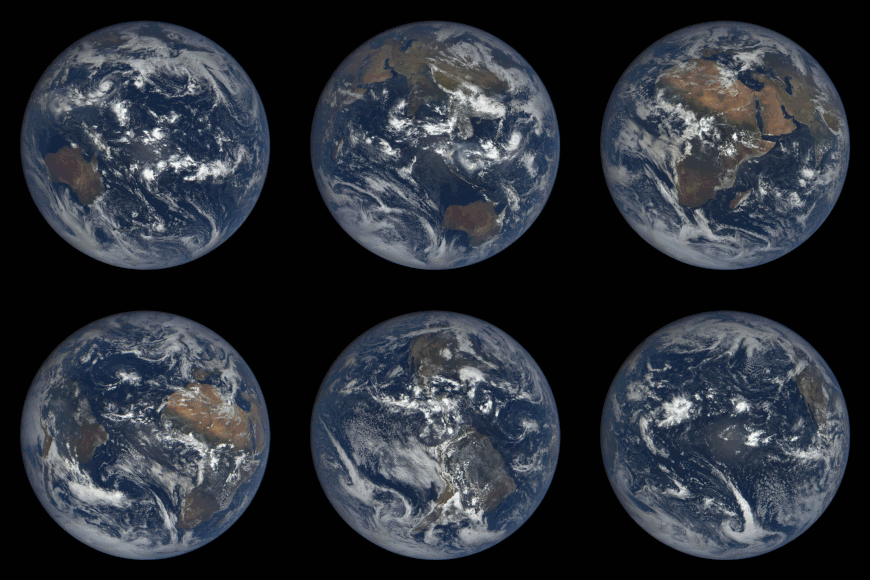
*Animated: Earth — placed from the Real G.E.N.E.R.A.T.I.V.E. course library (Robotics room). Source: Wikimedia Commons (via Wikipedia article media). [Details & license](https://commons.wikimedia.org/wiki/File:EpicEarth-Globespin-tilt-23.4.gif).*
> Earth is the third planet from the Sun and the only astronomical object known to harbor life. This is enabled by Earth being an ocean world, the only one in the Solar System sustaining liquid surface water. ([Wikipedia](https://en.wikipedia.org/wiki/Earth))
<!-- REAL-GENERATIVE-MEDIA:END -->
> **Official MAIN — Planet 3 — the control body.** Mining survey of the Space Mining In Minnesota CoE, on the Technate Expansion schema — ring **R2 Earth (contains R0-R1)**. Address: 0 — contains the Centroid (MN @ 45°N). Sibling surveys: the 14-body index.
## Mining Survey
**Confirmed resources.** The only body with a PROVEN, operating mining industry — every off-world survey in this series calibrates against it. Benchmark district: the Mesabi Range (majority of U.S. iron ore since 1892); the Duluth Complex (one of the largest undeveloped Cu-Ni-PGE deposits); and the Topaz helium field (13.8% He, He-3 verified 2026) — see History of Mining in Minnesota.
**Extraction constraints.** Deep gravity well (11.2 km/s escape) makes Earth the EXPORTER of equipment and IMPORTER of nothing (yet) — the economics all other surveys must beat.
**Survey status.** Comprehensively mapped (USGS, GEBCO, Natural Earth); the Atlas Earth body carries the beauty-pass candidates.
## Coordinate Frame
WGS84 / EPSG:4326.
Atlas: `Interplanetary-Atlas/Bodies/Earth` (harvest complete; coords UNVERIFIED pending Mac pass).
## Vocational-Technical Semiotics
Speaks the CoE's survey sign systems — geologic map symbols (exported off-world), phase diagrams (ice/volatile stability), crystallographic symbols (mineralogy), hazard pictograms ghs (volatiles handling) — per the CoE semiotics block.
<!-- SEMIOTIC-VOCAB:START -->
## Semiotic Vocabulary
| Term | Notation / glyph | Sign system | Meaning at this body |
|------|------------------|-------------|---------------------|
| Earth | ⊕ (U+2295 circled cross) | Astronomical symbols | The terrestrial sphere; control body for all survey calibration |
| WGS84 | EPSG:4326 | Geodetic reference systems | Global datum; spheroid model, major axis 6378.137 km, eccentricity 0.0818 |
| PLSS Township-Range | T45N R16W (grid notation) | Land subdivision notation | Minnesota @ 45°N; the Centroid's legal-survey land grammar |
| Mesabi banded iron | Fe₂O₃·n(H₂O) laminae, 2.5 μm spacing | Mineralogical notation; microscope photography | Prograde metamorphic magnetite-hematite alternation; ~60% Fe ore grade |
| Taconite pellet spec | ⌀12 mm, 63–65% Fe, 4.5% SiO₂ | Engineered aggregate classification | Agglomerated beneficiation product; sinter-locked, crush strength >170 N |
| Ore-grade assay | % Fe; % Cu; ppm Ni; g/t Au | Quantitative geochemical notation | Concentration per mass; Mesabi: 60–68% Fe; Duluth: 0.8–1.2% Cu + 0.4–0.6% Ni |
| Duluth Complex geology | Mafic–ultramafic (Mg-Fe) intrusion | Petrographic classification | Deep intrusive; 1.1 Ga emplacement; PGE disseminated in sulfide phases |
| GHS hazard placard | ⬘ (exploding bomb) · ☠ (skull) · ⚠ | ISO 7010 pictograms | Mine-face chemical/volatiles warning; hexagonal orange-red format |
| Mine plan drawing | Sectional view + isometric plan; dip angle marked; shaft collar labeled | Engineering drawing conventions (ISO 1219 derivative) | Subsurface prospect layout; extraction volume; ventilation flow paths |
| Hydraulic schematic (ISO 1219) | ⊡ (accumulator) · ▷ (pump) · ⊣ (directional valve) | Fluid-power symbolic notation (unofficial derivation) | Dewatering circuit; tailings recovery; ore-grade concentration plant |
| Crystallographic axes | a, b, c (orthogonal; hexagonal: a₁, a₂, a₃, c) | Hermann–Mauguin notation | Magnetite cubic Fe₃O₄; hematite trigonal Fe₂O₃; lattice orientation |
| Geologic map unit label | Qal (Quaternary alluvium) · Pz (Paleozoic) · Ar (Archean) | USGS/CGIS nomenclature (unofficial variant) | Stratum age-code + lithology; Mesabi succession: Archean graywacke–ironstone |
**References & cross-links:** geologic map symbols · engineering drawing views · hazard pictograms ghs · pid symbols · hydraulic pneumatic iso1219 · crystallographic symbols · usgs geologic age codes.
<!-- SEMIOTIC-VOCAB:END -->
## Navigation
- Space Mining In Minnesota CoE · Technate Expansion · All 14 surveys
- Centers of Excellence Portal
## Wikipedia : Wikitube
**Strict pair:** [Wikipedia](https://en.wikipedia.org/wiki/Earth) : [Wikitube](https://en.wikitube.io/wiki/Earth)
## Previous hub tags
Tree parent: [[Oxygen]].
Legacy hubs: none.
*Legacy media (later editing), kept in place under `Wikitube - Collision And Promoted Articles/Earth/`: `Earth Images` (1)*
---
*Sources: 2 legacy notes. Minted wave 1, 2026-07-30 (v1.6 order).*