# Mars
<!-- SOLSIM:BEGIN g31 — Solar System explorer state (hand-built on wt-core, specs/solar/); do not hand-edit inside -->
**Microsim — three.js (Wikitube framework):** *Mars in the Solar System explorer*
<div class="wt-sim" data-src="https://wikitube-3d-microsims.netlify.app/solar/Solar_System.html?obj=Mars&embed=1" data-title="Mars in the Solar System explorer"></div>
*The Solar System explorer locked on this article's state (`?obj=Mars`); every object and population of the [[PORTAL_Solar_System|Solar System portal]] has its own state in the same scene.*
<!-- SOLSIM:END -->
<!-- SOLART:BEGIN g31 — Solar System portal child article, wave 1 (SOL-012, pinned oldid 1373881454); do not hand-edit inside -->
*Try: set the speed to 1 month/s and follow Mars around its off-centre orbit, about 23 seconds a lap, watching the gap to Earth change from one close approach to the next; switch the scale to true to open Mars's local frame, then drop to 1 day/s and watch Phobos circle about three times a second while Deimos takes about 1.3 seconds; press o to hide the orbit lines.*
**Mars** is the fourth planet from the [[Sun]], a cold, dusty [[Terrestrial_planet|terrestrial planet]] about half the diameter of [[Earth]], with a mean radius of 3,389.5 km and a mass 10.7% of Earth's.[^nasa-fs] Its thin atmosphere, mostly [[Carbon|carbon]] dioxide at a mean surface pressure of about 6 hPa, cannot keep water liquid for long, and iron oxide in its dust gives the planet its reddish colour.[^nasa-fs][^R86] It has the largest volcano and one of the largest canyons in the Solar System, polar caps of water and carbon dioxide ice, and two small moons, Phobos and Deimos.[^R24][^R118][^R100][^nasa-fs]
Mars's surface records an early period of flowing water, followed by volcanism and a long, cold, dry era that continues today, and whether life ever arose there is a leading question of planetary science.[^R13][^R169] With an axial tilt of 25.19°, it has seasons like Earth's, but its year lasts 687 days and its orbit is markedly eccentric.[^nasa-fs] Mars has been studied by spacecraft since Mariner 4 flew past in 1965 and has hosted working robotic missions continuously since 1997.[^R272][^R74]
The explorer at the top of this page is locked on Mars. It draws the orbit from JPL elements, with an eccentricity of 0.094 that carries the planet from 206.7 million km from the Sun at perihelion to 249.3 million km at aphelion; in true scale it opens a local frame in which Phobos and Deimos orbit close in, with starting phases that are ILLUSTRATIVE.[^jpl-t1][^nasa-fs]
## Natural history
### Formation
Mars grew from the [[Protoplanetary_disk|protoplanetary disc]] about 4.5 billion years ago. Compared with Earth it is richer in volatile elements such as [[Chlorine|chlorine]], [[Phosphorus|phosphorus]] and [[Sulfur|sulfur]], which were probably driven outward in the young Solar System.[^R165]
### Late Heavy Bombardment
About 60% of the surface records the heavy cratering of the early Solar System.[^R145] The smooth northern lowlands may occupy a single enormous impact basin, the Borealis basin, about 10,600 by 8,500 km, which would make it the largest known impact structure and could explain the planet's split between low northern plains and high cratered southern uplands.[^R84][^R91] The inclination of Deimos's orbit has been read as evidence that Mars once had a ring, formed from a larger moon, some 3.5–4 billion years ago.[^R205]
### Geological periods
Martian history is divided into three main periods, named after surface regions.[^R90][^R13] The Noachian, from about 4.5 to 3.5 billion years ago, left heavily cratered terrain and evidence of abundant water. The Hesperian, which ended 3.3–2.9 billion years ago, saw extensive lava plains. The Amazonian continues to the present and includes the growth of Olympus Mons.[^R13]
### Recent geological activity
Sheet-like lava flows in Athabasca Valles are about 200 million years old, and water flowed through the Cerberus Fossae fractures less than 20 million years ago, suggesting recent volcanic intrusions.[^R110]
## Physical characteristics
Mars has about twice the diameter of the [[Moon]] and 15% of Earth's volume and 10.7% of its mass, so its mean [[Density|density]], 3,934 kg/m³, is well below Earth's, and its surface gravity is 3.73 m/s², 38% of Earth's.[^nasa-fs] Its surface area roughly equals all the dry land on Earth.[^R11] The colour comes from fine [[Iron|iron]](III) oxide.[^R86]
### Internal structure
Mars is differentiated into core, mantle and [[Crust_(geology)|crust]].[^R180] Seismic surface waves recorded by the InSight lander give an average crust of about 42–56 km, with the thinnest crust, about 6 km, under Isidis Planitia and the thickest, about 117 km, beneath the southern Tharsis plateau.[^R196][^R197] InSight recorded hundreds of marsquakes, confirming that the planet is seismically active.[^R191] A layer of molten silicate 150–180 km thick sits at the base of the mantle.[^R187][^R188] The liquid iron-rich core has a radius of about 1,650–1,675 km, rich in light elements such as sulfur and [[Oxygen|oxygen]];[^R185] a 2025 seismic study reported a solid inner core about 600 km in radius, which earlier analyses had not found.[^nasa-fs][^R199]
### Surface geology
The surface is mostly basalt, with silica-richer rocks, feldspar, pyroxene, hematite and olivine in places, all under a mantle of fine oxidised dust.[^R181][^R179] The Phoenix lander measured a slightly alkaline soil, pH about 7.7, containing about 0.6% perchlorate by weight.[^R212] Radiation at the surface averages about 0.64 millisieverts per day, less than the dose in interplanetary space during the cruise.[^R17]
### Magnetic characteristics
Mars has no global magnetic field today, but Mars Global Surveyor found strongly magnetised stripes in the ancient southern crust, recording an early dynamo whose field reversed polarity, possibly while some form of crustal spreading was active.[^R88][^R89]
## Geography and features
Features are named under IAU rules: large craters after scientists and writers who studied Mars, small craters after towns on Earth, and large valleys after the word for Mars in various languages.[^R79] Zero longitude passes through the small crater Airy-0, and with no sea level, heights are measured from a reference surface, the areoid, set originally at the level where the pressure is 610.5 Pa, near the triple point of water.[^R216][^R113]
### Volcanoes
The Tharsis upland carries several giant shield volcanoes. Olympus Mons is over 600 km wide and rises more than 21 km above the cliffs at its base, and about 26 km above the plains of Amazonis Planitia, roughly three times the height of Everest above sea level.[^R24][^R25] Only the central peak of the Rheasilvia basin on the asteroid [[4_Vesta|Vesta]] may be comparably tall.[^R26]
### Impact topography
Mars has about 43,000 craters wider than 5 km.[^R115] The largest well-exposed basin, Hellas, is about 2,300 km across and 7 km deep.[^R222] Some Martian craters have lobed ejecta suggesting that the ground was wet or icy when they formed.[^R117]
### Tectonic sites
Valles Marineris, about 4,000 km long and up to 7 km deep, stretches a fifth of the way around the planet; the Grand Canyon is 446 km long and about 2 km deep.[^R118] It formed as crust collapsed beside the swelling Tharsis region, and one study proposed that it also marks a boundary along which about 150 km of lateral slip has occurred.[^R28]
### Holes and caves
The Mars Odyssey orbiter imaged seven probable cave entrances, 100–252 m wide, on the flanks of Arsia Mons; such caves would shelter their interiors from radiation and micrometeorites.[^R119][^R121]
### Other features
The permanent north polar cap is named Planum Boreum and the southern cap Planum Australe; both are layered deposits of water ice and dust, capped in winter by carbon dioxide frost.[^R38] The largest dark albedo feature visible from Earth is Syrtis Major Planum.[^R215]
## Atmosphere
Mars lost its global magnetic field about four billion years ago, and the [[Solar_wind|solar wind]] has since stripped gas from the upper atmosphere, a loss measured today by MAVEN.[^R122][^R30] Surface pressure ranges from about 30 Pa on Olympus Mons to more than 1,155 Pa in Hellas Planitia, averaging about 600 Pa, 0.6% of Earth's.[^R124] The gas is about 95% carbon dioxide, with about 2.6% [[Nitrogen|nitrogen]] and 1.9% [[Argon|argon]].[^nasa-fs][^R31] The scale height, 11.0 km, is larger than Earth's 8.5 km, mainly because Mars's gravity is weaker: H = RT/(Mg) ≈ 8.314 × 210 / (0.0435 × 3.73) ≈ 10.8 km (derived).[^nasa-fs] Methane has been detected repeatedly at low and variable levels, but its source, geological or biological, remains unresolved.[^R230][^R231] Microphones on Perseverance measured the speed of sound at about 240 m/s at low frequencies and 250 m/s at high ones.[^R233] During a strong solar storm in September 2017 MAVEN saw a global aurora and radiation at the surface briefly doubled.[^R35]
### Climate
Because the orbit is eccentric, perihelion falls during the southern summer, making southern summers warmer and shorter than northern ones, by up to about 30 °C.[^R133] At 1.52 AU the planet receives 43% as much sunlight as Earth: 586.2 W/m² against 1,361 W/m² (derived ratio 0.431).[^nasa-fs] Surface temperatures range from about −110 °C to 35 °C in equatorial summer.[^R8] Dust storms can grow to cover the whole planet, usually around perihelion, and warm the atmosphere.[^R134]
## Hydrology
Most of the [[Water|water]] on Mars today is ice, in the polar caps and beneath the surface; the south polar cap alone holds enough to cover the planet 11 m deep if melted.[^R100] At less than 1% of Earth's pressure, liquid water cannot persist on the surface.[^R39]
### Past hydrosphere
Outflow channels up to hundreds of kilometres long, such as the 700 km Ma'adim Vallis, appear to have been cut by catastrophic floods, and dendritic valley networks on the oldest terrain point to rainfall or snowmelt.[^R118][^R169] Deltas preserved in craters such as Eberswalde record standing lakes.[^R170] Whether the northern lowlands held an ocean is debated.[^R172] The ratio of [[Deuterium|deuterium]] to hydrogen in today's atmosphere, several times Earth's, implies that much water has been lost.[^R45]
### History of observations and findings of water evidence
Water vapour was first identified spectroscopically in 1963.[^R240] Opportunity found jarosite in 2004, a mineral that forms in acidic water.[^R109] Recurring dark streaks on warm slopes were attributed in 2015 to hydrated salts, but later work favoured dry granular flows.[^R43][^R248] Korolev Crater is filled with about 2,200 km³ of ice, and a buried ice sheet in Utopia Planitia holds about as much water as Lake Superior.[^R46][^R47]
## Orbital motion
Mars orbits at a mean 227.96 million km (1.524 [[Astronomical_unit|AU]]) and takes 686.98 days to go round the Sun.[^nasa-fs] Its eccentricity of 0.0935 is the second largest among the planets after [[Mercury_(planet)|Mercury]]'s, so its distance from the Sun varies by 42.6 million km over a year (derived).[^nasa-fs] The eccentricity itself changes: 1.35 million years ago it was about 0.002.[^R136] A solar day, or sol, lasts 24 h 39 min 35 s, and the axis is tilted 25.19°.[^R254][^nasa-fs]
Earth overtakes Mars on average every 779.94 days, the synodic period, which follows from 1 / (1/365.26 − 1/686.98) (derived).[^nasa-fs] Because the Martian orbit is eccentric, the distance at opposition ranges from about 54.6 to about 103 million km, and the planet's apparent size and brightness vary accordingly; favourable perihelic oppositions recur every 15 or 17 years.[^nasa-fs][^R167][^R257] At its brightest Mars reaches magnitude −2.94; its mean is +0.71.[^nasa-fs][^R184] Near opposition it shows [[Apparent_retrograde_motion|retrograde motion]], appearing to loop backwards against the stars for about 72 days.[^R148]
## Moons
Mars has two small, dark, irregular moons.[^nasa-fs] Phobos, about 26 by 18 km and, like Deimos, locked by [[Tide|tides]] into synchronous rotation, orbits 9,378 km from the planet's centre every 7.65 hours, faster than Mars rotates, so it rises in the west; Deimos, about 16 by 10 km, orbits at 23,459 km every 30.3 hours.[^nasa-fs][^R259] Asaph Hall discovered both in 1877 and named them after the attendants of Ares.[^R258] Tides are drawing Phobos inward; in about 50 million years it may strike Mars or break into a ring.[^R259] Whether the moons are captured asteroids or accreted from debris of a giant impact is debated.[^R260][^R73] See [[Moons_of_Mars]].
## Human observations and exploration
### Ancient observations
Mesopotamian astronomers called Mars Nergal after their god of war and plague, and by the Neo-Babylonian period knew that the planet completes 37 synodic cycles in 79 years.[^R54][^R150] Egyptian astronomers knew of its retrograde motion by 1534 BC.[^R149]
### Early modern observations
[[Johannes_Kepler|Johannes Kepler]] used Tycho Brahe's observations of Mars to show in 1609 that planets move on ellipses, faster when nearer the Sun, the first two of [[Kepler's_laws_of_planetary_motion|Kepler's laws]].[^R55][^R56]
### Martian "canals"
At the 1877 perihelic opposition Giovanni Schiaparelli mapped Mars and drew straight *canali*, "channels", mistranslated as canals; Percival Lowell popularised them as the works of a civilisation, but larger telescopes showed no such lines and they were recognised as an optical illusion.[^R157][^R158][^R161]
### First exploration
The Soviet Mars 1 lost contact on the way in 1963. [[NASA]]'s Mariner 4 flew past on 15 July 1965 and returned the first close images of another planet.[^R272] Mariner 9 became the first spacecraft to orbit another planet on 14 November 1971 and mapped the whole surface, and the Viking landers searched the soil for life in 1976.[^nssdc-mariner9][^R163]
### Renewed exploration
Mars Pathfinder and Mars Global Surveyor, both arriving in 1997, began an uninterrupted robotic presence.[^R74]
### Current missions
As of 2023 orbiters from the United States, Europe, the United Arab Emirates and China were operating, along with the Curiosity and Perseverance rovers.[^R274][^R60]
### Future
Europe's Rosalind Franklin rover, delayed repeatedly since 2018, was restarted in 2024 for a launch no earlier than 2028, and China plans to launch its Tianwen-3 sample-return mission in 2028.[^R283][^R284]
## Habitability and habitation
Mars lies near the outer edge of the Sun's [[Habitable_zone|habitable zone]], but its thin atmosphere prevents stable surface water.[^R63] The Viking biology experiments of 1976 gave results that most scientists attribute to soil chemistry, although one experimenter maintained that they indicated life.[^R64] Perchlorates and ultraviolet light make the surface hostile to organic molecules.[^R212] In 2024 Perseverance sampled a rock, "Cheyava Falls", that NASA describes as a potential biosignature.[^R289]
### Human mission proposals
A 2017 US law directed NASA to study a crewed Mars mission, China has stated plans for a crewed mission in the 2030s, and SpaceX is developing its Starship vehicle with Mars settlement as a goal.[^R290][^R292][^R294] Low-energy launch windows open every 26 months, one synodic period (derived).[^nasa-fs]
## In culture
Mars bears the name of the Roman god of war, as it bore the Greek Ares and the Babylonian Nergal.[^R54] Holst's *The Planets* opens with "Mars, the Bringer of War".[^R300] Its symbol, a circle with an arrow, also marks the male sex.[^R301] Lowell's canals made Mars the classic home of fictional aliens, from H. G. Wells's *The War of the Worlds* onward.[^R176]
## See also
- [[Moons_of_Mars]]
- [[Terrestrial_planet]]
- [[Earth]] · [[Venus]] · [[Jupiter]]
- [[Habitable_zone]]
- [[PORTAL_Solar_System|Solar System portal]]
## Notes
Derived numbers use the NASA fact-sheet values: aphelion − perihelion = 249.26 − 206.65 ≈ 42.6 million km; synodic period 1 / (1/365.256 − 1/686.980) ≈ 780 days; irradiance ratio 586.2 / 1,361.0 ≈ 0.431; scale height with R = 8.314 J/(mol K), T ≈ 210 K, M = 0.0435 kg/mol and g = 3.73 m/s² is about 10.8 km, close to the fact-sheet 11.0 km. In the explorer at 1 month/s, the 687-day orbit takes about 23 seconds; at 1 day/s, Phobos's 0.319-day orbit takes about a third of a second and Deimos's 1.26-day orbit about 1.3 seconds.
## References
[^nasa-fs]: Williams, D. R. "Mars Fact Sheet". NASA NSSDCA, last updated 19 May 2025. https://nssdc.gsfc.nasa.gov/planetary/factsheet/marsfact.html (fetched 2026-09-18).
[^nssdc-mariner9]: NASA NSSDCA. "Mariner 9". NSSDCA Master Catalog, spacecraft 1971-051A. https://nssdc.gsfc.nasa.gov/nmc/spacecraft/display.action?id=1971-051A
[^jpl-t1]: JPL Solar System Dynamics. "Approximate Positions of the Planets", Table 1. https://ssd.jpl.nasa.gov/planets/approx_pos.html
[^R86]: Peplow, Mark (6 May 2004). "How Mars got its rust". *Nature*, news040503–6. https://doi.org/10.1038/news040503-6
[^R24]: Plescia, J. B. (2004). "Morphometric Properties of Martian Volcanoes". *J. Geophys. Res.* 109, E03003. https://doi.org/10.1029/2002JE002031
[^R118]: Lucchitta, B. K.; Rosanova, C. E. (26 August 2003). "Valles Marineris; The Grand Canyon of Mars". *USGS*. https://astrogeology.usgs.gov/Projects/VallesMarineris/
[^R100]: (15 March 2007). "Mars' South Pole Ice Deep and Wide". *NASA*. http://jpl.nasa.gov/news/news.cfm?release=2007-030
[^R13]: "ESA Science & Technology – The Ages of Mars". *sci.esa.int*. https://sci.esa.int/web/mars-express/-/55481-the-ages-of-mars
[^R169]: Craddock, R.A.; Howard, A.D. (2002). "The case for rainfall on a warm, wet early Mars". *Journal of Geophysical Research* 107, 21–1. https://doi.org/10.1029/2001JE001505
[^R272]: (20 December 2017). "Mariner 04". *NASA Solar System Exploration*. https://solarsystem.nasa.gov/missions/mariner-04/in-depth
[^R74]: Bond, Peter (2007). "Distant Worlds: Milestones in planetary exploration". *Springer*, 119. ISBN 978-0-387-40212-3
[^R165]: Halliday, A. N.; Wänke, H.; Birck, J.-L.; Clayton, R. N. (2001). "The Accretion, Composition and Early Differentiation of Mars". *Space Science Reviews* 96, 197–230. https://doi.org/10.1023/A:1011997206080
[^R145]: Zharkov, V. N. (1993). "Evolution of the Earth and Planets". *Washington DC American Geophysical Union Geophysical Monograph Series* 74, 7–17. https://doi.org/10.1029/GM074p0007 ISBN 978-1-118-66669-2
[^R84]: Yeager, Ashley (19 July 2008). "Impact May Have Transformed Mars". *ScienceNews.org*. http://www.sciencenews.org/view/generic/id/33622/title/Impact_may_have_transformed_Mars_
[^R91]: Minkel, J. R. (26 June 2008). "Giant Asteroid Flattened Half of Mars, Studies Suggest". *Scientific American*. https://www.scientificamerican.com/article/giant-asteroid-flattened/
[^R205]: Ćuk, Matija; Minton, David A.; Pouplin, Jennifer L. L.; Wishard, Carlisle (16 June 2020). "Evidence for a Past Martian Ring from the Orbital Inclination of Deimos". *The Astrophysical Journal* 896, L28. https://doi.org/10.3847/2041-8213/ab974f
[^R90]: Tanaka, K. L. (1986). "The Stratigraphy of Mars". *Journal of Geophysical Research* 91, E139–E158. https://doi.org/10.1029/JB091iB13p0E139
[^R110]: Mitchell, Karl L.; Wilson, Lionel (2003). "Mars: recent geological activity : Mars: a geologically active planet". *Astronomy & Geophysics* 44, 4.16–4.20. https://doi.org/10.1046/j.1468-4004.2003.44416.x
[^R11]: "Mars: Facts". *NASA Science*. https://science.nasa.gov/mars/facts/
[^R180]: Nimmo, Francis; Tanaka, Ken (2005). "Early Crustal Evolution of Mars". *Annual Review of Earth and Planetary Sciences* 33, 133–161. https://doi.org/10.1146/annurev.earth.33.092203.122637
[^R196]: Kim, D.; Duran, C.; Giardini, D.; Plesa, A. -C.; Stähler, S. C.; Boehm, C. et al. (June 2023). "Global Crustal Thickness Revealed by Surface Waves Orbiting Mars". *Geophysical Research Letters* 50. https://doi.org/10.1029/2023GL103482
[^R197]: Wieczorek, Mark A.; Broquet, Adrien; McLennan, Scott M.; Rivoldini, Attilio; Golombek, Matthew; Antonangeli, Daniele et al. (May 2022). "InSight Constraints on the Global Character of the Martian Crust". *Journal of Geophysical Research: Planets* 127. https://doi.org/10.1029/2022JE007298
[^R191]: Golombek, M.; Warner, N. H.; Grant, J. A.; Hauber, E.; Ansan, V.; Weitz, C. M. et al. (24 February 2020). "Geology of the InSight landing site on Mars". *Nature Communications* 11, 1014. https://doi.org/10.1038/s41467-020-14679-1
[^R187]: Samuel, Henri; Drilleau, Mélanie; Rivoldini, Attilio; Xu, Zongbo; Huang, Quancheng; Garcia, Raphaël F. et al. (October 2023). "Geophysical evidence for an enriched molten silicate layer above Mars's core". *Nature* 622, 712–717. https://doi.org/10.1038/s41586-023-06601-8
[^R188]: Khan, A.; Huang, D.; Durán, C.; Sossi, P. A.; Giardini, D.; Murakami, M. (October 2023). "Evidence for a liquid silicate layer atop the Martian core". *Nature* 622, 718–723. https://doi.org/10.1038/s41586-023-06586-4
[^R185]: Le Maistre, Sébastien; Rivoldini, Attilio; Caldiero, Alfonso; Yseboodt, Marie; Baland, Rose-Marie; Beuthe, Mikael et al. (14 June 2023). "Spin state and deep interior structure of Mars from InSight radio tracking". *Nature* 619, 733–737. https://doi.org/10.1038/s41586-023-06150-0
[^R199]: Bi, Huixing; Sun, Daoyuan; Sun, Ningyu; Mao, Zhu; Dai, Mingwei; Hemingway, Douglas (3 September 2025). "Seismic detection of a 600-km solid inner core in Mars". *Nature* 645, 67–72. https://doi.org/10.1038/s41586-025-09361-9
[^R181]: McSween, Harry Y.; Taylor, G. Jeffrey; Wyatt, Michael B. (May 2009). "Elemental Composition of the Martian Crust". *Science* 324, 736–739. https://doi.org/10.1126/science.1165871
[^R179]: Bandfield, Joshua L. (June 2002). "Global mineral distributions on Mars". *Journal of Geophysical Research: Planets* 107, 9–1–9–20. https://doi.org/10.1029/2001JE001510
[^R212]: Kounaves, S. P. (2010). "Wet Chemistry Experiments on the 2007 Phoenix Mars Scout Lander: Data Analysis and Results". *J. Geophys. Res.* 115, E00–E10. https://doi.org/10.1029/2008JE003084
[^R17]: Williams, Matt (21 November 2016). "How bad is the radiation on Mars?". *Phys.org*. https://phys.org/news/2016-11-bad-mars.html
[^R88]: Valentine, Theresa; Amde, Lishan (9 November 2006). "Magnetic Fields and Mars". *Mars Global Surveyor @ NASA*. http://mgs-mager.gsfc.nasa.gov/Kids/magfield.html
[^R89]: Neal-Jones, Nancy; O'Carroll, Cynthia "New Map Provides More Evidence Mars Once Like Earth". *NASA/Goddard Space Flight Center*. http://www.nasa.gov/centers/goddard/news/topstory/2005/mgs_plates.html
[^R79]: "Planetary Names: Categories for Naming Features on Planets and Satellites". *International Astronomical Union (IAU) Working Group for Planetary System Nomenclature (WGPSN)*. https://planetarynames.wr.usgs.gov/Page/Categories
[^R216]: Davies, Merton E.; Berg, Richard A. (10 January 1971). "A preliminary control net of Mars". *Journal of Geophysical Research* 76, 373–393. https://doi.org/10.1029/JB076i002p00373
[^R113]: Zeitler, W.; Ohlhof, T.; Ebner, H. (2000). "Recomputation of the global Mars control-point network". *Photogrammetric Engineering & Remote Sensing* 66, 155–161.
[^R25]: Comins, Neil F. (2012). "Discovering the Essential Universe". *W. H. Freeman*, 148. https://books.google.com/books?id=qK_4mNve1DYC&pg=PA148 ISBN 978-1-4292-5519-6
[^R26]: Schenk, P. (2012). "The Geologically Recent Giant Impact Basins at Vesta's South Pole". *Science* 336, 694–697. https://doi.org/10.1126/science.1223272
[^R115]: Wright, Shawn (4 April 2003). "Infrared Analyses of Small Impact Craters on Earth and Mars". *University of Pittsburgh*. http://ivis.eps.pitt.edu/projects/MC/
[^R222]: Vogt, Gregory L. (2008). "Landscapes of Mars". *Springer*, 44. https://doi.org/10.1007/978-0-387-75468-0 ISBN 978-0-387-75467-3
[^R117]: Costard, Francois M. (1989). "The spatial distribution of volatiles in the Martian hydrolithosphere". *Earth, Moon, and Planets* 45, 265–290. https://doi.org/10.1007/BF00057747
[^R28]: Wolpert, Stuart (9 August 2012). "UCLA scientist discovers plate tectonics on Mars". *UCLA*. http://newsroom.ucla.edu/portal/ucla/ucla-scientist-discovers-plate-237303.aspx
[^R119]: Cushing, G. E.; Titus, T. N.; Wynne, J. J.; Christensen, P. R. (2007). "Themis Observes Possible Cave Skylights on Mars". *Lunar and Planetary Science XXXVIII*. http://www.lpi.usra.edu/meetings/lpsc2007/pdf/1371.pdf
[^R121]: Rincon, Paul (17 March 2007). "'Cave entrances' spotted on Mars". *BBC News*. http://news.bbc.co.uk/2/hi/science/nature/6461201.stm
[^R38]: "Polar Caps". *Mars Education at Arizona State University*. https://marsed.asu.edu/mep/ice/polar-caps
[^R215]: (2019). "The Atlas of Mars: Mapping its Geography and Geology". *Cambridge University Press*, 136–139. https://doi.org/10.1017/9781139567428.018 ISBN 978-1-139-56742-8
[^R122]: Philips, Tony (31 January 2001). "The Solar Wind at Mars". *Science@NASA*. https://science.nasa.gov/science-news/science-at-nasa/2001/ast31jan_1/
[^R30]: Jakosky, Bruce M. (1 April 2022). "How did Mars lose its atmosphere and water?". *Physics Today* 75, 62–63. https://doi.org/10.1063/PT.3.4988
[^R124]: Bolonkin, Alexander A. (2009). "Artificial Environments on Mars". *Springer*, 599–625. ISBN 978-3-642-03629-3
[^R31]: Mahaffy, P. R. (19 July 2013). "Abundance and Isotopic Composition of Gases in the Martian Atmosphere from the Curiosity Rover". *Science* 341, 263–266. https://doi.org/10.1126/science.1237966
[^R230]: Shekhtman, Lonnie (22 April 2024). "Why is Methane Seeping on Mars? NASA Scientists Have New Ideas – NASA Science". *NASA Science*. https://science.nasa.gov/solar-system/planets/mars/why-is-methane-seeping-on-mars-nasa-scientists-have-new-ideas/
[^R231]: Sutter, Paul (16 November 2024). "What's Behind the Martian Methane Mystery?". *Universe Today*. https://www.universetoday.com/articles/whats-behind-the-martian-methane-mystery
[^R233]: Wright, Katherine (22 March 2022). "Sound Speed Measured on Mars". *Physics* 15. https://doi.org/10.1103/Physics.15.43
[^R35]: Schneider, N. M.; Jain, S. K.; Deighan, J.; Nasr, C. R.; Brain, D. A.; Larson, D. et al. (16 August 2018). "Global Aurora on Mars During the September 2017 Space Weather Event". *Geophysical Research Letters* 45, 7391–7398. https://doi.org/10.1029/2018GL077772
[^R133]: Goodman, Jason C. (22 September 1997). "The Past, Present, and Possible Future of Martian Climate". *MIT*. https://www.mit.edu/people/goodmanj/terraforming/terraforming.html
[^R8]: (12 June 2007). "Mars Exploration Rover Mission: Spotlight". *Marsrover.nasa.gov*. http://marsrover.nasa.gov/spotlight/20070612.html
[^R134]: Philips, Tony (16 July 2001). "Planet Gobbling Dust Storms". *Science @ NASA*. https://science.nasa.gov/headlines/y2001/ast16jul_1.htm
[^R39]: "NASA – NASA Rover Finds Clues to Changes in Mars' Atmosphere". *NASA*. http://www.nasa.gov/mission_pages/msl/news/msl20121102.html
[^R170]: Lewis, K.W.; Aharonson, O. (2006). "Stratigraphic analysis of the distributary fan in Eberswalde crater using stereo imagery". *Journal of Geophysical Research* 111, E06001. https://doi.org/10.1029/2005JE002558
[^R172]: Head, J.W. (1999). "Possible Ancient Oceans on Mars: Evidence from Mars Orbiter Laser Altimeter Data". *Science* 286, 2134–7. https://doi.org/10.1126/science.286.5447.2134
[^R45]: Kaufman, Marc (5 March 2015). "Mars Had an Ocean, Scientists Say, Pointing to New Data". *The New York Times*. https://www.nytimes.com/2015/03/06/science/mars-had-an-ocean-scientists-say-pointing-to-new-data.html
[^R240]: Jakosky, Bruce M.; Mellon, Michael T. (1 April 2004). "Special Issue: Water on Mars". *Physics Today* 57, 71–76. https://doi.org/10.1063/1.1752425
[^R109]: (12 July 2007). "Mars Exploration Rover Mission: Science". *NASA*. http://marsrover.nasa.gov/science/goal1-results.html
[^R43]: Ojha, L.; Wilhelm, M. B.; Murchie, S. L.; McEwen, A. S.; Wray, J. J.; Hanley, J. et al. (2015). "Spectral evidence for hydrated salts in recurring slope lineae on Mars". *Nature Geoscience* 8, 829–832. https://doi.org/10.1038/ngeo2546
[^R248]: Dundas, Colin M.; McEwen, Alfred S.; Chojnacki, Matthew; Milazzo, Moses P.; Byrne, Shane; McElwaine, Jim N. et al. (December 2017). "Granular flows at recurring slope lineae on Mars indicate a limited role for liquid water". *Nature Geoscience* 10, 903–907. https://doi.org/10.1038/s41561-017-0012-5
[^R46]: Sample, Ian (21 December 2018). "Mars Express beams back images of ice-filled Korolev crater". *The Guardian*. https://www.theguardian.com/science/2018/dec/21/mars-express-beams-back-images-of-ice-filled-korolev-crater
[^R47]: Staff (22 November 2016). "Scalloped Terrain Led to Finding of Buried Ice on Mars". *NASA*. http://photojournal.jpl.nasa.gov/catalog/PIA21136
[^R136]: Vitagliano, Aldo (2003). "Mars' Orbital eccentricity over time". *Solex*. http://main.chemistry.unina.it/~alvitagl/solex/MarsDist.html
[^R254]: Badescu, Viorel (2009). "Mars: Prospective Energy and Material Resources". *Springer Science & Business Media*, 600. https://books.google.com/books?id=BnPE37Ms5awC&pg=PA600 ISBN 978-3-642-03629-3
[^R167]: Laskar, Jacques (14 August 2003). "Primer on Mars oppositions". *IMCCE, Paris Observatory*. http://www.imcce.fr/Equipes/ASD/mars/oppo_en.html
[^R257]: (10 November 2017). "Mars Close Approach". *NASA's Mars Exploration Program*. https://mars.nasa.gov/all-about-mars/night-sky/close-approach
[^R184]: Mallama, Anthony; Hilton, James L. (October 2018). "Computing apparent planetary magnitudes for The Astronomical Almanac". *Astronomy and Computing* 25, 10–24. https://doi.org/10.1016/j.ascom.2018.08.002
[^R148]: Zeilik, Michael (2002). "Astronomy: the Evolving Universe". *Cambridge University Press*, 14. ISBN 978-0-521-80090-7
[^R259]: (19 December 2019). "Phobos". *NASA Solar System Exploration*. https://solarsystem.nasa.gov/moons/mars-moons/phobos/in-depth
[^R258]: "Planetary Names". *planetarynames.wr.usgs.gov*. https://planetarynames.wr.usgs.gov/Page/Planets#MartianSystem
[^R260]: (23 September 2016). "Explaining the Birth of the Martian Moons". *AAS Nova*. https://aasnova.org/2016/09/23/explaining-the-birth-of-the-martian-moons/
[^R73]: Giuranna, M.; Roush, T. L.; Duxbury, T.; Hogan, R. C.; Geminale, A.; Formisano, V. (2010). "Compositional Interpretation of PFS/MEx and TES/MGS Thermal Infrared Spectra of Phobos". *European Planetary Science Congress Abstracts, Vol. 5*. http://meetingorganizer.copernicus.org/EPSC2010/EPSC2010-211.pdf
[^R54]: Rabkin, Eric S. (2005). "Mars: A Tour of the Human Imagination". *Praeger*, 9–11. https://books.google.com/books?id=a2QP30zybNkC&pg=PA11 ISBN 978-0-275-98719-0
[^R150]: North, John David (2008). "Cosmos: an illustrated history of astronomy and cosmology". *University of Chicago Press*, 48–52. ISBN 978-0-226-59441-5
[^R149]: Novakovic, B. (2008). "Senenmut: An Ancient Egyptian Astronomer". *Publications of the Astronomical Observatory of Belgrade* 85, 19–23. bibcode 2008POBeo..85...19N
[^R55]: Cooper, Keith (22 December 2023). "Johannes Kepler: Unlocking the Secrets of Planetary Motion". *Space*. https://www.space.com/15787-johannes-kepler.html
[^R56]: Frautschi, Steven C.; Olenick, Richard P.; Apostol, Tom M.; Goodstein, David L. (2007). "The Mechanical Universe: Mechanics and Heat". *Cambridge University Press*. ISBN 978-0-521-71590-4
[^R157]: Sagan, Carl (1980). "Cosmos". *Random House*, [https://archive.org/details/cosmos00saga/page/107 107]. https://archive.org/details/cosmos00saga ISBN 978-0-394-50294-6
[^R158]: Basalla, George (2006). "Civilized Life in the Universe: Scientists on Intelligent Extraterrestrials". *Oxford University Press US*, [https://archive.org/details/civilizedlifeinu0000basa/page/67 67–88]. https://archive.org/details/civilizedlifeinu0000basa/page/67 ISBN 978-0-19-517181-5
[^R161]: Zahnle, K. (2001). "Decline and fall of the Martian empire". *Nature* 412, 209–213. https://doi.org/10.1038/35084148
[^R163]: Ward, Peter Douglas; Brownlee, Donald (2000). "Rare Earth: Why complex life is uncommon in the universe". *Springer*, 253. ISBN 978-0-387-95289-5
[^R274]: Strickland, Ashley (12 February 2021). "Meet the orbiters that help rovers on Mars talk to Earth". *CNN*. https://www.cnn.com/2021/02/12/world/nasa-maven-mro-mars-orbiters-scn/index.html
[^R60]: Myers, Steven Lee; Chang, Kenneth (14 May 2021). "China's Mars Rover Mission Lands on the Red Planet". *The New York Times*. https://www.nytimes.com/2021/05/14/science/china-mars.html
[^R283]: Nadjedja "A saga for Rosalind Franklin – To Mars and back". *European Space Agency Blogs*. https://blogs.esa.int/to-mars-and-back/2024/05/09/a-saga-for-rosalind-franklin/
[^R284]: Jones, A. (5 September 2024). "China to launch Mars sample return mission in 2028, will follow planetary protection guidelines/". *Spacenews*. https://spacenews.com/china-to-launch-mars-sample-return-mission-in-2028-will-follow-planetary-protection-guidelines/
[^R63]: Kopparapu, Ravi Kumar; Ramirez, Ramses; Kasting, James F.; Eymet, Vincent; Robinson, Tyler D.; Mahadevan, Suvrath et al. (2013). "Habitable Zones Around Main-Sequence Stars: New Estimates". *The Astrophysical Journal* 765, 131. https://doi.org/10.1088/0004-637X/765/2/131
[^R64]: Chang, Kenneth (4 August 2021). "Gilbert V. Levin, Who Said He Found Signs of Life on Mars, Dies at 97". *The New York Times*. https://www.nytimes.com/2021/08/04/science/space/gilbert-v-levin-dead.html
[^R289]: "NASA Says Mars Rover Discovered Potential Biosignature Last Year - NASA". *NASA*. https://www.nasa.gov/news-release/nasa-says-mars-rover-discovered-potential-biosignature-last-year/
[^R290]: (21 March 2017). "S.442 – National Aeronautics and Space Administration Transition Authorization Act of 2017". *congress.gov*. https://www.congress.gov/bill/115th-congress/senate-bill/442/text
[^R292]: (23 June 2021). "China plans its first crewed mission to Mars in 2033". *Reuters*. https://www.reuters.com/business/aerospace-defense/china-plans-its-first-crewed-mission-mars-2033-2021-06-24/
[^R294]: Howell, Elizabeth (13 April 2024). "SpaceX's giant Starship will be 500 feet tall for Mars missions, Elon Musk says (video)". *Space.com*. https://www.space.com/spacex-starship-500-feet-tall-mars-missions-elon-musk
[^R300]: Reid, James (2011). "An Astronomer's Guide to Holst's The Planets". *Sky and Telescope* 121, 66. https://skyandtelescope.org/wp-content/uploads/Reid_on_Holst.pdf
[^R301]: (30 January 2018). "Solar System Symbols". *NASA Solar System Exploration*. https://solarsystem.nasa.gov/resources/680/solar-system-symbols
[^R176]: Lightman, Bernard V. (1997). "Victorian Science in Context". *University of Chicago Press*, 268–273. ISBN 978-0-226-48111-1
## Further reading
- Carr, M. H. (2006). *The Surface of Mars*. Cambridge University Press. ISBN 978-0-521-87201-0.
## External links
- NASA Science: Mars. https://science.nasa.gov/mars/
- NASA NSSDCA Mars Fact Sheet. https://nssdc.gsfc.nasa.gov/planetary/factsheet/marsfact.html
- ESA Mars Express. https://www.esa.int/Science_Exploration/Space_Science/Mars_Express
- USGS/IAU Gazetteer of Planetary Nomenclature: Mars. https://planetarynames.wr.usgs.gov/Page/MARS/target
*Article prose: Solar System portal child articles, wave 1, 2026-09-18 · row SOL-012 · strict pair pinned at revision [1373881454](https://en.wikipedia.org/w/index.php?oldid=1373881454). The sections below this block are the page's earlier material, kept in place.*
<!-- SOLART:END -->
## Microsim
### Live player
<div class="microsim-player">
<iframe src="https://editor.p5js.org/sciencenibber/full/p472uEZ32" width="100%" height="620" frameborder="0" sandbox="allow-scripts allow-same-origin"></iframe>
</div>
<div class="microsim-fallback">
<img src="Microsims/thumbs/Mars.png" alt="Mars microsim poster" style="width:100%;border:1px solid #4445;border-radius:6px;">
<p><em>Live microsim (desktop) · <a href="https://editor.p5js.org/sciencenibber/sketches/p472uEZ32">open sketch in the p5.js editor</a></em></p>
</div>
**Editor URL:** https://editor.p5js.org/sciencenibber/sketches/p472uEZ32
**Description (100 words):**
This microsim animates Mars tracing its elliptical orbit around the Sun, which sits at one focus of the ellipse (Kepler's first law). A shaded orange wedge sweeps out the area covered over the last several frames, staying roughly constant in size as the planet speeds up near perihelion and slows near aphelion, making Kepler's second law visible. Drag the sliders to change the semi-major axis a and the eccentricity e; the readouts update the orbital period T from Kepler's third law (T^2 = a^3), the current radius r, and the vis-viva speed. Defaults match real Mars: a = 1.524 AU, e = 0.0934.
```js
/*
* Mars - orbital microsim
* ------------------------------------------------------------------
* Wikitube microsim - en.wikitube.io/wiki/Mars
*
* Idea: Mars orbits the Sun on an ellipse with the Sun at one focus
* (Kepler's first law). A planet sweeps equal areas in equal times
* (Kepler's second law), so it moves fastest at perihelion and
* slowest at aphelion. The orbital period follows from the
* semi-major axis alone (Kepler's third law).
*
* Real Mars: a = 1.524 AU, e = 0.0934, T = 1.88 yr (687 days).
*
* Parameters (sliders):
* a - semi-major axis in AU (orbit size)
* e - eccentricity, 0 = circle (orbit shape)
* rate - animation time multiplier (cosmetic)
*
* Equations:
* Kepler III : T^2 = a^3 (a in AU, T in years)
* vis-viva : v = sqrt( GM * (2/r - 1/a) )
* r(theta) : r = a (1 - e^2) / (1 + e cos theta)
*
* Notes: integrate the true anomaly by conserving angular momentum
* (r^2 * dtheta/dt = const) so the equal-area law emerges naturally.
*/
const ARTICLE = "Mars";
p5.disableFriendlyErrors = true;
// ---- layout + physical constants -------------------------------------
let sA, sE, sSpeed; // sliders
const AU_PX = 150; // pixels per AU at the default scale
let cx, cy; // Sun position (one focus) in canvas px
// orbit integration state
let theta = 0; // true anomaly (radians)
let trail = []; // recent positions for the swept-area wedge
const TRAIL_LEN = 26; // frames of wedge memory (the "equal area")
function setup() {
createCanvas(720, 520);
pixelDensity(2);
cx = width * 0.46;
cy = height * 0.52;
// a: AU. Mars default 1.524. Range covers inner-system orbits.
sA = createSlider(0.6, 2.4, 1.524, 0.001);
sA.position(150, height - 92);
sA.style("width", "200px");
// e: eccentricity. Mars default 0.0934. 0 = perfect circle.
sE = createSlider(0, 0.6, 0.0934, 0.001);
sE.position(150, height - 64);
sE.style("width", "200px");
// rate: cosmetic animation multiplier (does not change the physics ratios).
sSpeed = createSlider(0.2, 3, 1, 0.1);
sSpeed.position(150, height - 36);
sSpeed.style("width", "200px");
}
function draw() {
background(8, 10, 22); // deep space
const a = sA.value(); // AU
const e = sE.value(); // dimensionless
const spd = sSpeed.value(); // animation rate multiplier
// --- advance the orbit by conserving angular momentum -------------
// r^2 * dtheta = h * dt ; pick h so a full orbit feels ~ period-like.
const p = a * (1 - e * e); // semi-latus rectum (AU)
const r = p / (1 + e * cos(theta)); // current radius (AU)
const h = 0.9 * sqrt(p); // specific angular momentum (scaled)
const dtheta = (h / (r * r)) * 0.06 * spd;
theta += dtheta;
if (theta > TWO_PI) theta -= TWO_PI;
// Kepler III: period from a only (years). v from vis-viva (scaled).
const T = pow(a, 1.5);
const v = sqrt(2 / r - 1 / a); // vis-viva up to GM scaling
// --- geometry: ellipse with Sun at the focus ----------------------
// semi-minor axis and the focus offset c = a*e.
const b = a * sqrt(1 - e * e);
const c = a * e;
// ellipse center is offset from the focus (Sun) by c along +x.
const ecx = cx + c * AU_PX;
const ecy = cy;
// reference orbit ellipse (neutral grey, drawn first)
push();
noFill();
stroke(70, 80, 110);
strokeWeight(1.5);
ellipse(ecx, ecy, 2 * a * AU_PX, 2 * b * AU_PX);
pop();
// Mars position from the focus, using r(theta)
const mx = cx + r * cos(theta) * AU_PX;
const my = cy + r * sin(theta) * AU_PX;
// --- equal-area wedge (Kepler II) ---------------------------------
trail.push({ x: mx, y: my });
if (trail.length > TRAIL_LEN) trail.shift();
noStroke();
fill(220, 130, 40, 60); // orange swept sector
beginShape();
vertex(cx, cy);
for (const pt of trail) vertex(pt.x, pt.y);
endShape(CLOSE);
// --- the Sun (active geometry, accent yellow) ---------------------
noStroke();
fill(255, 210, 70);
circle(cx, cy, 22);
fill(255, 210, 70, 50);
circle(cx, cy, 38);
// --- Mars (accent red) --------------------------------------------
noStroke();
fill(220, 70, 50);
circle(mx, my, 13);
// radius line from Sun to Mars
stroke(220, 130, 40, 160);
strokeWeight(1);
line(cx, cy, mx, my);
drawHUD(a, e, r, v, T);
}
// ---- HUD: title, hints, readouts, equation footer --------------------
function drawHUD(a, e, r, v, T) {
noStroke();
textFont("system-ui");
// 2a. top-left title block
textAlign(LEFT, TOP);
fill(235);
textSize(20);
text("Mars", 16, 14);
fill(150);
textSize(12);
text("Wikitube microsim - en.wikitube.io/wiki/" + ARTICLE, 16, 40);
// 2b. top-right control hints
textAlign(RIGHT, TOP);
fill(150);
textSize(11);
text("sliders: a (size), e (shape), rate", width - 14, 14);
text("equal orange area swept in equal time (Kepler II)", width - 14, 30);
// 2c. bottom-left live readouts (canonical symbols)
textAlign(LEFT, BOTTOM);
textSize(13);
fill(255, 200, 90);
text("a = " + a.toFixed(3) + " AU", 16, height - 118);
fill(220, 130, 90);
text("e = " + e.toFixed(3), 16, height - 100);
fill(200);
text("r = " + r.toFixed(3) + " AU v ~ " + v.toFixed(2) + " (vis-viva)", 380, height - 100);
fill(120, 200, 255);
text("T = " + T.toFixed(2) + " yr", 380, height - 118);
// slider labels (left of each slider, right-aligned)
textAlign(RIGHT, CENTER);
textSize(12);
fill(150);
text("a (AU)", 142, height - 84);
text("e", 142, height - 56);
text("rate", 142, height - 28);
// 2d. bottom-right equation footer (ASCII only)
textAlign(RIGHT, BOTTOM);
textSize(11);
fill(170);
text("T^2 = a^3 r = a(1-e^2)/(1+e cos th) v = sqrt(GM(2/r - 1/a))", width - 14, height - 14);
}
```
## Links (Wikipedia order)
<!-- injected from _registry/childlinks/Mars.json (2026-07-30T02:09:12Z) -->
`10_Hygiea` · `120347_Salacia` · `174567_Varda` · `2001_Mars_Odyssey` · `2013_ND15` · `2019_UO14` · `2060_Chiron` · `208996_Achlys` · `28978_Ixion` · `2_Pallas` · `307261_Máni` · `3D_projection` · `4_Vesta` · `532037_Chiminigagua` · `55565_Aya` · `Absolute_magnitude` · `Absorbed_dose` · `Accretion_(astrophysics)` · `Accretion_disk` · `Active_asteroid` · `Aelita_project` · `Aeolian_processes` · `Aerial_Regional-scale_Environmental_Survey` · `Albedo` · `Alessandro_Morbidelli_(astronomer)` · `Alexandria` · `Alien_invasion` · `Alluvial_fan` · `Almagest` · [[Aluminium]] · `American_Astronomical_Society` · `Ancient_Greece` · `Ancient_Rome` · `Angular_diameter` · `Apollo_1_Hills` · `Apparent_magnitude` · `Apparent_retrograde_motion` · `Apsis` · `Arctic_Mars_Analog_Svalbard_Expedition` · `Arctic_Ocean` · `Areography` · `Ares` · [[Argon]] · `Argument_of_periapsis` · `Ariel_(moon)` · `Aristotle` · `Ars_Technica` · `Asaph_Hall` · `Asteroid` · `Asteroid_belt` · `Asteroid_family` · `Asteroid_mining` · `Astrobiology_Field_Laboratory` · `Astronomical_transit` · `Astronomy` · `Astronomy_&_Geophysics` · `Atmosphere_of_Earth` · `Atmosphere_of_Mars` · `Atmospheric_chemistry` · `Atmospheric_pressure` · `Aurora` · `Aurora_on_Mars` · `Aurora_programme` · `Axial_tilt` · `BBC_News` · `Babylonian_astronomy` · `Bad_Astronomy` · `Bar_(unit)` · `Basalt` · `Base_(chemistry)` · `Beagle_2` · `Beagle_3` · `Biological_Oxidant_and_Life_Detection` · `Biosignature` · `Bond_albedo` · `Breccia` · `Brine` · `C._S._Lewis` · `C/2013_A1_(Siding_Spring)` · [[Calcium]] · `Calcium_sulfate` · `Callisto_(moon)` · `Canyon` · `Capture_of_Triton` · [[Carbon]] · `Carbon_dioxide` · `Carbon_monoxide` · `Carbonaceous_chondrite` · `Carl_Sagan` · `Cave` · `Centaur_(small_Solar_System_body)` · [[Ceres_(dwarf_planet)]] · `Charon_(moon)` · `Chemical_compound` · `Cheyava_Falls` · `China` · `Chinese_astronomy` · `Chiron_(hypothetical_moon)` · `Chlorate` · [[Chlorine]] · `Chondrite` · [[Christiaan_Huygens]] · `Chrysalis_(hypothetical_moon)` · `Circular_orbit` · `Circumplanetary_disk` · `Circumstellar_disc` · `Circumstellar_envelope` · `Cirrus_cloud` · `Claimed_moons_of_Earth` · `Classical_Kuiper_belt_object` · `Classical_planet` · `Climate_of_Mars` · `Co-orbital_configuration` · `Coatlicue_(star)` · `Colonization_of_Mars` · `Comet` · `Composition_of_Mars` · `Concordia_Station` · `Conjunction_(astronomy)` · `Constellation_program` · `Copernicus_(Martian_crater)` · `Coronal_mass_ejection` · `Cosmic_dust` · `Counter-Earth` · `Crater_chain` · [[Crust_(geology)]] · `Curiosity_(rover)` · `Damocloid` · `Dawn_(spacecraft)` · `Debris_disk` · `Declination` · `Deep_Space_2` · `Deep_space_exploration` · `Deimos_(moon)` · `Deimos_and_Phobos_Interior_Explorer` · `Delta-v_budget` · [[Density]] · `Desert` · `Desert_planet` · `Detached_object` · `Deuterium` · `Dione_(moon)` · `Discovery_and_exploration_of_the_Solar_System` · `Disrupted_planet` · `Dose_rate` · `Double_planet` · `Dry_ice` · `Dust_devil` · `Dust_storm` · `Dwarf_planet` · `Dynamo_theory` · `Dysnomia_(moon)` · `ESCAPADE` · [[Earth]] · `Earth's_inner_core` · `Earth_and_Planetary_Science_Letters` · `Earth_trojan` · `Ecliptic` · `Effective_temperature` · `Effects_of_Planet_Nine_on_trans-Neptunian_objects` · `Egyptian_astronomy` · [[Ellipse]] · `Ellipsoid` · `Emirates_Mars_Mission` · `Enceladus` · `Environmental_radioactivity` · `Epoch_(astronomy)` · `Equator` · `Equivalent_dose` · `Eris_(dwarf_planet)` · `Escape_velocity` · `Europa_(moon)` · `Europa_Clipper` · `European_Space_Agency` · `ExoLance` · `Exoplanetary_Circumstellar_Environments_and_Disk_Explorer` · `Exozodiacal_dust` · `Exploration_of_Jupiter` · `Exploration_of_Mars` · `Exploration_of_Mercury` · `Exploration_of_Neptune` · `Exploration_of_Pluto` · `Exploration_of_Saturn` · `Exploration_of_Uranus` · `Exploration_of_the_Moon` · `Extraterrestrial_materials` · `Extraterrestrial_sample_curation` · `Fifth_Giant` · `Five-planet_Nice_model` · `Flattening` · `Fobos-Grunt` · `Fog` · `Formaldehyde` · `Formation_and_evolution_of_the_Solar_System` · `Frost` · `Frost_line_(astrophysics)` · `Gale_(crater)` · `Galileo_Galilei` · `Ganymede_(moon)` · `Gas_giant` · `Geographical_pole` · `Geoid` · `Geological_history_of_Mars` · `Geology_(journal)` · `Geology_of_Mars` · `Geometric_albedo` · [[Geomorphology]] · `Geophysical_Research_Letters` · `Geysers_on_Mars` · `Giant-impact_hypothesis` · `Giant_planet` · `Gilbert_Levin` · `Giovanni_Domenico_Cassini` · `Giovanni_Schiaparelli` · `Goethite` · `Gonggong_(dwarf_planet)` · `Gould_Belt` · `Graben` · `Grand_Canyon` · `Grand_tack_hypothesis` · `Gravitational_collapse` · `Gravitational_potential` · `Gravity_assist` · `Gravity_of_Earth` · `Greek_language` · `Greek_mythology` · `Greenwich` · `Gusev_(Martian_crater)` · `Gustav_Holst` · `Gypsum` · `Gérard_de_Vaucouleurs` · `H._G._Wells` · `Haumea` · [[Heat_transfer]] · `Heidelberg` · `Heightmap` · `Hematite` · `Hera_(space_mission)` · `Heracles` · `Hercules` · `Highland` · `Hill_sphere` · `Hills_cloud` · `Historical_models_of_the_Solar_System` · `History_of_Solar_System_formation_and_evolution_hypotheses` · `Hiʻiaka_(moon)` · `Human_mission_to_Mars` · `Human_spaceflight` · `Human_spaceflight_programs` · `Huygens_(crater)` · `Hydra_(moon)` · [[Hydrogen]] · `Hyperion_(moon)` · `Hypothetical_moon_of_Mercury` · `ISRO` · `Iapetus_(moon)` · `Icarus_(journal)` · `Ice_giant` · `Icebreaker_Life` · `Idefix_(rover)` · `Impact_crater` · `Impact_event` · `InSight` · [[In_situ_resource_utilization]] · `India` · `Ingenuity_(helicopter)` · `Inspiration_Mars_Foundation` · `Interplanetary_dust_cloud` · `Interplanetary_medium` · `Interstellar_cloud` · `Interstellar_medium` · `Invariable_plane` · `Io_(moon)` · `Ionosphere` · [[Iron]] · `Iron(III)_oxide` · `Iron(III)_oxide-hydroxide` · `Iron_oxide` · `Iron–nickel_alloy` · `Japan` · `Jean_Meeus` · `Jezero_(crater)` · `Johann_Heinrich_von_Mädler` · [[Johannes_Kepler]] · `Jonathan_Lunine` · `Joseph_Needham` · `Journal_of_Geophysical_Research` · [[Jupiter]] · `Jupiter_trojan` · `Katharina_Lodders` · `Kazachok` · `Kerberos_(moon)` · `Kim_Stanley_Robinson` · `Kirkwood_gap` · `Kosmos_419` · `Kuiper_belt` · `Lagrange_point` · `Lake_Superior` · `Laniakea_Supercluster` · `Late_Heavy_Bombardment` · `Lava_tube` · `Lick_Observatory` · `Life_on_Mars` · `LightShip_(spacecraft)` · `List_of_Earth-crossing_asteroids` · `List_of_Ingenuity_flights` · `List_of_Jupiter-crossing_minor_planets` · `List_of_Jupiter_trojans_(Greek_camp)` · `List_of_Jupiter_trojans_(Trojan_camp)` · `List_of_Mars-crossing_minor_planets` · `List_of_Mars_landers` · `List_of_Mars_orbiters` · `List_of_Martian_meteorites` · `List_of_Mercury-crossing_minor_planets` · `List_of_Solar_System_objects` · `List_of_Solar_System_objects_by_size` · `List_of_Solar_System_probes` · `List_of_Venus-crossing_minor_planets` · `List_of_adjectivals_and_demonyms_of_astronomical_bodies` · `List_of_artificial_objects_on_Mars` · `List_of_crewed_spacecraft` · `List_of_exceptional_asteroids` · `List_of_extraterrestrial_dune_fields` · `List_of_extraterrestrial_memorials` · `List_of_gravitationally_rounded_objects_of_the_Solar_System` · `List_of_hypothetical_Solar_System_objects` · `List_of_interstellar_and_circumstellar_molecules` · `List_of_missions_to_Mars` · `List_of_missions_to_comets` · `List_of_natural_satellites` · `List_of_possible_dwarf_planets` · `List_of_surface_features_of_Mars_visited_by_Spirit_and_Opportunity` · `List_of_tallest_mountains_in_the_Solar_System` · `Lithosphere` · `Local_Bubble` · `Local_Group` · `Local_Hole` · `Local_Interstellar_Cloud` · `Local_Sheet` · `Local_Volume` · `Longitude_of_the_ascending_node` · `Low_Earth_orbit` · `Lowell_Observatory` · `Lower_mantle` · `Lunar_resources` · `MARS-500` · `MAVEN` · `MBR_Explorer` · `MELOS` · `Magma_ocean` · [[Magnesium]] · `Magnetic_field_of_Mars` · `Magnetosphere` · `Makemake` · `Mantle_(geology)` · `Mariner_3` · `Mariner_4` · `Mariner_6_and_7` · `Mariner_8` · `Mariner_9` · `Mariner_program` · [[Mars]] · `Mars-Aster` · `Mars-Grunt` · `Mars_(mythology)` · `Mars_1` · `Mars_1M_No.1` · `Mars_1M_No.2` · `Mars_2` · `Mars_2020` · `Mars_2MV-3_No.1` · `Mars_2MV-4_No.1` · `Mars_2M_No.521` · `Mars_2M_No.522` · `Mars_3` · `Mars_4` · `Mars_5` · `Mars_5M` · `Mars_6` · `Mars_7` · `Mars_96` · `Mars_Aerial_and_Ground_Global_Intelligent_Explorer` · `Mars_Astrobiology_Explorer-Cacher` · `Mars_Climate_Orbiter` · `Mars_Cube_One` · `Mars_Design_Reference_Mission` · `Mars_Direct` · `Mars_Exploration_Joint_Initiative` · `Mars_Exploration_Program` · `Mars_Exploration_Rover` · `Mars_Express` · `Mars_Geyser_Hopper` · `Mars_Global_Surveyor` · `Mars_Institute` · `Mars_MetNet` · `Mars_Micro_Orbiter` · `Mars_Observer` · `Mars_One` · `Mars_Orbiter_Mission` · `Mars_Pathfinder` · `Mars_Polar_Lander` · `Mars_Reconnaissance_Orbiter` · `Mars_Sample_Recovery_Helicopter` · `Mars_Science_Laboratory` · `Mars_Society` · `Mars_Surveyor_2001` · `Mars_Telecommunications_Orbiter` · `Mars_aircraft` · `Mars_atmospheric_entry` · `Mars_flyby` · `Mars_landing` · `Mars_race` · `Mars_rover` · `Mars_sample-return_mission` · `Mars_surface_color` · `Mars_to_Stay` · `Mars_trilogy` · `Mars_trojan` · `Marsokhod` · `Martian_Moons_eXploration` · `Martian_Piloted_Complex` · `Martian_meteorite` · `Martian_regolith` · `Martian_spherules` · `Mass` · `Mauna_Kea` · `Mean_anomaly` · `Mean_radius_(astronomy)` · `Meanings_of_minor-planet_names` · `Medusae_Fossae_Formation` · `Mercury_(planet)` · `Metal` · `Meteoroid` · `Methane` · `Michael_Maestlin` · `Milan` · `Milankovitch_cycles` · `Milky_Way` · `Mimas` · `Mineral` · `Mineral_hydration` · `Minor-planet_moon` · `Minor_planet` · `Miranda_(moon)` · `Mohammed_bin_Rashid_Space_Centre` · `Molecular_cloud` · `Moment_of_inertia_factor` · [[Moon]] · `Moonlet` · `Moons_of_Haumea` · `Moons_of_Jupiter` · `Moons_of_Mars` · `Moons_of_Neptune` · `Moons_of_Pluto` · `Moons_of_Saturn` · `Moons_of_Uranus` · `Mount_Everest` · `Mount_Pinatubo` · `NASA` · `NASA-ESA_Mars_Sample_Return` · `NEEMO` · `NPR` · `Nadia_Drake` · `Nakhlite` · `Namaka_(moon)` · `National_Academies_of_Sciences,_Engineering,_and_Medicine` · `Natural_methane_on_Mars` · `Natural_satellite` · `Nature_(journal)` · `Nature_Geoscience` · `Near-Earth_object` · `Nebular_hypothesis` · `Neith_(hypothetical_moon)` · `Nemesis_(hypothetical_star)` · `Neo-Babylonian_Empire` · `Neptune` · `Neptune_trojan` · `Nereid_(moon)` · `Nergal` · `NetLander` · `Next_Mars_Orbiter` · `Nibiru_cataclysm` · `Nice_2_model` · `Nice_model` · `Nineveh` · `Nitrate` · [[Nitrogen]] · `Nix_(moon)` · `Noachis_quadrangle` · `Northern_Arizona_University` · `Northern_Light_(spacecraft)` · `Nozomi_(spacecraft)` · `Oberon_(moon)` · `Observable_universe` · `Observations_and_explorations_of_Venus` · `Occultation` · `Olivine` · `Oort_cloud` · `Oort_limit` · `Opportunity_(rover)` · `Opposition_(astronomy)` · `Optical_depth` · `Optical_illusion` · `Orbital_eccentricity` · `Orbital_inclination` · `Orbital_period` · `Orbital_plane` · `Orbital_speed` · `Orcus_(dwarf_planet)` · `Orders_of_magnitude_(radiation)` · `Organism` · `Orion_Arm` · `Osculating_orbit` · `Outer_space` · `Outline_of_space_exploration` · `Outline_of_the_Solar_System` · `Oxyanion` · [[Oxygen]] · `Oxyrhynchus_Papyri` · `PH` · `Paleomagnetism` · `Pascal_(unit)` · `Perchlorate` · `Percival_Lowell` · `Permafrost` · `Perseverance_(rover)` · `Phaeton_(hypothetical_planet)` · `Phil_Plait` · `Phobos_(moon)` · `Phobos_1` · `Phobos_2` · `Phobos_And_Deimos_&_Mars_Environment` · `Phobos_program` · `Phoebe_(moon)` · `Phoenix_(spacecraft)` · `Phootprint` · [[Phosphorus]] · `Physics_(magazine)` · `Pink` · `Pisces–Cetus_Supercluster_Complex` · `Plain` · `Planet` · `Planet_Nine` · `Planet_V` · `Planetary-mass_object` · `Planetary_core` · `Planetary_differentiation` · `Planetary_habitability` · `Planetary_migration` · `Planetary_objects_proposed_in_religion,_astrology,_ufology_and_pseudoscience` · [[Planetary_system]] · `Planetesimal` · `Planets_beyond_Neptune` · `Planets_in_astrology` · `Plate_tectonics` · `Plutino` · `Pluto` · [[Potassium]] · `Potentially_hazardous_object` · `Pound_per_square_inch` · `PrOP-M` · `Private_spaceflight` · `Proceedings_of_the_National_Academy_of_Sciences_of_the_United_States_of_America` · `Proteus_(moon)` · `Protoplanetary_disk` · `Psyche_(spacecraft)` · `Ptolemy` · `Public_domain` · `Pyroeis` · `Pyroxene` · `Quaoar` · `Rad_(radiation_unit)` · `Radiation` · `Ray_Bradbury` · `Redox` · `Rhea_(moon)` · `Rheasilvia` · `Ride_Report` · `Right_ascension` · `Ring_system` · `Rings_of_Chariklo` · `Rings_of_Earth` · `Rings_of_Jupiter` · `Rings_of_Neptune` · `Rings_of_Rhea` · `Rings_of_Saturn` · `Rings_of_Uranus` · `River_delta` · `Robert_A._Heinlein` · `Roche_limit` · `Rock_(geology)` · `Rootless_cone` · `Rosalind_Franklin_(rover)` · `Roscosmos` · `Rosetta_(spacecraft)` · `Rubble_pile` · `S/2015_(136472)_1` · `Sample-return_mission` · `Sample_Collection_for_Investigation_of_Mars` · `Satellite_galaxies_of_the_Milky_Way` · `Saturn` · `Scale_height` · `Scattered_disc` · `Schiaparelli_EDM` · `SciTech_(magazine)` · [[Science_(journal)]] · `Science_fiction` · `Scientific_American` · `Sea_level` · `Season` · `Seasonal_flows_on_warm_Martian_slopes` · `Sedna_(dwarf_planet)` · `Sednoid` · `Self-portrait` · `Semi-major_and_semi-minor_axes` · `Serpentinite` · `Shield_volcano` · `Sievert` · [[Silicon]] · `Sky-Sailor` · `Sky_crane_(landing_system)` · `Small_Solar_System_body` · `Snow` · [[Sodium]] · `Sojourner_(rover)` · `Solar_System` · `Solar_System_model` · `Solar_flare` · `Solar_wind` · `South_Pole–Aitken_basin` · `Soviet_space_program` · `SpaceX` · `SpaceX_Red_Dragon` · `SpaceX_Starship` · `Space_Exploration_Initiative` · `Space_colonization` · `Space_elevator` · `Space_exploration` · `Space_probe` · `Space_station` · `Spacecraft` · `Spheroid` · `Spirit_(rover)` · `Springer_Science+Business_Media` · `Standard_gravity` · `Star_formation` · `Stellar_collision` · `Steven_Frautschi` · `Stochastic_process` · `Styx_(moon)` · `Sub-Earth` · `Sublimation_(phase_transition)` · `Subsatellite` · [[Sulfur]] · `Sumer` · [[Sun]] · `Surface_gravity` · `Surface_runoff` · `Synestia` · `Syrtis_Major_Planum` · `Syzygy_(astronomy)` · `TMK` · `Temperature` · `Tera-hertz_Explorer` · `Terra_Cimmeria` · `Terraforming_of_Mars` · `Terrestrial_planet` · `Tethys_(moon)` · `Tharsis` · `Tharsis_Montes` · `The_Case_for_Mars` · `The_Mars_Project` · `The_Mechanical_Universe` · `The_New_York_Times` · `The_Planetary_Society` · `The_Planets` · `Theia_(hypothetical_planet)` · `Themis_(hypothetical_moon)` · `Thermal_Emission_Imaging_System` · `Thermal_inertia` · `Tianwen-1` · `Tianwen-3` · `Tidal_force` · `Tidal_locking` · `Timekeeping_on_Mars` · `Timeline_of_Mars_2020` · `Timeline_of_Mars_Reconnaissance_Orbiter` · `Timeline_of_Mars_Science_Laboratory` · `Timeline_of_Opportunity` · `Timeline_of_Solar_System_exploration` · `Timeline_of_Spirit` · `Timeline_of_discovery_of_Solar_System_planets_and_their_moons` · `Titan_(moon)` · `Titania_(moon)` · `Tom_M._Apostol` · `Trace_Gas_Orbiter` · `Trans-Neptunian_object` · `Transform_fault` · `Transition_zone_(Earth)` · `Triple_point` · `Triton_(moon)` · `Trojan_(celestial_body)` · `Tweet_(social_media)` · `Tyche_(hypothetical_planet)` · `Tycho_Brahe` · `Ultraviolet–visible_spectroscopy` · `Umbriel` · `United_Kingdom` · `United_States_Geological_Survey` · `Universe` · `Uranus` · `Valles_Marineris` · `Vanth_(moon)` · `Vapor_pressure` · `Vein_(geology)` · [[Venus]] · `Vesta_(spacecraft)` · `Vesto_Slipher` · `Viking_1` · `Viking_2` · `Viking_program` · `Virgo_Supercluster` · `Vision_for_Space_Exploration` · `Volcanism` · `Volcano` · `Volume` · `Voyager_program_(Mars)` · `Vulcan_(hypothetical_planet)` · `Vulcanoid` · `Water_on_Mars` · `Water_vapor` · [[Wayback_Machine]] · `Weywot` · `Wilhelm_Beer` · `William_Wallace_Campbell` · `Wuxing_(Chinese_philosophy)` · `Xiangliu_(moon)` · `Yinghuo-1` · `Zhurong_(rover)`
## From the Real GENERATIVE library
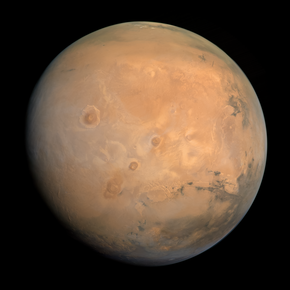
*Mars — placed from the Real G.E.N.E.R.A.T.I.V.E. course library (Robotics room). Source: Wikimedia Commons (via Wikipedia article media). [Details & license](https://commons.wikimedia.org/wiki/File:Mars_-_August_30_2021_-_Flickr_-_Kevin_M._Gill.png).*

*Animated: Mars — placed from the Real G.E.N.E.R.A.T.I.V.E. course library (Robotics room). Source: Wikimedia Commons (via Wikipedia article media). [Details & license](https://commons.wikimedia.org/wiki/File:PIA22546-Mars-AnnualCO2ice-N%26SPoles-20180806.gif).*
> Mars is the fourth planet from the Sun. The surface of Mars is orange-red because it is covered in iron(III) oxide dust, giving it the nickname "the Red Planet".[22][23] Mars is among the brightest objects in Earth's sky, and its high-contrast albedo features have made it a common subject for telescope viewing. ([Wikipedia](https://en.wikipedia.org/wiki/Mars))
<!-- REAL-GENERATIVE-MEDIA:END -->
<!-- LOCAL-MEDIA-PASS:START -->
## From the vault media library
!Mars thumb.png
*Mars — from the vault's own media holdings, placed 2026-07-09. MTN / Wikitube.io original · CC BY-SA 4.0.*
<!-- LOCAL-MEDIA-PASS:END -->
<!-- SIGN-SYSTEMS:START -->
**Semiotic universals** (the notations and alphabet letters this article speaks — each opens its canonical card): momentum · rotation · conservation · flow. Index: the glyph gallery · SEMIOTICS PORTAL.
<!-- SIGN-SYSTEMS:END -->
> **Room:** [[Robotics]] · **Status:** ✅ shipped
## Overview
Mars is the fourth planet from the Sun. The surface of Mars is orange-red because it is covered in iron(III) oxide dust, giving it the nickname "the Red Planet".2223 Mars is among the brightest objects in [[Earth]]'s sky, and its high-contrast albedo features have made it a common subject for telescope viewing. It is classified as a terrestrial planet and is the second smallest of the Solar [[System]]'s planets with a diameter of 6,779km (4,212mi). In terms of orbital motion, a Martian solar day (sol) is equal to 24.5 hours, and a Martian solar year is equal to 1.88 Earth years (687 Earth days). Mars has two natural satellites that are small and irregular in shape: Phobos and Deimos.
_(Overview is shorter than 200 words; the pipeline should expand it from textbook context before publishing.)_
## See also
- Room hub: [[Robotics]]
- p5.js Editor conventions: P5 JS EDITOR
- Wiki root: MAIN
---
*Scaffolded by `generative-microsim` from row 6 of the Robotics sheet on 2026-06-03T05:17:44Z.*
<!-- REAL-GENERATIVE-MEDIA:START -->
<!-- CRAFT-LINK:START g12 -->
*Built to the [[WT!P5_js_Microsim_Master_Class|p5.js Master Class]].*
<!-- CRAFT-LINK:END -->
## Wikipedia : Wikitube
**Strict pair:** [Wikipedia](https://en.wikipedia.org/wiki/Mars) : [Wikitube](https://en.wikitube.io/wiki/Mars)
## Previous hub tags
Tree parent: [[Oxygen]].
Legacy hubs: `GENERATIVE`.
*Legacy media (later editing), kept in place under `Wikitube - Collision And Promoted Articles/Mars/`: `Mars Images` (1)*
---
*Sources: 2 legacy notes. Minted wave 1, 2026-07-30 (v1.6 order).*