# Property (philosophy)
## Links (Wikipedia order)
<!-- injected from _registry/childlinks/Property_(philosophy).json (2026-07-30T02:09:12Z) -->
`A._J._Ayer` · `A_Treatise_Concerning_the_Principles_of_Human_Knowledge` · `Abstract_and_concrete` · `Abstract_object_theory` · `Abstraction` · `Accident_(philosophy)` · `Action_theory_(philosophy)` · `Al-Ghazali` · `Al-Kindi` · `Al-Nijat` · `Alciphron_(book)` · `Alexius_Meinong` · `Alfred_North_Whitehead` · `Alvin_Plantinga` · `Ambiguity` · `An_Essay_Towards_a_Real_Character,_and_a_Philosophical_Language` · `Analytic_philosophy` · `Anima_mundi` · `Anti-realism` · `Antoine_Arnauld` · `Aristotelianism` · `Aristotle` · `Arthur_Schopenhauer` · `Autological_word` · `Averroes` · `Avicenna` · `Baruch_Spinoza` · `Being_and_Nothingness` · `Being_and_Time` · `Benjamin_Lee_Whorf` · `Bernard_Bolzano` · `Bertrand_Russell` · `Boethius` · `Cant` · `Causal_closure` · `Causal_theory_of_reference` · `Causality` · `Charles_Sanders_Peirce` · `Chomsky_hierarchy` · `Christian_Wolff_(philosopher)` · `Chrysippus` · `Class_(philosophy)` · `Class_(set_theory)` · `Claude_Lancelot` · `Cogito,_ergo_sum` · `Concept` · `Concluding_Unscientific_Postscript_to_Philosophical_Fragments` · `Confucius` · `Contrastivism` · `Conventionalism` · `Cosmology` · `Cosmos` · `Cratylism` · `Cratylus` · `Cratylus_(dialogue)` · `Critique_of_Pure_Reason` · `Daniel_Dennett` · `Data` · `David_Hume` · `David_Lewis_(philosopher)` · `David_Malet_Armstrong` · `De_Arte_Combinatoria` · `De_rerum_natura` · `Deconstruction` · `Definite_description` · `Derek_Parfit` · `Descriptivist_theory_of_names` · `Determinism` · `Diodorus_Cronus` · `Direct_reference_theory` · `Doctrine_of_internal_relations` · `Donald_Davidson_(philosopher)` · `Dramatism` · `Duns_Scotus` · `Dynamic_semantics` · `E._J._Lowe_(philosopher)` · `Edward_N._Zalta` · `Edward_Sapir` · `Embodied_cognition` · [[Emergence]] · `Enactivism` · `Enneads` · `Entity` · `Epistemology` · `Essence` · `Essentialism` · `Eubulides` · `Existence` · `Existentialism` · [[Experience]] · `Expressivism` · `Extensionality` · `Family_resemblance` · `Feminist_metaphysics` · `Ferdinand_de_Saussure` · `Francisco_Suárez` · `Franz_Boas` · `Free_will` · `Friedrich_Nietzsche` · `Fritz_Mauthner` · `G._E._M._Anscombe` · `G._E._Moore` · `General_semantics` · `Georg_Wilhelm_Friedrich_Hegel` · `George_Berkeley` · `Gilbert_Ryle` · `Gilles_Deleuze` · `Gorgias` · `Gottfried_Wilhelm_Leibniz` · `Gottlob_Frege` · `Greek_mythology` · `Grelling–Nelson_paradox` · `Hans-Georg_Gadamer` · `Henri_Bergson` · `Hermann_Lotze` · `Hilary_Putnam` · `Hypostatic_abstraction` · `Ibn_Khaldun` · `Idea` · `Idealism` · `Identity_(philosophy)` · `Identity_of_indiscernibles` · `Immanuel_Kant` · `Importance` · [[Information]] · `Inquisitive_semantics` · `Insight` · `Intelligence` · `Intension` · `Intention` · `Interpretations_of_quantum_mechanics` · [[Isaac_Newton]] · `J._L._Austin` · `Jaakko_Hintikka` · `Jacques_Derrida` · `Jean-Paul_Sartre` · `Jean_Baudrillard` · `Johann_Gottfried_Herder` · `John_Locke` · `John_Wilkins` · `Language` · `Language,_Truth,_and_Logic` · `Laozi` · `Leonard_Bloomfield` · `Lev_Vygotsky` · `Libertarianism_(metaphysics)` · `Liberty` · `Limited_Inc` · `Linguistic_determinism` · `Linguistic_relativity` · `Linguistics` · `List_of_metaphysicians` · `List_of_philosophers_of_language` · [[Logic]] · `Logical_form` · `Lucretius` · `Ludwig_Wittgenstein` · `Martin_Heidegger` · `Mass` · `Materialism` · `Meaning_(existential)` · `Meaning_of_life` · `Mediated_reference_theory` · `Meditations_on_First_Philosophy` · `Mental_representation` · [[Mereology]] · `Meta_(prefix)` · `Metalanguage` · `Metaphysical_necessity` · `Metaphysics` · `Metaphysics_(Aristotle)` · `Michael_Dummett` · `Mind` · `Mind–body_dualism` · `Modality_(semantics)` · `Monadology` · `Monism` · `Motion` · `Mozi` · `Naming_and_Necessity` · `Naturalism_(philosophy)` · `Nature_(philosophy)` · `Nicolas_Malebranche` · `Nihilism` · `Noam_Chomsky` · `Nominalism` · `Non-cognitivism` · `Nyāya_Sūtras` · `Of_Grammatology` · `On_Denoting` · [[Ontology]] · `P._F._Strawson` · `Parmenides` · `Pattern` · `Paul_Grice` · `Paul_Ricœur` · `Paul_Tillich` · `Paul_Watzlawick` · `Pegasus` · `Perception` · `Peter_van_Inwagen` · `Phallogocentrism` · `Phenomenalism` · `Phenomenology_(philosophy)` · `Philosophical_Investigations` · `Philosophical_logic` · `Philosophical_realism` · `Philosophy` · `Philosophy_of_information` · `Philosophy_of_language` · `Philosophy_of_matter` · `Philosophy_of_mind` · `Philosophy_of_psychology` · `Philosophy_of_self` · `Philosophy_of_space_and_time` · `Physical_object` · `Physicalism` · `Plato` · `Plotinus` · `Port-Royal_Grammar` · `Pragmatics` · `Predicate_(grammar)` · `Presupposition` · `Principle` · `Principle_of_compositionality` · `Problem_of_universals` · `Proclus` · `Prolegomena_to_Any_Future_Metaphysics` · `Property_dualism` · [[Proposition]] · `Qualia` · `Quality_(philosophy)` · `R._G._Collingwood` · `Reality` · `Relation_(philosophy)` · `Relativism` · `Relevance_theory` · `René_Descartes` · `Respect` · `Rhetoric` · `Rudolf_Carnap` · `Russell's_paradox` · `Saul_Kripke` · `Scholasticism` · `School_of_Names` · `Scientific_realism` · `Self` · `Semantic_externalism` · `Semantic_holism` · `Semantics` · `Semiotics` · `Sense_and_reference` · `Sentence_(linguistics)` · `Sign_(semiotics)` · `Similarity_(philosophy)` · `Simulacra_and_Simulation` · `Situation_semantics` · `Socrates` · `Solipsism` · `Sophist_(dialogue)` · `Soul` · `Speech_act` · `Spiritualism_(philosophy)` · `Stanford_Encyclopedia_of_Philosophy` · `Structuralism` · `Subject_(grammar)` · `Subject_and_object_(philosophy)` · `Subjectivism` · `Substance_theory` · `Substantial_form` · `Supervenience` · `Supposition_theory` · `Symbiosism` · `Symbol` · `Søren_Kierkegaard` · `Teleology` · `The_Phenomenology_of_Spirit` · `The_World_as_Will_and_Representation` · `Theological_noncognitivism` · `Theory_of_descriptions` · `Theory_of_forms` · `Thomas_Aquinas` · `Thomas_Hobbes` · `Thomas_Reid` · `Thought` · `Timaeus_(dialogue)` · `Time` · `Tractatus_Logico-Philosophicus` · `Trope_(philosophy)` · `Truth` · `Truth-bearer` · `Truthmaker_theory` · `Twin_Earth_thought_experiment` · `Two_Dogmas_of_Empiricism` · `Type_theory` · `Type–token_distinction` · `Universal_(metaphysics)` · `Unobservable` · `Use–mention_distinction` · `Value_(ethics)` · `Verificationism` · `Weight` · `Wilhelm_von_Humboldt` · `Willard_Van_Orman_Quine` · `Wittgenstein_on_Rules_and_Private_Language` · `Xunzi_(philosopher)` · `Zhuang_Zhou`
## From the Real GENERATIVE library
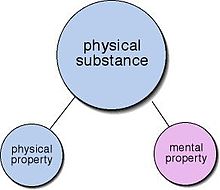
*Property (philosophy) — placed from the Real G.E.N.E.R.A.T.I.V.E. course library (Information room). Source: Wikimedia Commons (via Wikipedia article media). [Details & license](https://commons.wikimedia.org/wiki/File:Property_dualism.jpg).*
> In logic and philosophy (especially metaphysics), a property is a characteristic of an object; a red object is said to have the property of redness. The property may be considered a form of object in its own right, able to possess other properties. ([Wikipedia](https://en.wikipedia.org/wiki/Property_%28philosophy%29))
<!-- REAL-GENERATIVE-MEDIA:END -->
> Summary stub · part of Systems Thinking · [Wikipedia source](https://en.wikipedia.org/wiki/Property_%28philosophy%29)
## Summary
In philosophy and logic (especially metaphysics), a property is a characteristic of an object; for example, a red object is said to have the property of redness. The property may be considered a form of object in its own right, able to possess other properties. A property, however, differs from individual objects in that it may be instantiated, and often in more than one object. It differs from the logical and mathematical concept of class by not having any concept of extensionality, and from the philosophical concept of class in that a property is considered to be distinct from the objects which possess it. Understanding how different individual entities (or particulars) can in some sense have some of the same properties is the basis of the problem of universals.
## Key points
- In philosophy and logic (especially metaphysics), a property is a characteristic of an object; for example, a red object is said to have the property of redness.
- The property may be considered a form of object in its own right, able to possess other properties.
- A property, however, differs from individual objects in that it may be instantiated, and often in more than one object.
- It differs from the logical and mathematical concept of class by not having any concept of extensionality, and from the philosophical concept of class in that a property is considered to be distinct from the objects which possess it.
- Understanding how different individual entities (or particulars) can in some sense have some of the same properties is the basis of the problem of universals.
## Relation to Systems Thinking
Property (philosophy) sits within the Systems Thinking cluster of related concepts. Its principles contribute to understanding [[Feedback|feedback]], [[Emergence|emergence]], and dynamic behavior in complex adaptive systems.
## Sources
- [Property (philosophy) — Wikipedia](https://en.wikipedia.org/wiki/Property_%28philosophy%29)
Back to Systems Thinking
---
<!-- SEMIOTIC-PROFILE:START -->
## Semiotic profile
> *The semiotic universals this article invokes, machine-derived from the crossref — **unverified** (born so). Populated 2026-07-06 for the Systems room.*
**Universals (3):** 🟡 system (7) · 🟢 emergence (2) · 🟢 feedback (2)
**Enter by sign:** Systems Semiotic Gateway · Alphabetum · Icon Registry · ← Systems Portal
<!-- SEMIOTIC-PROFILE:END -->
<!-- REAL-GENERATIVE-MEDIA:START -->
## Wikipedia : Wikitube
**Strict pair:** [Wikipedia](https://en.wikipedia.org/wiki/Property_%28philosophy%29) : [Wikitube](https://en.wikitube.io/wiki/Property_%28philosophy%29)
## Previous hub tags
Tree parent: [[Systems_theory]].
Legacy hubs: none.
---
*Sources: 1 legacy note. Minted wave 1, 2026-07-30 (v1.6 order).*