# Queueing theory
<!-- MICROSIMGEN:BEGIN v1.7 — generated by g08_place_microsims.py; three.js first (§15); do not hand-edit inside -->
## Microsims — three.js
### Queueing theory (three.js)
<div class="microsim-player">
<iframe src="https://wikitube-3d-microsims.netlify.app/Queueing_theory.html" width="100%" height="620" frameborder="0" loading="lazy" sandbox="allow-scripts allow-same-origin" title="Queueing theory — three.js microsim"></iframe>
</div>
**Open it full-screen:** [Queueing_theory.html](https://wikitube-3d-microsims.netlify.app/Queueing_theory.html) · library `threejs` · route `microsim/threejs/`
### Related microsims
Live sims on neighbouring articles:
- [[Failure_mode_and_effects_analysis]]
- [[Mathematical_optimization]]
- [[Reliability_engineering]]
- [[Stanford_torus]]
- [[Structural_engineering]]
- [[Tribology]]
*Sim hosted off-article; the article owns the reference, not the runtime (WIKI_RULES §10.4). Placed by `g08_place_microsims.py`.*
<!-- MICROSIMGEN:END -->
## MicroSim spec
### Parameters (tunable controls)
- `Arrival rate lambda` · 0–2 · mean customers arriving per unit time
- `Service rate mu` · 0–2 · mean customers served per unit time
- `Servers c` · 1–5 · number of parallel service channels
### What animates
Customers arrive, wait in a line, and depart from servers; the queue grows and shrinks live.
### Learning objective
Relate arrival and service rates to queue length and waiting time.
## Links (Wikipedia order)
<!-- injected from _registry/childlinks/Queueing_theory.json (2026-07-30T02:09:12Z) -->
`ARPANET` · `Agner_Krarup_Erlang` · `Aleksandr_Khinchin` · `Average` · `Balance_equation` · `Birth–death_process` · [[Black_box]] · `Bulk_queue` · `Buzen's_algorithm` · `Computing` · `Continuous-time_Markov_chain` · `Data_buffer` · `David_George_Kendall` · `Diffusion_process` · `Empirical_measure` · `Epidemiology` · `Erlang_(unit)` · `Erlang_distribution` · `FIFO_(computing_and_electronics)` · `Flow_control_(data)` · `Flow_network` · `Fluid_queue` · `Frank_Kelly_(mathematician)` · `G-network` · `Geometric_distribution` · `Gordon–Newell_theorem` · [[Industrial_engineering]] · [[Information_system]] · `Integral_equation` · `John_Kingman` · `Journal_of_the_ACM` · `K._Mani_Chandy` · `Layered_queueing_network` · `Leonard_Kleinrock` · `Line_management` · `M/G/1_queue` · `M/M/1_queue` · `M/M/c_queue` · [[Management_science]] · `Markovian_arrival_process` · `Massachusetts_Institute_of_Technology` · `Mathematical_Proceedings_of_the_Cambridge_Philosophical_Society` · `Mean-field_theory` · `Mean_sojourn_time` · `Message_queue` · `Message_switching` · `Mor_Harchol-Balter` · `Network_congestion` · `Network_scheduler` · `Network_simulation` · `Normalizing_constant` · `Operations_Research_(journal)` · [[Operations_research]] · `Ornstein–Uhlenbeck_process` · `Orthant` · `Packet_switching` · `Peter_Whittle_(mathematician)` · `Phase-type_distribution` · `Pipeline_(software)` · `Poisson_point_process` · `Probability_distribution` · [[Project_management]] · `Project_production_management` · `Quality_of_service` · `Queue_area` · `Reflected_Brownian_motion` · `Renewal_theory` · `Round-robin_scheduling` · `Scheduling_(computing)` · `Shortest_job_next` · `Shortest_remaining_time` · `Steady_state` · `Stochastic_scheduling` · `Survival_analysis` · [[Telecommunications]] · `Teletraffic_engineering` · [[Traffic_engineering_(transportation)]] · `Transient_state`
## From the Real GENERATIVE library
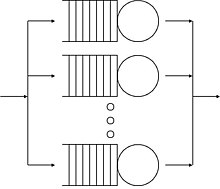
*Queueing theory — placed from the Real G.E.N.E.R.A.T.I.V.E. course library (Engineering room). Source: Wikimedia Commons (via Wikipedia article media). [Details & license](https://commons.wikimedia.org/wiki/File:ServidorParalelo.jpg).*
> Queueing theory is the mathematical study of waiting lines, or queues.[1] A queueing model is constructed so that queue lengths and waiting time can be predicted.[1] Queueing theory is generally considered a branch of operations research because the results are often used when making business decisions about the resources needed to provide a service. ([Wikipedia](https://en.wikipedia.org/wiki/Queueing_theory))
<!-- REAL-GENERATIVE-MEDIA:END -->
> p5.js MicroSim stub · part of Systems Engineering · [Wikipedia source](https://en.wikipedia.org/wiki/Queueing_theory)
## Concept summary
Queueing theory is the mathematical study of waiting lines, or queues. A queueing model is constructed so that queue lengths and waiting time can be predicted.
## Build checklist
- [ ] Claim it: set `status: in-progress` + `lease` + `leased_at`
- [ ] Write the child page explaining the concept (tie it back to Systems Engineering)
- [ ] Finalize parameter ranges and defaults
- [ ] Implement the p5.js sketch (drawing + control regions)
- [ ] Add caption + the learning objective on the page
- [ ] Set `status: done`
## p5.js sketch
```javascript
// MicroSim: Queueing theory
const ARTICLE = "Queueing_theory";
let p1, p2, p3;
function setup() {
createCanvas(720, 520);
pixelDensity(2);
// queue-sim sim — create the three sliders described above:
// Arrival rate lambda (0–2), Service rate mu (0–2), Servers c (1–5).
// TODO: build labelled sliders in the control region (below the drawing region).
}
function draw() {
background(248);
// TODO: read p1/p2/p3; render the queue-sim in the drawing region and respond live.
// TODO: HUD — title + en.wikitube.io/wiki/Queueing_theory + control hints + live readouts.
}
```
---
Back to Systems Engineering
---
<!-- SEMIOTIC-PROFILE:START -->
## Semiotic profile
> *The semiotic universals this article invokes, machine-derived from the crossref — **unverified** (born so). Populated 2026-07-06 for the Systems room.*
**Universals (1):** 🟡 system (4)
**Enter by sign:** Systems Semiotic Gateway · Alphabetum · Icon Registry · ← Systems Portal
<!-- SEMIOTIC-PROFILE:END -->
<!-- REAL-GENERATIVE-MEDIA:START -->
## Wikipedia : Wikitube
**Strict pair:** [Wikipedia](https://en.wikipedia.org/wiki/Queueing_theory) : [Wikitube](https://en.wikitube.io/wiki/Queueing_theory)
## Previous hub tags
Tree parents: [[Operations_research]] · [[Systems_engineering]].
Legacy hubs: none.
---
*Sources: 1 legacy note. Minted wave 1, 2026-07-30 (v1.6 order).*