# Second-order cybernetics
## Links (Wikipedia order)
<!-- injected from _registry/childlinks/Second-order_cybernetics.json (2026-07-30T02:09:12Z) -->
[[Action_research]] · `Actor` · `Albert_Einstein` · `Alexander_Lerner` · `Alexey_Lyapunov` · `Alfred_Radcliffe-Brown` · [[Allenna_Leonard]] · `American_Society_for_Cybernetics` · `Andrew_Pickering` · [[Anthony_Wilden]] · [[Artificial_intelligence]] · `Autonomous_agency_theory` · `Autonomy` · [[Autopoiesis]] · `BioSystems` · `Biocybernetics` · `Biological_Computer_Laboratory` · `Biomedical_cybernetics` · `Biorobotics` · `Biosemiotics` · `Brain–computer_interface` · `Buckminster_Fuller` · [[Catastrophe_theory]] · `Cedric_Price` · `Charles_François_(systems_scientist)` · `Christopher_Alexander` · `Claude_Bernard` · `Cliff_Joslyn` · `Coherence_therapy` · `Communication` · [[Complex_system]] · `Complexity_economics` · `Computational_neuroscience` · `Connectionism` · `Constructivism_(philosophy_of_science)` · `Constructivist_Foundations` · [[Control_theory]] · [[Conversation_theory]] · [[Cybernetics]] · `Cybernetics_and_Human_Knowing` · `Cybernetics_and_Systems` · `Cybernetics_in_the_Soviet_Union` · [[Decision_theory]] · `Double-loop_learning` · `Double_hermeneutic` · `Embodied_cognition` · [[Emergence]] · `Enactivism` · `Engineering_cybernetics` · `Epistemology` · `Erich_von_Holst` · `Ernst_von_Glasersfeld` · `Erwin_Schrödinger` · `Family_therapy` · `Francis_Heylighen` · [[Francisco_Varela]] · `Frederic_Vester` · `Genevieve_Bell` · `Geoffrey_Vickers` · [[Gordon_Pask]] · `Gordon_S._Brown` · [[Gregory_Bateson]] · [[Heinz_von_Foerster]] · `Henri_Atlan` · `Herbert_Brün` · [[Homeostasis]] · `Horst_Rittel` · [[Humberto_Maturana]] · `I._A._Richards` · `Igor_Aleksander` · [[Information_theory]] · `Interactive_architecture` · `International_Society_for_the_Systems_Sciences` · [[Isaac_Newton]] · `Jacque_Fresco` · `Jakob_Johann_von_Uexküll` · `Jason_Jixuan_Hu` · [[Jay_Wright_Forrester]] · [[Jennifer_Wilby]] · [[John_N._Warfield]] · [[Kenneth_D._Bailey_(sociologist)]] · `Kenneth_E._Boulding` · [[Kevin_Warwick]] · `Klaus_Krippendorff` · `Kybernetes` · `Lars_Löfgren` · `Laws_of_Form` · `Linguistic_turn` · [[Living_systems]] · `Loet_Leydesdorff` · `Louis_Kauffman` · `Luciano_Floridi` · [[Ludwig_von_Bertalanffy]] · [[Macy_conferences]] · `Maleyka_Abbaszadeh` · `Management_cybernetics` · [[Manfred_Clynes]] · [[Margaret_Boden]] · [[Margaret_Mead]] · `Marian_Mazur` · `Medical_cybernetics` · `Mental_Research_Institute` · `Meta_(prefix)` · `Metadesign` · `N._Katherine_Hayles` · `Natalia_Bekhtereva` · `Neurophenomenology` · `Nicholas_Negroponte` · [[Niklas_Luhmann]] · [[Norbert_Wiener]] · `Organizational_theory` · `Paul_Watzlawick` · `Petro_Grigorenko` · `Policy_Sciences` · `Political_science` · `Public_administration` · [[Qian_Xuesen]] · `Radical_constructivism` · `Ranulph_Glanville` · `Reflexivity_(social_theory)` · `Robert_Trappl` · `Roy_Ascott` · [[Self-organization]] · [[Self-reference]] · [[Self-replication]] · `Social_system` · `Sociocybernetics` · [[Stafford_Beer]] · `Stewart_Brand` · `Stuart_Kauffman` · `Stuart_Umpleby` · `Symbolic_artificial_intelligence` · `Synergetics_(Haken)` · `System_of_systems` · `Systemic_design` · `Systemics` · [[Systems_science]] · [[Systems_theory]] · [[Systems_thinking]] · [[Talcott_Parsons]] · `Ulla_Mitzdorf` · `Valentin_Turchin` · `Valentino_Braitenberg` · `Viable_system_model` · [[Viable_system_theory]] · `W._Ross_Ashby` · `Walter_Bradford_Cannon` · `Walter_Pitts` · `Warren_Sturgis_McCulloch` · `William_Grey_Walter` · `William_Irwin_Thompson`
## From the Real GENERATIVE library (beauty pass)
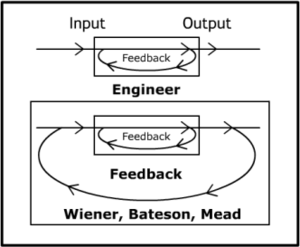
*Second-order cybernetics — image hotlinked from Wikimedia Commons (via the Real G.E.N.E.R.A.T.I.V.E. course library, Information room). [Details & license](https://commons.wikimedia.org/wiki/File:SOCyberntics.png).*
> Second-order cybernetics, also known as the cybernetics of cybernetics, is the recursive application of cybernetics to itself and the reflexive practice of cybernetics according to such a critique. It is cybernetics where "the role of the observer is appreciated and acknowledged rather than disguised, as had become traditional in western science".[1] Second-order cybernetics was developed between the late 1960s and mid 1970s[note 1] by Heinz von Foerster and others, with key insp ([Wikipedia](https://en.wikipedia.org/wiki/Second-order_cybernetics))
<!-- BEAUTY-PASS-MEDIA:END -->
> Summary stub · part of Systems Thinking · [Wikipedia source](https://en.wikipedia.org/wiki/Second-order_cybernetics)
## Summary
Second-order cybernetics, also known as the [[Cybernetics|cybernetics]] of cybernetics, is the recursive application of cybernetics to itself and the reflexive practice of cybernetics according to such a critique. It is cybernetics where "the role of the observer is appreciated and acknowledged rather than disguised, as had become traditional in western [[Science|science]]".[1] Second-order cybernetics was developed between the late 1960s and mid 1970s[note 1] by [[Heinz_von_Foerster|Heinz von Foerster]] and others, with key inspiration coming from [[Margaret_Mead|Margaret Mead]]. Foerster referred to it as "the control of control and the communication of communication" and differentiated first-order cybernetics as "the cybernetics of observed systems" and second-order cybernetics as "the cybernetics of observing systems".
## Key points
- Second-order cybernetics, also known as the cybernetics of cybernetics, is the recursive application of cybernetics to itself and the reflexive practice of cybernetics according to such a critique.
- It is cybernetics where "the role of the observer is appreciated and acknowledged rather than disguised, as had become traditional in western science".
- Second-order cybernetics was developed between the late 1960s and mid 1970s[note 1] by Heinz von Foerster and others, with key inspiration coming from Margaret Mead.
- Foerster referred to it as "the control of control and the communication of communication" and differentiated first-order cybernetics as "the cybernetics of observed systems" and second-order cybernetics as "the cybernetics of observing systems".
## Relation to Systems Thinking
Second-order cybernetics sits within the Systems Thinking cluster of related concepts. Its principles contribute to understanding [[Feedback|feedback]], [[Emergence|emergence]], and dynamic behavior in complex adaptive systems.
## Sources
- [Second-order cybernetics — Wikipedia](https://en.wikipedia.org/wiki/Second-order_cybernetics)
Back to Systems Thinking
---
<!-- SEMIOTIC-PROFILE:START -->
## Semiotic profile
> *The semiotic universals this article invokes, machine-derived from the crossref — **unverified** (born so). Populated 2026-07-06 for the Systems room.*
**Universals (6):** 🟡 system (22) · 🟡 science (12) · 🟢 recursion (4) · 🟢 emergence (2) · 🟢 feedback (2) · 🟢 control loop (1)
**Enter by sign:** Systems Semiotic Gateway · Alphabetum · Icon Registry · ← Systems Portal
<!-- SEMIOTIC-PROFILE:END -->
<!-- BEAUTY-PASS-MEDIA:START -->
## Wikipedia : Wikitube
**Strict pair:** [Wikipedia](https://en.wikipedia.org/wiki/Second-order_cybernetics) : [Wikitube](https://en.wikitube.io/wiki/Second-order_cybernetics)
## Previous hub tags
Tree parents: [[Complex_system]] · [[Control_theory]] · [[Cybernetics]] · [[Decision_theory]] · [[Emergence]] · [[Feedback]] · [[Information_theory]] · [[Self-organization]] · [[Systems_science]] · [[Systems_theory]].
Legacy hubs: none.
---
*Sources: 2 legacy notes. Minted wave 1, 2026-07-30 (v1.6 order).*