# Spillway
A **spillway** is a structure that lets flood water pass a dam safely, over or around it rather than through its turbines. Water crossing the crest becomes critical, accelerates down the chute and arrives at the toe fast and shallow — supercritical, with a [[Froude_number|Froude number]] well above one — and must be slowed in a stilling basin through a [[Hydraulic_jump|hydraulic jump]] before it reaches the riverbed.[^smyth-9] Every [[Hydropower|hydropower]] dam needs one, sized for the largest flood its catchment can produce.
<div class="microsim-player">
<iframe src="https://wikitube-3d-microsims.netlify.app/Spillway.html" width="100%" height="620" frameborder="0" loading="lazy" sandbox="allow-scripts allow-same-origin" allow="accelerometer; gyroscope" title="Spillway — p5.js microsim"></iframe>
</div>
*Microsim (THY-072): raise the pool over the crest and watch the discharge climb with H^{3/2}; lower the tailwater and the jump is swept out of the basin. ILLUSTRATIVE: a critical-flow weir crest and a single chute loss factor.*
Videos: [16:9](https://wikitube-3d-microsims.netlify.app/media/Spillway_16x9.mp4) · [9:16](https://wikitube-3d-microsims.netlify.app/media/Spillway_9x16.mp4)
## Types
Spillways are classed by how the water leaves the reservoir: over a crest into an open chute, down a vertical shaft, through a siphon, or through gated openings in the dam itself. They may be uncontrolled, spilling whenever the pool rises above the crest, or controlled by gates that operators open to pass floods.
### Open channel spillway
The most common type carries water over a crest shaped to follow the underside of a free-falling sheet of water (an ogee), then down a chute to a stilling basin. Over a crest the flow passes through critical depth, so the discharge per metre of crest rises with the 3/2 power of the height of the pool above it; for an idealized broad crest, q = √g (2H/3)^{3/2}.
### Bell-mouth spillway
A bell-mouth (morning-glory) spillway is a funnel-shaped intake in the reservoir that drops water down a vertical shaft into a tunnel beneath or around the dam.
### Siphon spillway
A siphon spillway uses a closed conduit over the crest; once the rising pool primes it, it passes large flows with a small rise in reservoir level.
### Other types
Other designs include stepped chutes, which dissipate energy on the way down, and labyrinth crests, which fold a long crest into a narrow width to pass more water at the same pool level.
## Design considerations
A spillway is designed for an inflow design flood, often the probable maximum flood estimated from rainfall records and a model of the catchment. The crest must pass that flood without the reservoir overtopping the dam, and the chute and basin must carry it without damage.
### Energy dissipation
At the toe of a high spillway the water can move at 20 m/s or more. A stilling basin forces a hydraulic jump, in which fast shallow flow suddenly becomes slow deep flow and its excess energy is spent as turbulence. The downstream depth needed to hold the jump follows from momentum: h₂/h₁ = (√(1 + 8Fr₁²) − 1)/2. In a worked example, flow 1 m deep at 6 m/s has Fr₁ = 1.92 and jumps to 2.26 m deep at 2.65 m/s.[^smyth-9] If the tailwater is lower than the sequent depth h₂, the jump is swept downstream and the fast flow scours the riverbed.
## Safety
Inadequate spillway capacity and erosion of spillways and their foundations are among the causes of dam failures, which is why spillways are designed for extreme floods and inspected regularly.
## Gallery
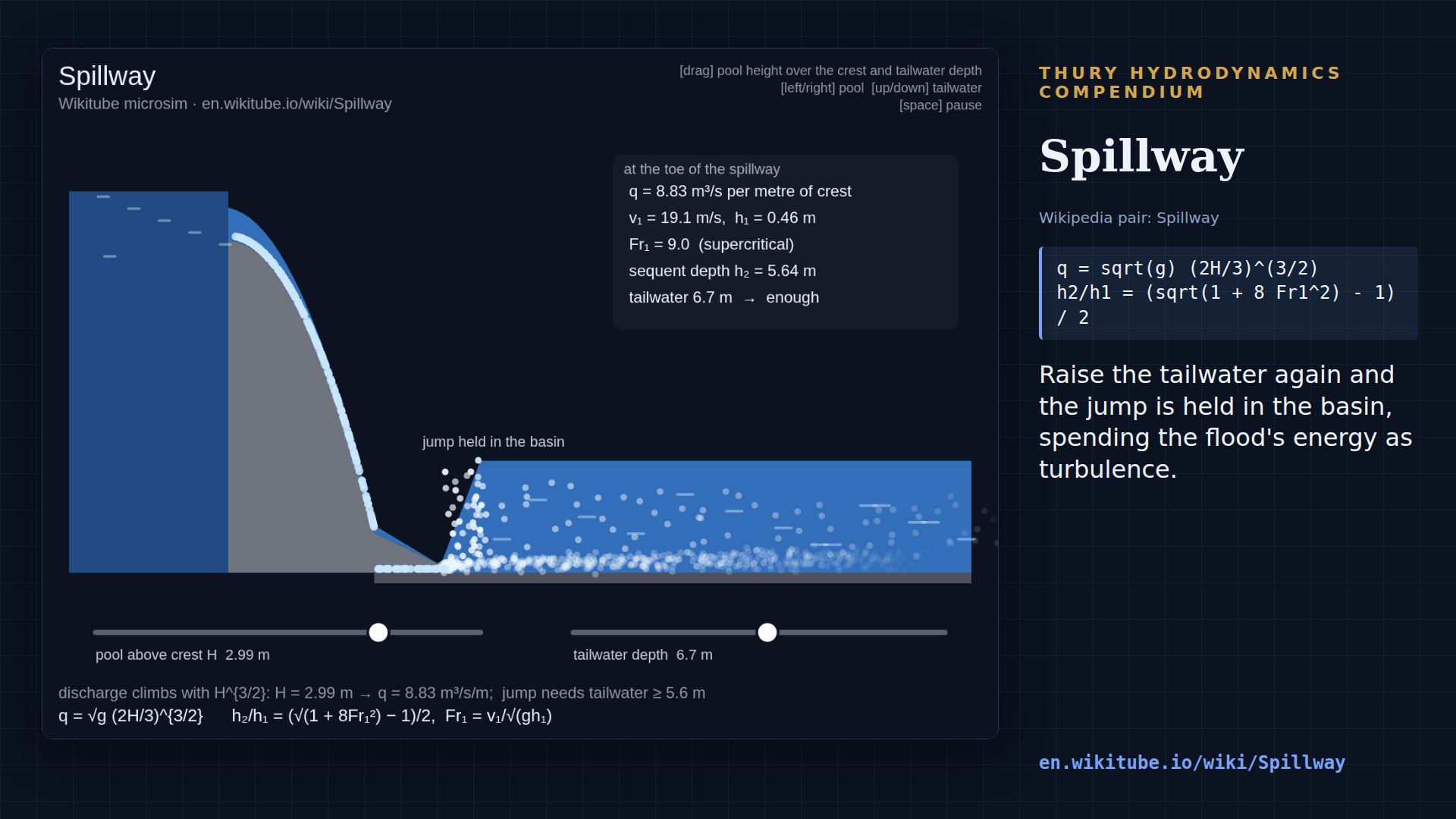
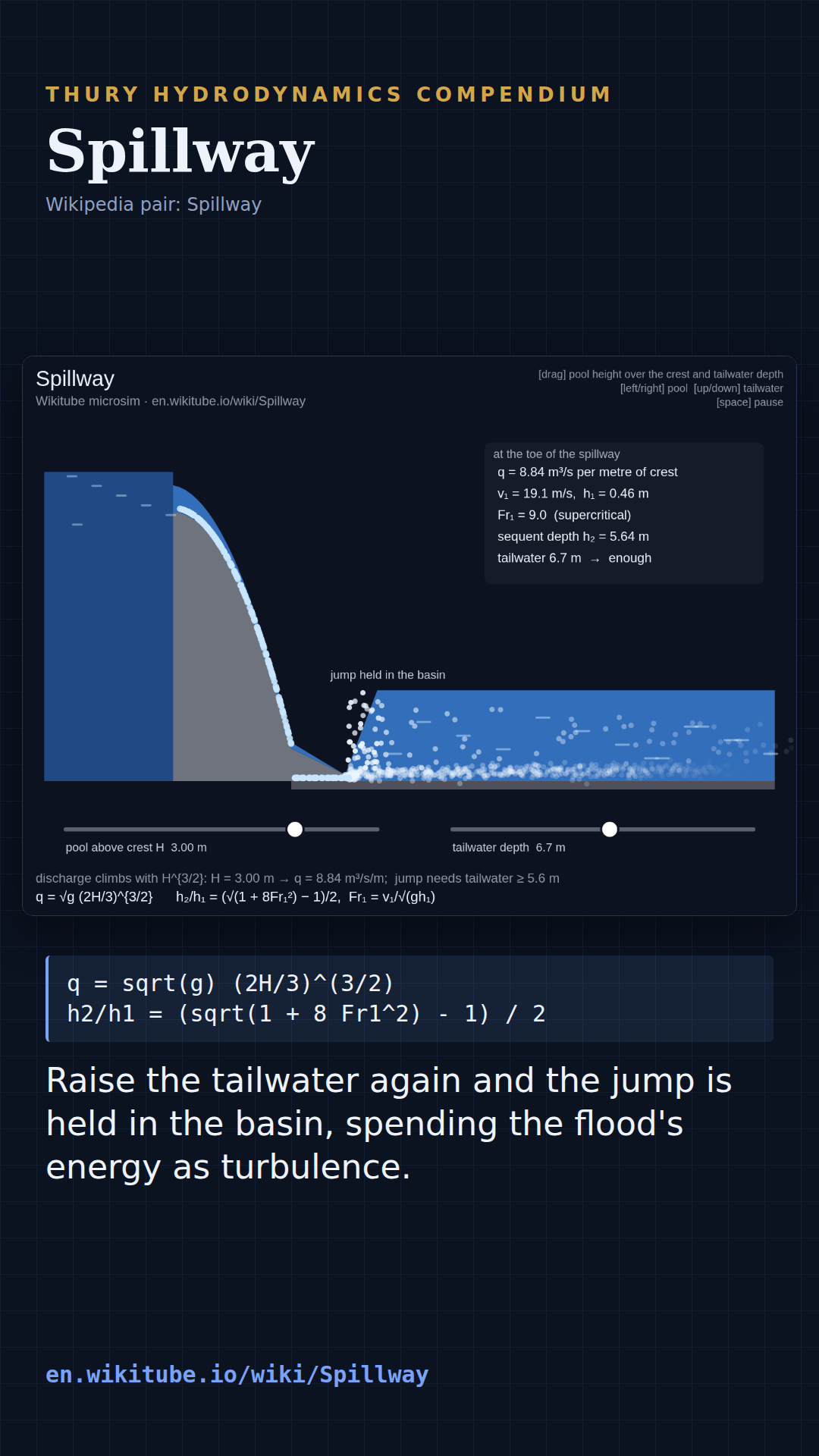
The station's stills, from the THY-072 microsim: the spillway crest, the chute and the hydraulic jump in the stilling basin.
## See also
- [[Hydraulic_jump]]
- [[Froude_number]]
- [[Hydropower]]
- [[River_engineering]]
## References
[^smyth-9]: Smyth, W. D. (2019). *All Things Flow: Fluid Mechanics for the Natural Sciences*, §9.3 (hydraulic jump; spillway example). Oregon State University. https://open.umn.edu/opentextbooks/textbooks/all-things-flow-fluid-mechanics-for-the-natural-sciences
### Portal Books
- Smyth, W. D. (2019). *All Things Flow: Fluid Mechanics for the Natural Sciences* — [OTL record](https://open.umn.edu/opentextbooks/textbooks/all-things-flow-fluid-mechanics-for-the-natural-sciences); on the [[PORTAL_Thury_Hydrodynamics_Apex_Spine]] shelf.
- Bar-Meir, Genick (2025). *Basics of Fluid Mechanics*, v0.7.5 — [OTL record](https://open.umn.edu/opentextbooks/textbooks/basics-of-fluid-mechanics); on the [[PORTAL_WT!Thury_Hydrodynamics_Compendium|Compendium]] Fluid core shelf.
## External links
- [Hydropower](https://www.dnr.state.mn.us/waters/surfacewater_section/stream_hydro/hydropower.html), Minnesota Department of Natural Resources (dam licensing and review)
<!-- COMPENDIUMLINK:BEGIN g19 — generated from _registry/plans/THURY_COMPENDIUM_SECTIONS.md; do not hand-edit inside -->
*Linked from the [[WT!Thury_Hydrodynamics_Compendium|Thury Hydrodynamics Compendium]], section 30, Dams and reservoirs.*
<!-- COMPENDIUMLINK:END -->
<!-- THURYSIM:BEGIN g21 — Thury Compendium microsim (framework build, specs/variants/Spillway.json); do not hand-edit inside -->
**Microsim — three.js (Wikitube framework):** *Spillway*
<div class="wt-sim" data-src="https://wikitube-3d-microsims.netlify.app/thury/Spillway.html" data-title="Spillway"></div>
*Built from `MICROSIM_GUIDE/specs/variants/Spillway.json`; part of the [[WT!Thury_Hydrodynamics_Compendium|Thury Hydrodynamics Compendium]] set.*
<!-- THURYSIM:END -->
## Wikipedia : Wikitube
**Strict pair:** [Wikipedia](https://en.wikipedia.org/wiki/Spillway) : [Wikitube](https://en.wikitube.io/wiki/Spillway) · pinned revision [1357233475](https://en.wikipedia.org/w/index.php?oldid=1357233475) · 2026-09-10
## Previous hub tags
Hubs: `Life_Physics`, `Systems`. Portals: [[PORTAL_Thury_Hydrodynamics_Apex_Spine]], [[PORTAL_Energy]].
---
*Thury station wave · 2026-09-10 · drafted · microsim THY-072 (p5.js) · parent [[Hydropower]].*