# Zero-point energy
<!-- MICROSIMGEN:BEGIN v1.7 — generated by g08_place_microsims.py; three.js first (§15); do not hand-edit inside -->
## Microsims — three.js
### Zero-point energy (three.js)
<div class="microsim-player">
<iframe src="https://wikitube-3d-microsims.netlify.app/Zero-point_energy.html" width="100%" height="620" frameborder="0" loading="lazy" sandbox="allow-scripts allow-same-origin" title="Zero-point energy — three.js microsim"></iframe>
</div>
**Open it full-screen:** [Zero-point_energy.html](https://wikitube-3d-microsims.netlify.app/Zero-point_energy.html) · library `threejs` · route `microsim/threejs/`
### Related microsims
Live sims on neighbouring articles — 2 of them inside this article's own Wikipedia link tree:
- [[Boson]] *(in tree)*
- [[Superconductivity]] *(in tree)*
- [[Dilution_refrigerator]]
- [[Superfluid_helium-4]]
*Sim hosted off-article; the article owns the reference, not the runtime (WIKI_RULES §10.4). Placed by `g08_place_microsims.py`.*
<!-- MICROSIMGEN:END -->
## Microsim
### Live player
<div class="microsim-player">
<iframe src="https://editor.p5js.org/sciencenibber/full/npXlwW_az" width="100%" height="620" frameborder="0" sandbox="allow-scripts allow-same-origin"></iframe>
</div>
<div class="microsim-fallback">
<img src="Microsims/thumbs/Zero-point_energy.png" alt="Zero-point_energy microsim poster" style="width:100%;border:1px solid #4445;border-radius:6px;">
<p><em>Live microsim (desktop) · <a href="https://editor.p5js.org/sciencenibber/sketches/npXlwW_az">open sketch in the p5.js editor</a></em></p>
</div>
**Editor URL:** https://editor.p5js.org/sciencenibber/sketches/npXlwW_az
**Description (100 words):**
A quantum harmonic oscillator -- the canonical model in which zero-point energy first appears. The reader sees a structural grey parabolic potential well V(x) = (1/2) m omega^2 x^2 with eight horizontal energy levels stacked at E_n = (n + 1/2) hbar*omega. The n = 0 level glows yellow at exactly (1/2) hbar*omega, the irreducible zero-point energy, and below it a yellow bar marks the ground-state Gaussian width sigma_0 = sqrt(hbar / (m*omega)). A blue |psi_n(x)|^2 lobe sits on whatever level the n slider selects. Three sliders -- omega, mass m, and level n -- let the reader watch the ladder, the wavefunction, and the zero-point width respond. An orange callout reminds: sigma_0/d_NN ~ 0.30 in helium, which is why helium refuses to solidify at T = 0.
```js
// =====================================================================
// Zero-point_energy.js -- Wikitube microsim
// Article: Zero-point energy en.wikitube.io/wiki/Zero-point_energy
// Room: Helium Pattern: D (parametric curves)
// ---------------------------------------------------------------------
// Idea: an interactive quantum harmonic oscillator -- the canonical
// model in which zero-point energy first appears. The reader sees:
//
// 1. A parabolic potential well V(x) = (1/2) k x^2 in the main
// plot, drawn in the structural grey of every other Helium-room
// Pattern-D sketch.
// 2. Horizontal energy levels at E_n = (n + 1/2) hbar*omega,
// starting from n = 0. The n = 0 level -- the zero-point energy
// (1/2) hbar*omega -- is drawn in the yellow TRAJ accent and
// labelled as "ground state -- zero-point".
// 3. The ground-state probability density |psi_0(x)|^2 , a Gaussian
// of width sigma = sqrt(hbar / (m*omega)) , drawn as a filled
// blue glow on top of the potential. This is the irreducible
// "smearing" of the particle that the uncertainty principle
// forbids you to remove, even at T = 0.
// 4. A selected n-level (0 by default) gets its full |psi_n(x)|^2
// overlaid in COLD blue so the reader can sweep n upward and
// watch the wavefunction interpolate toward the classical
// parabolic-bowl probability distribution.
//
// Why this matters for the Helium room:
// Helium has the largest de Boer quantum parameter of any element
// (Lambda_star ~ 2.7 for He-4, ~ 3.1 for He-3). At the nearest-
// neighbour distance of liquid He, the zero-point amplitude
// sigma_0 = sqrt(hbar / (m * omega_Debye)) is roughly 30 percent
// of the interatomic spacing. That single number is why helium
// refuses to solidify at any temperature under its own vapour
// pressure -- the zero-point motion shakes the lattice apart.
// A "Helium reference" callout in the lower-left shows this number.
//
// Canonical equations on the chart:
// E_n = (n + 1/2) * hbar * omega (energy ladder)
// E_0 = (1/2) hbar * omega (zero-point energy)
// sigma = sqrt(hbar / (m * omega)) (ground-state width)
// dx dp >= hbar / 2 (uncertainty bound)
//
// Visual layout (720 x 520 canvas):
// * top-left: HUD title + en.wikitube.io/wiki/Zero-point_energy
// * top-right: control hint summary
// * center: potential well + energy ladder + |psi_n|^2 overlay
// * lower-left: He-4 zero-point amplitude callout (orange dim)
// * bottom: 3 sliders (omega, mass m, level n) + canonical eq
//
// Conventions (Wikitube Betterfire Standard v0):
// * single ARTICLE constant at top, single quotes
// * p5.disableFriendlyErrors = true (clean console)
// * pixelDensity(2); textFont('system-ui')
// * every createSlider has .position(x,y).size(w)
// * non-ASCII (psi, omega, sigma, lambda) lives in COMMENTS ONLY;
// every text() string literal is ASCII
// * Energy-room palette: BG=18, FG=240, HOT, COLD, STRUCT, TRAJ
// * HUD factored into drawHUD()
// =====================================================================
const ARTICLE = 'Zero-point_energy';
const TITLE = ARTICLE.replace(/_/g, ' ');
p5.disableFriendlyErrors = true;
// ----- Energy room palette (P5_JS_EDITOR section 4) ------------------
const BG = 18;
const FG = 240;
const DIM = [240, 240, 240, 140];
const HOT = [220, 110, 60]; // warm accents (He callout)
const COLD = [60, 130, 220]; // cool: |psi_n|^2 overlay
const COLDER = [40, 80, 180, 160]; // |psi_0|^2 fill
const STRUCT = [120, 130, 150]; // structural grey: potential V(x)
const TRAJ = [240, 220, 80]; // accent: ground-state level
const SCRATCH = [120, 120, 120, 90]; // grid / scratch lines
const LEVEL = [200, 200, 210, 200]; // excited-state levels
// ----- Physical constants (natural units; not real SI) ---------------
// We work in a dimensionless system where hbar = 1 and the plot's x
// axis runs over -6 .. +6 in oscillator units. omega and m are
// user-adjustable; the wavefunction width is sigma = 1/sqrt(m*omega).
// E_n = (n + 1/2) * omega in these units.
const HBAR = 1.0;
const X_RANGE = 6.0; // half-width of x window
const E_MAX = 12.0; // y-axis ceiling for energy ladder
const N_MAX = 8; // highest level we draw (above n we stop)
// ----- Plot rectangle in canvas pixels (set in setup) ----------------
let plotX, plotY, plotW, plotH;
// ----- Sliders --------------------------------------------------------
let omegaSlider, massSlider, nSlider;
let omegaVal = 1.0; // angular frequency (natural units)
let massVal = 1.0; // mass (natural units)
let nLevel = 0; // selected energy level
function setup() {
createCanvas(720, 520);
pixelDensity(2);
textFont('system-ui');
// Plot area: leaves room for HUD top + sliders bottom + axis margin.
plotX = 70;
plotY = 70;
plotW = width - 100;
plotH = height - 200;
// omega slider -- range 0.3 .. 3.0 in natural units
omegaSlider = createSlider(0.3, 3.0, 1.0, 0.05);
omegaSlider.position(90, height - 95);
omegaSlider.size(160);
// mass slider -- range 0.3 .. 3.0 (small mass = wider sigma, He-like)
massSlider = createSlider(0.3, 3.0, 1.0, 0.05);
massSlider.position(310, height - 95);
massSlider.size(160);
// n slider -- range 0 .. N_MAX
nSlider = createSlider(0, N_MAX, 0, 1);
nSlider.position(530, height - 95);
nSlider.size(160);
}
function draw() {
background(BG);
// Pull latest control values once per frame.
omegaVal = omegaSlider.value();
massVal = massSlider.value();
nLevel = nSlider.value();
// Layer order: grid -> potential -> psi_n overlay -> energy ladder
// -> ground-state highlight -> labels -> HUD/sliders.
drawAxes();
drawPotentialWell();
drawPsiOverlay(); // |psi_n|^2 for selected n
drawEnergyLadder();
drawGroundStateHighlight();
drawLandmarks();
drawHeliumCallout();
drawHUD();
drawSliderLabels();
}
// =====================================================================
// Coordinate transforms: (x [units], E [units]) <-> (px, py) in pixels
// =====================================================================
function xToPx(x) {
return map(x, -X_RANGE, X_RANGE, plotX, plotX + plotW);
}
function eToPy(E) {
// Energy 0 at bottom of plot, E_MAX at top.
return map(E, 0, E_MAX, plotY + plotH, plotY);
}
// =====================================================================
// Physical functions: V(x), E_n, sigma_0, psi_n^2
// =====================================================================
// Parabolic potential in natural units: V(x) = (1/2) m omega^2 x^2
function potential(x) {
return 0.5 * massVal * omegaVal * omegaVal * x * x;
}
// Energy ladder: E_n = (n + 1/2) * hbar * omega
function energyOfLevel(n) {
return (n + 0.5) * HBAR * omegaVal;
}
// Ground-state Gaussian width: sigma_0 = sqrt(hbar / (m omega))
function sigmaZero() {
return Math.sqrt(HBAR / (massVal * omegaVal));
}
// Hermite polynomials by recurrence H_{n+1} = 2 x H_n - 2 n H_{n-1}.
// Used for |psi_n(x)|^2 visualisation only (not for high-precision
// quantum mechanics -- numerics fine up to n = 8).
function hermite(n, x) {
if (n === 0) return 1.0;
if (n === 1) return 2.0 * x;
let h0 = 1.0;
let h1 = 2.0 * x;
for (let k = 1; k < n; k++) {
const h2 = 2.0 * x * h1 - 2.0 * k * h0;
h0 = h1;
h1 = h2;
}
return h1;
}
// |psi_n(x)|^2 -- absolute square of the n-th harmonic oscillator
// eigenfunction. The full prefactor 1/(2^n n! sqrt(pi) sigma) is
// absorbed by an empirical max-normalisation at plot time, so the
// peak of each |psi_n|^2 lands at a consistent visual height.
function psiSquared(n, x) {
const sig = sigmaZero();
const xi = x / sig;
const Hn = hermite(n, xi);
const gauss = Math.exp(-xi * xi);
return Hn * Hn * gauss;
}
// Find the max of |psi_n|^2 on [-X_RANGE, X_RANGE] for normalisation.
function psiSquaredMax(n) {
let m = 0;
const STEPS = 200;
for (let i = 0; i <= STEPS; i++) {
const x = -X_RANGE + 2 * X_RANGE * (i / STEPS);
const v = psiSquared(n, x);
if (v > m) m = v;
}
return m || 1;
}
// =====================================================================
// Rendering: axes, potential, levels, wavefunction overlay, labels
// =====================================================================
function drawAxes() {
push();
// Plot bounding box
noFill();
stroke(...SCRATCH);
strokeWeight(1);
rect(plotX, plotY, plotW, plotH);
// x-axis ticks at integer values
textSize(10);
noStroke();
fill(...DIM);
textAlign(CENTER, TOP);
for (let xv = -X_RANGE + 1; xv <= X_RANGE - 1; xv++) {
if (xv === 0) continue;
const px = xToPx(xv);
stroke(...SCRATCH);
line(px, plotY + plotH, px, plotY + plotH - 4);
noStroke();
text(xv.toFixed(0), px, plotY + plotH + 4);
}
// y-axis ticks at integer energies
textAlign(RIGHT, CENTER);
for (let E = 2; E <= E_MAX - 2; E += 2) {
const py = eToPy(E);
stroke(...SCRATCH);
line(plotX, py, plotX + 4, py);
noStroke();
text(E.toFixed(0), plotX - 6, py);
}
// Axis labels
fill(...DIM);
textAlign(CENTER, BOTTOM);
textSize(11);
text('position x (oscillator units)', plotX + plotW / 2, plotY + plotH + 28);
push();
translate(plotX - 38, plotY + plotH / 2);
rotate(-HALF_PI);
textAlign(CENTER, TOP);
text('energy E (hbar * omega units)', 0, 0);
pop();
pop();
}
function drawPotentialWell() {
push();
noFill();
stroke(...STRUCT);
strokeWeight(2);
beginShape();
const STEPS = 200;
for (let i = 0; i <= STEPS; i++) {
const x = -X_RANGE + 2 * X_RANGE * (i / STEPS);
const V = potential(x);
if (V > E_MAX) {
// Clip the parabola at the plot ceiling so it doesn't escape.
vertex(xToPx(x), eToPy(E_MAX));
} else {
vertex(xToPx(x), eToPy(V));
}
}
endShape();
// "V(x)" annotation up on the right wall of the parabola
noStroke();
fill(...STRUCT);
textSize(11);
textAlign(LEFT, BOTTOM);
text('V(x) = (1/2) m omega^2 x^2', xToPx(2.6), eToPy(8.5));
pop();
}
function drawEnergyLadder() {
push();
textSize(10);
// Draw E_n for n = 1 .. N_MAX (n = 0 gets the special highlight).
for (let n = 1; n <= N_MAX; n++) {
const E = energyOfLevel(n);
if (E > E_MAX) break;
// Find the classical turning points x_n = sqrt(2 E_n / (m omega^2))
// so the level only stretches inside the parabolic well.
const xTurn = Math.sqrt(2 * E / (massVal * omegaVal * omegaVal));
const xLo = Math.max(-X_RANGE, -xTurn);
const xHi = Math.min(X_RANGE, xTurn);
stroke(...LEVEL);
strokeWeight(n === nLevel ? 2.5 : 1);
line(xToPx(xLo), eToPy(E), xToPx(xHi), eToPy(E));
noStroke();
fill(...LEVEL);
textAlign(LEFT, CENTER);
text('n=' + n, xToPx(xHi) + 6, eToPy(E));
}
pop();
}
function drawGroundStateHighlight() {
push();
const E0 = energyOfLevel(0);
const xTurn = Math.sqrt(2 * E0 / (massVal * omegaVal * omegaVal));
const xLo = Math.max(-X_RANGE, -xTurn);
const xHi = Math.min(X_RANGE, xTurn);
// The zero-point level itself -- thick yellow line.
stroke(...TRAJ);
strokeWeight(nLevel === 0 ? 3.5 : 2.5);
line(xToPx(xLo), eToPy(E0), xToPx(xHi), eToPy(E0));
// Label
noStroke();
fill(...TRAJ);
textSize(11);
textAlign(LEFT, BOTTOM);
text('n=0 zero-point E_0 = (1/2) hbar*omega = ' + nf(E0, 0, 3),
xToPx(xHi) + 6, eToPy(E0) - 2);
pop();
}
function drawPsiOverlay() {
push();
const n = nLevel;
const E_n = energyOfLevel(n);
const yBase = eToPy(E_n);
// Vertical scale: the wavefunction lobe should sit ON the level
// line and rise by at most ~1 inter-level gap so neighbouring
// levels don't visually collide.
const gap = HBAR * omegaVal;
const lobeH = Math.min(gap * 0.85, 1.1);
const pxLobeH = (gap > 0)
? (eToPy(E_n) - eToPy(E_n + lobeH))
: 30;
const norm = psiSquaredMax(n);
const STEPS = 240;
// Filled lobe (cold blue glow)
noStroke();
fill(...COLDER);
beginShape();
vertex(xToPx(-X_RANGE), yBase);
for (let i = 0; i <= STEPS; i++) {
const x = -X_RANGE + 2 * X_RANGE * (i / STEPS);
const v = psiSquared(n, x) / norm;
vertex(xToPx(x), yBase - v * pxLobeH);
}
vertex(xToPx(X_RANGE), yBase);
endShape(CLOSE);
// Outline for crispness
noFill();
stroke(...COLD);
strokeWeight(1.2);
beginShape();
for (let i = 0; i <= STEPS; i++) {
const x = -X_RANGE + 2 * X_RANGE * (i / STEPS);
const v = psiSquared(n, x) / norm;
vertex(xToPx(x), yBase - v * pxLobeH);
}
endShape();
// Label: "|psi_n(x)|^2 for selected n"
noStroke();
fill(...COLD);
textSize(10);
textAlign(LEFT, BOTTOM);
text('|psi_' + n + '(x)|^2', xToPx(-X_RANGE) + 6, yBase - pxLobeH - 4);
pop();
}
function drawLandmarks() {
push();
// Mark the ground-state width sigma_0 with a small horizontal bar
// below the n=0 level, between -sigma_0 and +sigma_0.
const sig = sigmaZero();
const yBar = eToPy(0) - 12;
stroke(...TRAJ);
strokeWeight(2);
line(xToPx(-sig), yBar, xToPx(sig), yBar);
// Tick marks at the ends
line(xToPx(-sig), yBar - 4, xToPx(-sig), yBar + 4);
line(xToPx( sig), yBar - 4, xToPx( sig), yBar + 4);
noStroke();
fill(...TRAJ);
textSize(10);
textAlign(CENTER, BOTTOM);
text('+/- sigma_0 = +/- ' + nf(sig, 0, 3), xToPx(0), yBar - 4);
pop();
}
function drawHeliumCallout() {
// Lower-left mini box: liquid-helium reference number.
// sigma_4He / d_NN ~ 0.30 at the He-4 Debye frequency.
push();
const boxX = 14;
const boxY = height - 158;
const boxW = 240;
const boxH = 52;
// Border
noFill();
stroke(...HOT);
strokeWeight(1);
rect(boxX, boxY, boxW, boxH, 4);
noStroke();
fill(...HOT);
textSize(11);
textAlign(LEFT, TOP);
text('Helium reference (de Boer)', boxX + 8, boxY + 4);
fill(...DIM);
textSize(10);
text('Lambda_star(He-4) ~ 2.7 Lambda_star(He-3) ~ 3.1', boxX + 8, boxY + 20);
text('sigma_0 / d_NN ~ 0.30 -> no solid at T=0', boxX + 8, boxY + 34);
pop();
}
// =====================================================================
// HUD + slider labels
// =====================================================================
function drawHUD() {
// Top-left: title + Wikitube URL (Betterfire Standard rule 2)
noStroke();
fill(FG);
textAlign(LEFT, TOP);
textSize(20);
text(TITLE, 14, 12);
fill(...DIM);
textSize(12);
text('Wikitube microsim . en.wikitube.io/wiki/Zero-point_energy', 14, 36);
// Top-right: control hints (Betterfire Standard rule 3)
textAlign(RIGHT, TOP);
textSize(10);
text('omega -- oscillator frequency', width - 14, 12);
text('mass m -- particle mass', width - 14, 24);
text('n -- selected energy level', width - 14, 36);
// Bottom-right: canonical equation (Betterfire Standard rule 4)
textAlign(RIGHT, BOTTOM);
fill(FG);
textSize(13);
text('E_n = (n + 1/2) hbar * omega', width - 14, height - 6);
// Just above that: ground-state energy live readout
textSize(11);
fill(...DIM);
text('E_0 = ' + nf(0.5 * omegaVal, 0, 3) +
' sigma_0 = ' + nf(sigmaZero(), 0, 3),
width - 14, height - 24);
}
function drawSliderLabels() {
push();
noStroke();
fill(...DIM);
textSize(10);
textAlign(LEFT, BOTTOM);
// Above each slider: a tiny label with the current value.
text('omega = ' + nf(omegaVal, 0, 2), 90, height - 100);
text('mass m = ' + nf(massVal, 0, 2), 310, height - 100);
text('level n = ' + nLevel, 530, height - 100);
// Just below each slider: short caption.
fill(...DIM);
textSize(9);
textAlign(LEFT, TOP);
text('oscillator frequency', 90, height - 78);
text('particle mass', 310, height - 78);
text('selected eigenstate', 530, height - 78);
pop();
}
// =====================================================================
// End of Zero-point_energy.js -- Wikitube microsim, Helium room,
// Pattern D (parametric curves, energy ladder, |psi_n|^2 overlay).
// =====================================================================
```
## Links (Wikipedia order)
<!-- injected from _registry/childlinks/Zero-point_energy.json (2026-07-30T02:09:12Z) -->
`4D_N_=_1_global_supersymmetry` · `4D_N_=_1_supergravity` · `6D_(2,0)_superconformal_field_theory` · `ABJM_superconformal_field_theory` · `Abraham–Lorentz_force` · `Absolute_zero` · `Acoustics` · `Adam_Riess` · `Aether_(classical_element)` · `Aharonov–Bohm_effect` · `Air_(classical_element)` · `Air_Force_Research_Laboratory` · `Albert_Einstein` · `Algebraic_quantum_field_theory` · `Amorphous_magnet` · `Amorphous_solid` · `Analytical_mechanics` · `Anderson_localization` · [[Angular_frequency]] · `Annalen_der_Physik` · `Anomalous_magnetic_dipole_moment` · `Anomaly_(physics)` · `Antiferromagnetism` · `Anyon` · `Applied_physics` · [[Argon]] · `Aristotle` · `Astronomy` · `Astrophysics` · `Atmospheric_physics` · `Atom` · `Atomic,_molecular,_and_optical_physics` · `Atomic_physics` · `Axiomatic_quantum_field_theory` · `BAE_Systems` · `BCS_theory` · `BF_model` · `BRST_quantization` · `Background_field_method` · `Bargmann–Wigner_equations` · `Baryogenesis` · `Baryon` · `Basic_research` · `Bell_test` · `Bhabha_scattering` · `Bharat_Ratra` · `Big_Bang` · `Biophysics` · `Birefringence` · `Bistability` · `Bloch's_theorem` · `Boeing` · `Bogoliubov_quasiparticle` · [[Bohr_model]] · `Boltzmann_constant` · `Born_rule` · `Born–Infeld_model` · `Bose–Einstein_condensate` · [[Boson]] · `Branches_of_physics` · `Bra–ket_notation` · `Breit–Wheeler_process` · `Bremsstrahlung` · `Brownian_motion` · `Bryce_DeWitt` · `Bullough–Dodd_model` · `CERN` · `Calque` · `Casimir_effect` · `Cavity_quantum_electrodynamics` · `Celestial_mechanics` · [[Chaos_theory]] · `Chemical_physics` · `Chern–Simons_theory` · `Chiral_model` · `Classical_electromagnetism` · `Classical_element` · `Classical_mechanics` · `Classical_physics` · `Colloid` · `Color_charge` · `Commutator` · `Complementarity_(physics)` · `Compton_scattering` · `Computational_physics` · `Condensed_matter_physics` · `Conformal_field_theory` · `Consciousness_causes_collapse` · `Conservative_force` · `Consistent_histories` · `Continuum_mechanics` · `Copenhagen_interpretation` · `Correlation_function_(quantum_field_theory)` · `Cosmic_inflation` · `Cosmic_microwave_background` · `Cosmic_string` · `Cosmological_constant` · `Cosmological_constant_problem` · `Cosmology` · `Coupling_constant` · `Creation_and_annihilation_operators` · `Critical_phenomena` · `Crossing_(physics)` · `Crystallography` · `DARPA` · `Dark_energy` · `Davisson–Germer_experiment` · `De_Broglie–Bohm_theory` · `Degenerate_energy_levels` · `Delayed-choice_quantum_eraser` · `Delbrück_scattering` · `Dennis_W._Sciama` · `Density_functional_theory` · `Density_matrix` · `Diamagnetism` · `Dielectric` · `Dirac_equation` · `Dirac_sea` · `Double-slit_experiment` · `Drude_model` · `Dual_photon` · `Dumbbell` · [[Earth]] · `Earth_(classical_element)` · `Edwards_Air_Force_Base` · `Effective_action` · `Effective_field_theory` · `Einstein–Podolsky–Rosen_paradox` · `Electrical_conductor` · `Electromagnetic_field` · `Electromagnetic_radiation` · `Electromagnetism` · [[Electron]] · `Electron_hole` · `Electron_magnetic_moment` · `Electronic_band_structure` · `Electrostriction` · `Electroweak_interaction` · `Elementary_particle` · `Eleven-dimensional_supergravity` · `Elitzur–Vaidman_bomb_tester` · [[Emergence]] · [[Energy]] · `Energy_level` · [[Engineering_physics]] · `Ensemble_interpretation` · [[Entropy]] · `Equivalence_principle` · `Erg` · `Ernest_Solvay` · `Erwin_Schrödinger` · `Ethan_Siegel` · `Euler–Heisenberg_Lagrangian` · `European_Space_Agency` · `Excited_state` · `Exciton` · `Exciton-polariton` · `Exotic_matter` · `Expansion_of_the_universe` · `Expectation_value_(quantum_mechanics)` · `Experimental_physics` · `Explicit_symmetry_breaking` · `Faddeev–Popov_ghost` · `Faraday_effect` · `Faster-than-light` · `Fermi's_interaction` · `Fermi_gas` · `Fermi_liquid_theory` · `Fermionic_condensate` · `Ferroelectricity` · `Ferromagnetism` · `Feynman_diagram` · `Field_(physics)` · `Fine-structure_constant` · `Fine_structure` · `Fire_(classical_element)` · `Flexoelectricity` · `Force_field_(physics)` · `Franck–Hertz_experiment` · `Free_electron_model` · `Frequency` · `Fringe_science` · `Fritz_London` · `Furry's_theorem` · `GE_Aerospace_(1960s)` · `Galaxy_formation_and_evolution` · `Gas` · `Gauge_boson` · `Gauge_symmetry_(mathematics)` · `Gauge_theory` · `General_relativity` · `Geometrical_optics` · `Geophysics` · `Ginzburg–Landau_theory` · `Glossary_of_elementary_quantum_mechanics` · `Gluon` · `Grand_Unified_Theory` · `Granular_material` · `Gravitational_wave` · `Gross–Neveu_model` · `Ground_state` · `Gupta–Bleuler_formalism` · `Hall_effect` · `Hamiltonian_(quantum_mechanics)` · `Hans_Bethe` · `Hans_Kramers` · `Hard_X-ray_Modulation_Telescope` · `Harmonic_oscillator` · `Harry_Nyquist` · `Hartree–Fock_method` · `Heisenberg_picture` · `Helmholtz_equation` · `Helmut_Rechenberg` · `Henry_M._Foley` · `Herbert_Callen` · `Hidden-variable_theory` · `Higgs_boson` · `Higgs_mechanism` · `Higher-dimensional_supergravity` · `History_of_physics` · `History_of_quantum_field_theory` · `History_of_quantum_mechanics` · `Hubbard_model` · [[Hydrogen]] · `Hydrogen_atom` · `Insulator_(electricity)` · `Interaction_picture` · `Interface_and_colloid_science` · `Interpretations_of_quantum_mechanics` · `Introduction_to_quantum_mechanics` · `Jagdish_Mehra` · `James_Clerk_Maxwell` · `Jet_Propulsion_Laboratory` · `Jim_Peebles` · `Josephson_effect` · `Julian_Schwinger` · `Kinetic_energy` · `Kip_Thorne` · `Klein–Gordon_equation` · `Klein–Nishina_formula` · `Kohn–Sham_equations` · `Kondo_effect` · `LSZ_reduction_formula` · `Lamb_shift` · `Lambda_point` · `Landau_pole` · `Lattice_field_theory` · `Laws_of_thermodynamics` · `Lepton` · `Lev_Pitaevskii` · `Linus_Pauling` · `Liouville_field_theory` · `Liquid` · `Liquid_crystal` · [[Liquid_helium]] · `List_of_unsolved_problems_in_physics` · `Local_hidden-variable_theory` · `Logarithmic_conformal_field_theory` · `Loop_quantum_cosmology` · `Loop_quantum_gravity` · `Lorentz-violating_electrodynamics` · `Luminiferous_aether` · `Luttinger_liquid` · `Mach–Zehnder_interferometer` · `Magnetic_flux_quantum` · `Magnetic_moment` · `Magnetic_monopole` · `Magnon` · `Majorana_equation` · `Many-worlds_interpretation` · `Martin_Rees` · `Mass` · `Massless_free_scalar_bosons_in_two_dimensions` · [[Materials_science]] · `Mathematical_formulation_of_quantum_mechanics` · `Mathematical_physics` · `Matrix_mechanics` · `Matter` · `Max_Born` · `Max_Planck` · `Maxwell's_equations` · `Measurement_in_quantum_mechanics` · `Measurement_problem` · `Medical_physics` · `Meissner_effect` · [[Mercury_(element)]] · `Metamagnetism` · `Michelson–Morley_experiment` · `Microwave` · `Milan` · `Minimal_Supersymmetric_Standard_Model` · `Minimal_model_(physics)` · `Modern_physics` · `Modern_searches_for_Lorentz_violation` · `Molecular_orbital_theory` · `Molecular_physics` · `Molecule` · `Momentum` · `Mott_insulator` · `Møller_scattering` · `NASA` · `N_=_1_supersymmetric_Yang–Mills_theory` · `N_=_4_supersymmetric_Yang–Mills_theory` · `N_=_8_supergravity` · `Nadia_Drake` · `Nambu–Jona-Lasinio_model` · `Nanotechnology` · `Nearly_free_electron_model` · `Negative_energy` · `Negative_temperature` · `Netherlands` · `Neutron_star` · `Neutronium` · `New_Scientist` · [[Newton's_laws_of_motion]] · `Next-to-Minimal_Supersymmetric_Standard_Model` · `Niels_Bohr` · `Nikola_Tesla` · `Nima_Arkani-Hamed` · `Nobel_Prize_in_Physics` · `Non-equilibrium_thermodynamics` · `Non-linear_sigma_model` · `Noncommutative_quantum_field_theory` · `Normal_order` · `Nuclear_physics` · `Objective-collapse_theory` · `Observable_universe` · `Old_quantum_theory` · `On_shell_and_off_shell` · `Operator_(physics)` · `Optics` · `Order_of_magnitude` · `Otto_Stern` · `Otto_von_Guericke` · `Outline_of_astrophysics` · `PBS` · `Paramagnetism` · `Parity_(physics)` · `Particle` · `Particle_in_a_box` · `Particle_physics` · `Partition_function_(quantum_field_theory)` · `Pascual_Jordan` · `Paul_Davies` · `Paul_Dirac` · `Paul_Ehrenfest` · `Paul_Langevin` · `Pauli_equation` · `Perturbation_theory` · `Peter_Debye` · `Peter_W._Milonni` · `Phase-space_formulation` · [[Phase_transition]] · `Philosophy` · `Philosophy_of_physics` · `Phonon` · `Phonon_polariton` · [[Photon]] · `Physical_Review` · `Physical_Review_A` · `Physical_Review_Letters` · `Physical_cosmology` · `Physical_oceanography` · `Physical_optics` · `Physicist` · `Physics_education` · `Physics_education_research` · `Piezoelectricity` · `Pines'_demon` · `Planck_constant` · [[Plasma_(physics)]] · `Plasmon` · `Polariton` · `Polaron` · `Polyakov_action` · `Polykarp_Kusch` · `Polymer` · `Popper's_experiment` · `Positron` · `Positronium` · `Potential` · `Potential_energy` · `Potential_well` · `Proca_action` · `Propagator` · `Pseudoscience` · `Pure_4D_N_=_1_supergravity` · `QCD_vacuum` · `QED_vacuum` · `Quantization_(physics)` · `Quantum` · `Quantum_Hall_effect` · `Quantum_algorithm` · `Quantum_amplifier` · `Quantum_biology` · `Quantum_bus` · `Quantum_cellular_automaton` · `Quantum_channel` · `Quantum_chaos` · `Quantum_chemistry` · `Quantum_chromodynamics` · `Quantum_circuit` · `Quantum_complexity_theory` · [[Quantum_computing]] · `Quantum_cosmology` · `Quantum_cryptography` · `Quantum_decoherence` · `Quantum_differential_calculus` · `Quantum_dynamics` · `Quantum_electrodynamics` · `Quantum_engineering` · `Quantum_entanglement` · `Quantum_eraser_experiment` · `Quantum_error_correction` · `Quantum_field_theory` · `Quantum_field_theory_in_curved_spacetime` · `Quantum_finite_automaton` · `Quantum_fluctuation` · `Quantum_foam` · `Quantum_geometry` · `Quantum_gravity` · `Quantum_hadrodynamics` · `Quantum_harmonic_oscillator` · `Quantum_hydrodynamics` · `Quantum_image_processing` · `Quantum_imaging` · `Quantum_information` · `Quantum_information_science` · `Quantum_jump` · `Quantum_key_distribution` · `Quantum_logic` · `Quantum_logic_gate` · `Quantum_machine` · `Quantum_machine_learning` · [[Quantum_mechanics]] · `Quantum_metamaterial` · `Quantum_metrology` · `Quantum_mind` · `Quantum_mysticism` · `Quantum_network` · `Quantum_neural_network` · `Quantum_nonlocality` · `Quantum_number` · `Quantum_optics` · `Quantum_programming` · `Quantum_sensor` · `Quantum_simulator` · `Quantum_spacetime` · `Quantum_spin_Hall_effect` · `Quantum_state` · `Quantum_statistical_mechanics` · `Quantum_stochastic_calculus` · `Quantum_superposition` · `Quantum_teleportation` · `Quantum_thermodynamics` · `Quantum_tunnelling` · `Quark` · `Quartic_interaction` · `Quasiparticle` · `Quintessence_(physics)` · `Rarita–Schwinger_equation` · `Regularization_(physics)` · `Relational_quantum_mechanics` · `Relativistic_mechanics` · `Relativistic_quantum_mechanics` · `Renaissance` · `Renormalization` · `Renormalization_group` · `Robert_L._Forward` · `Robert_Retherford` · `Robert_S._Mulliken` · `Rutherford_scattering_experiments` · `Rydberg_formula` · `Saul_Perlmutter` · `Scalar_chromodynamics` · `Scalar_electrodynamics` · `Scalar_field` · `Scattering` · `Schrödinger's_cat` · [[Schrödinger_equation]] · `Schrödinger_picture` · `Schwinger_effect` · `Schwinger_limit` · `Schwinger_model` · `Scientific_American_Frontiers` · `Sean_M._Carroll` · `Seattle` · `Seiberg–Witten_theory` · `Self-energy` · `Semiconductor` · `Semimetal` · `Simon_Saunders` · `Sine-Gordon_equation` · [[Sine_wave]] · `Soft_matter` · `Soler_model` · `Solid` · `Solid-state_physics` · `Spacetime` · `Special_relativity` · `Speed_of_light` · [[Spin_(physics)]] · `Spin_Hall_effect` · `Spin_gapless_semiconductor` · `Spin_glass` · `Spontaneous_emission` · `Spontaneous_symmetry_breaking` · `Standard_Model` · `State_of_matter` · `Statistical_mechanics` · `Stern–Gerlach_experiment` · `Steven_Weinberg` · `Strictly-correlated-electrons_density_functional_theory` · `String_theory` · `Strong_interaction` · `Structure_formation` · `Stueckelberg_action` · `Super_QCD` · [[Superconductivity]] · `Superdeterminism` · `Superdiamagnetism` · `Superfluidity` · `Supergravity` · `Supernova` · `Superparamagnetism` · `Supersolid` · `Supersymmetry` · `Symmetry` · `Symmetry_(physics)` · `Symmetry_breaking` · `Symmetry_in_quantum_mechanics` · `T-symmetry` · `Technicolor_(physics)` · `Telescope` · `Temperature` · `Term_symbol` · `Theoretical_physics` · `Theory_of_everything` · `Thermal_quantum_field_theory` · `Thermal_radiation` · [[Thermodynamics]] · `Thermoelectric_effect` · `Third_law_of_thermodynamics` · `Thirring_model` · `Thirring–Wess_model` · `Thomas_Kuhn` · `Thought_experiment` · `Time-dependent_density_functional_theory` · `Time_crystal` · `Timeline_of_fundamental_physics_discoveries` · `Timeline_of_quantum_computing_and_communication` · `Timeline_of_quantum_mechanics` · `Toda_field_theory` · `Topological_insulator` · `Topological_order` · `Topological_quantum_field_theory` · `Toroid` · `Transactional_interpretation` · `Two-dimensional_Yang–Mills_theory` · `Two-dimensional_conformal_field_theory` · `Two-photon_physics` · `Type_IIA_supergravity` · `Type_IIB_supergravity` · `Type_I_supergravity` · `Uehling_potential` · [[Uncertainty_principle]] · `Unitary_operator` · `United_States_Department_of_Defense` · `Universal_wave_function` · `University_of_Colorado_Boulder` · `Unruh_effect` · `Vacuum` · `Vacuum_energy` · `Vacuum_expectation_value` · `Vacuum_permittivity` · `Vacuum_polarization` · `Valence_bond_theory` · `Vector_boson` · `Vertex_function` · `Victor_Weisskopf` · `Virtual_particle` · `Walter_Heitler` · `Walther_Nernst` · `Ward–Takahashi_identity` · `Water_(classical_element)` · [[Wave]] · `Wave_function` · `Wave_function_collapse` · `Wave_interference` · `Wave–particle_duality` · `Werner_Heisenberg` · `Wess–Zumino_model` · `Wess–Zumino–Witten_model` · `Weyl_equation` · `Wheeler's_delayed-choice_experiment` · `Wheeler–DeWitt_equation` · `Wick's_theorem` · `Wightman_axioms` · `Wigner's_friend` · `Willis_Lamb` · `Wolfgang_Pauli` · `Work_(physics)` · `X-ray` · `X-ray_diffraction` · `Yang–Mills_theory` · `Yang–Mills–Higgs_equations`
## From the Real GENERATIVE library
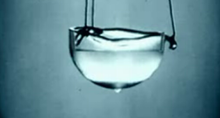
*Zero-point energy — placed from the Real G.E.N.E.R.A.T.I.V.E. course library (Nuclear room). Source: Wikimedia Commons (via Wikipedia article media). [Details & license](https://commons.wikimedia.org/wiki/File:2_Helium.png).*

*Animated: Zero-point energy — placed from the Real G.E.N.E.R.A.T.I.V.E. course library (Nuclear room). Source: Wikimedia Commons (via Wikipedia article media). [Details & license](https://commons.wikimedia.org/wiki/File:QHO-groundstate-animation-color.gif).*
> Zero-point energy (ZPE) is the lowest possible energy that a quantum mechanical system may have. Unlike in classical mechanics, quantum systems constantly fluctuate in their lowest energy state as described by the Heisenberg uncertainty principle.[1] Therefore, even at absolute zero, atoms and molecules retain some vibrational motion. ([Wikipedia](https://en.wikipedia.org/wiki/Zero-point_energy))
<!-- REAL-GENERATIVE-MEDIA:END -->
## Media (PD/CC)
<!-- MEDIA-DEPLOY:Zero-point_energy/QHO-groundstate-animation-color.gif -->
!Gif Library/Zero-point energy/QHO-groundstate-animation-color.gif
*QHO-groundstate-animation-color.gif · Geek3 · CC BY 3.0 · [source](https://commons.wikimedia.org/wiki/File:QHO-groundstate-animation-color.gif)*
<!-- /MEDIA-DEPLOY -->
<!-- SIGN-SYSTEMS:START -->
**Semiotic universals** (the notations and alphabet letters this article speaks — each opens its canonical card): energy · oscillation · harmonic · distribution · frequency. Index: the glyph gallery · SEMIOTICS PORTAL.
<!-- SIGN-SYSTEMS:END -->
> **Room:** [[Helium]] · **Status:** ✅ shipped
## Overview
**Zero-point energy** is the lowest possible [[Energy|energy]] that a quantum mechanical [[System|system]] retains in its ground state — the irreducible residual motion that survives even at absolute zero. For the quantum harmonic oscillator, the canonical model of every chemical bond, lattice mode and electromagnetic cavity field, the ground-state energy is **E_0 = (1/2)hbar*omega**, a direct consequence of the **Heisenberg uncertainty principle** dx*dp >= hbar/2, which forbids a particle from simultaneously possessing zero kinetic energy and a definite position. The idea was introduced by **Planck (1911)** in his second theory of black-body radiation, formalised by **Einstein and Stern (1913)** for the heat capacity of hydrogen, and made fully rigorous when Heisenberg, Born and Jordan derived matrix mechanics in 1925-26. In condensed matter the relevant landmark is the **de Boer quantum parameter** Lambda_star = h / (sigma * sqrt(m*epsilon)) of the inter-atomic Lennard-Jones well: for helium-4 (Lambda_star ~ 2.7) and helium-3 (Lambda_star ~ 3.1) the zero-point amplitude exceeds thirty percent of the nearest-neighbour distance, so helium **refuses to solidify** at any temperature under its own vapour pressure and remains liquid down to absolute zero, the only element with this property. Zero-point energy underlies the **Casimir [[Force|force]]** between conducting plates, the **Lamb shift** of atomic hydrogen, vacuum fluctuations in quantum electrodynamics, the residual phonon noise that ultimately limits gravitational-[[Wave|wave]] interferometers, and the zero-point pressure that keeps He-3 / He-4 mixtures from fully phase-separating in a **[[Dilution_refrigerator|dilution refrigerator]]** below 0.87 K, making it indispensable to [[Cryogenics|cryogenics]], quantum optics and [[Quantum_computing|quantum computing]] alike.
## See also
- Room hub: [[Helium]]
- p5.js Editor conventions: P5 JS EDITOR
- Wiki root: MAIN
---
*Scaffolded by `generative-microsim` from row 142 of the Helium sheet on 2026-05-14T16:51:27Z.*
<!-- REAL-GENERATIVE-MEDIA:START -->
<!-- CRAFT-LINK:START g12 -->
*Built to the [[WT!P5_js_Microsim_Master_Class|p5.js Master Class]].*
<!-- CRAFT-LINK:END -->
## Wikipedia : Wikitube
**Strict pair:** [Wikipedia](https://en.wikipedia.org/wiki/Zero-point_energy) : [Wikitube](https://en.wikitube.io/wiki/Zero-point_energy)
## Previous hub tags
Tree parents: [[Helium]] · [[Helium-3]].
Legacy hubs: none.
---
*Sources: 1 legacy note. Minted wave 1, 2026-07-30 (v1.6 order).*